Scotland’s Wild Deer Dilemma

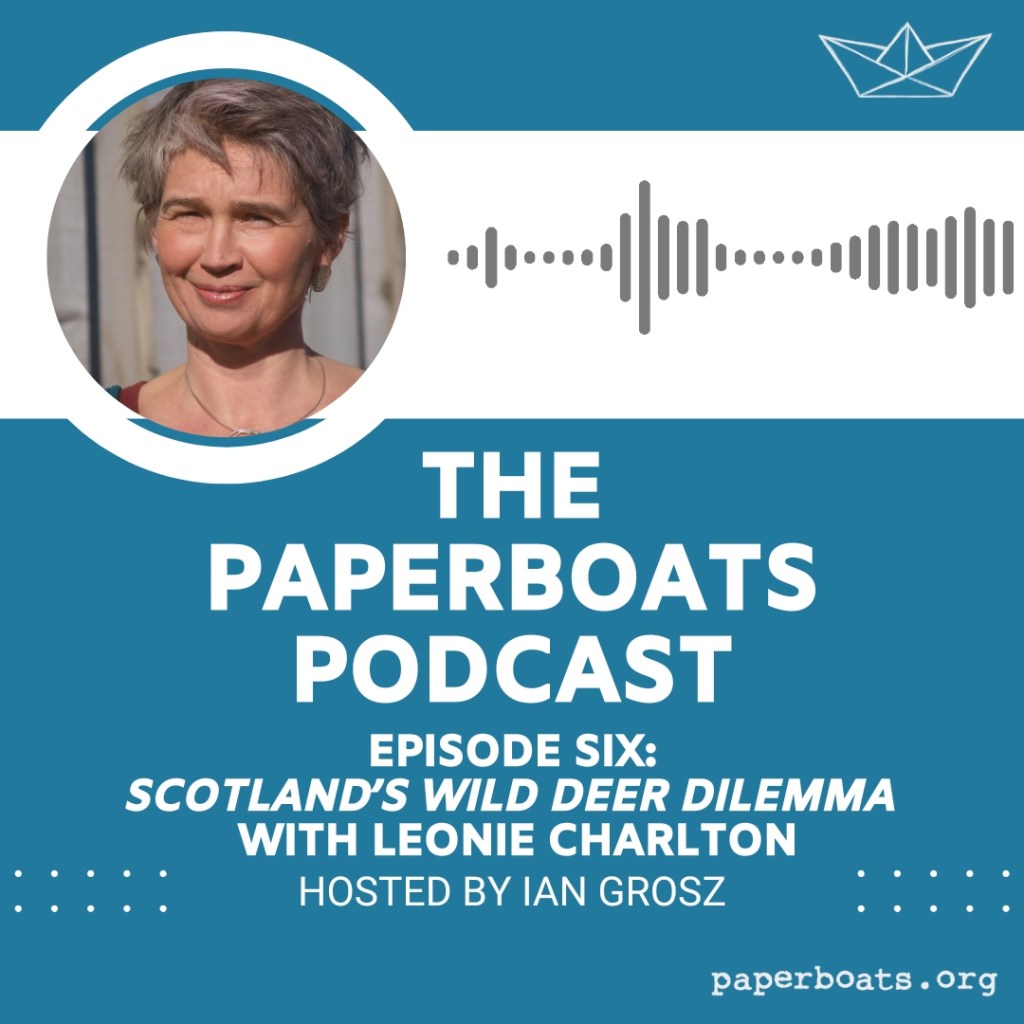
The latest episode of the Paperboats Podcast, released Friday March 07, features author and poet Leonie Charlton.

Leonie lives in Argyll and is currently undertaking a practice-based PhD exploring Scotland’s ‘wild deer dilemma’ through the University of the Highlands and Islands. Her publications include her debut poetry pamphlet Ten Minutes of Weather Away (Cinnamon Press, 2021), and her travel-memoir Marram (Sandstone Press, 2020), which was Waterstone’s Scottish Book of the Month for April 2022.

Leonie reads an extract from her diary essay ‘Fragments’, which first featured in Issue 1 of the Paperboats Zine and is included in the travel writing anthology There She Goes, edited by Esa Aldegheri and published by Saraband this month. Leonie discusses spiritual ecology, our lost connections with nature, and the way she approaches writing about the more-than-human world. She also talks about her PhD by practice and the conflict of interests inherent in deer management and re-wilding.

I had a very open and meaningful chat with Leonie that offers real insight into her work and the issues she writes about, so please do head to your preferred podcast platform, grab a coffee and take thirty minutes out to give it a listen. And if you enjoy it, follow and subscribe to keep up with all future episodes, released each month across all platforms.

Thank you for taking time to read this, and please do leave a comment if you enjoyed this podcast.
New Writing on THE CLEARING

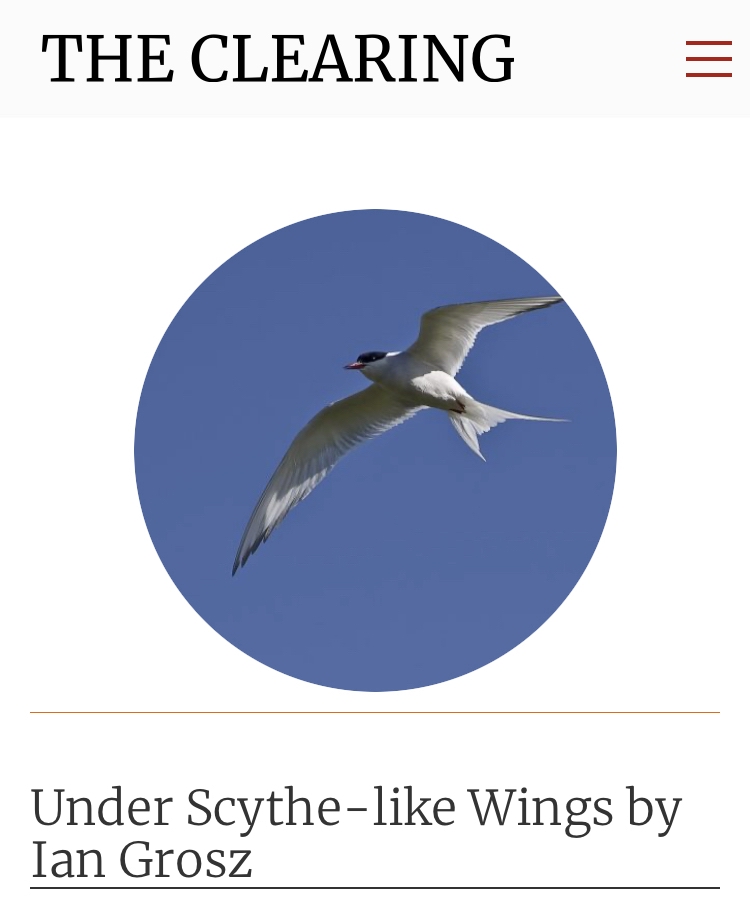
‘The screeching increased, and we found the terns now hovering above our heads: dark, piercing eyes glaring down at us, the flash of razored wings folding in on themselves in a sudden flurry of air and feathers as they dove to drive us off. We stumbled on, wary of our footsteps and continually harried by the terns. Eventually we came across a half-collapsed stone dyke and ducked down behind it, leaving the mass of screaming birds behind and feeling guilty for our intrusion.’

Very happy to have some new writing back on THE CLEARING.

It stems from a trip to Orkney in the summer where I had an encounter with an arctic tern colony, and reflects on the draw of the islands and the potential negative impacts of tourism on Orkney’s wildlife.

THE CLEARING is a journal of landscape, nature and place published by Little Toller based in Dorset and edited by Jon Woolcott, author of Real Dorset.

Sacred Mountain – an autumn equinox walk with BBC Radio Scotland.

In 2022 I took a walk up everybody’s favourite hill in Aberdeebnshire to witness the autumn equinox sunrise from the summit of Mither Tap – the site of a Pictish hill fort that dominated what was, for the Picts, a sacred landscape.

I wrote an essay about the walk, exploring what the idea of a sacred landscape might mean to us today, which was published on The Clearing – Little Toller’s online journal of Nature, Landscape and Place.

Here I return to the hill as the autumn equinox approached, in the company of BBC Radio Broadcaster Helen Needham. We talk about our connection to landscape and place, and the importance of taking time out from our busy lives to pause and to reflect, and to notice the changing of the seasons.

Extracts from my essay are woven through the recording Helen made as we walked up the hill, following the Maiden Causeway – an ancient track leading to the Pictish fort on the summit of Mither Tap.

You can listen to the podcast here or click on the image above.

And you can read my essay on The Clearing here.

Archipelago 2.3

‘I bend down and trace the outline of each foot in the cool, hardened silt. I can feel the definite impression of the man’s big toe and a ridge of sand that had been pulled up under the ball of the foot as the toes gripped the surface and he pushed his weight forward with each stride. I can feel the outline of the woman’s heel: the rounded edge and then forward into the arch.

“So how old are these prints, again?” I ask. 

“About six-thousand years old,” Burns tells me. “Just in that transition between the Mesolithic and the Neolithic.”‘

From ‘Traces’ Archipelago 2.3 edited by Andrew McNeillie and James Macdonald Lockhart, published by The Clutag Press (2024), pp. 107-115.

To say I’m pleased to have writing in these pages is an understatement. I’ve been following Archipelago for years and to be in it is, well, something. All issues of the journal get archived in the Bodleian Library in Oxford so I could be sitting hidden on a library shelf for many more years, yet…

’Traces’ explores the Mesolithic landscapes of the Sefton coast with archaeologist Dr Alison Burns. We search for prehistoric footprints found in fossilised beds of ancient mud along Formby beach, reconstruct the landscapes and lives of the Mesolithic past, and consider the implications of modern day sea level rise. 

Also in these pages: 

Nicholas Allen, Alex Boyd, Julie Brook, John Bryant, Moyà Cannon, George Chamier, Claire Connolly, Tony Crowley, Gerald Dawe, Tim Ecott, Nick Groom, Kirsty Gunn, Andrew Hadfield, Howell Harris, Ben Keatinge, Angela Leighton, James Macdonald-Lockhart, Edna Longley, Michael Longley, Jamie McKendrick, Garry MacKenzie, Angus Macmillan, Robert Minhinnick, Heather O’Donoghue, Judy O’Kane, John Purser, Alan Riach, Fiona Stafford, Michael Viney, David Wheatley and Lyn Youngson. 

Very humbling company. 

You can order Archipelago direct from The Clutag Press.

The Cusp of Change

As the western calendar year comes to a close, it’s a natural time to look back and reflect on the previous twelve months. It’s been a significant year for me on a personal level. I turned fifty early in the second quarter of 2023 – a significant event for anybody – and I successfully defended my PhD thesis early in November, which marked the culmination of a long process of research, writing and reflection that helped answer questions that have occupied my thoughts for many years: questions of place, of identity, of how the landscape shapes our lives. 

I have been able to explore these questions both creatively and academically, and the submission and accession of my thesis – comprised of a book-length work of creative nonfiction alongside a critical commentary – closes a significant period in my life whilst opening up another. The time spent working toward the PhD signifies a period of deep change and transition: from a former life as a helicopter pilot largely servicing the offshore oil and gas industry toward a new life that places my feet firmly on the ground, encompassing and embracing community and working in a way that is less certain but offers more freedom and is more in line with my values and the aspirations I have now.

This year has been one where I’ve seen hard work begin to pay off and a future direction begin to take shape, replacing the uncertainty that came with the end of a career and dominated my life as I embarked on doctoral study in the midst of a pandemic. It is a year that leaves me feeling hopeful and positive as I go forward, despite all the world-changing events that this same period has also been witness to. 

As a writer, I have seen some of my writing find a home with Stravaig, Hinterland nonfiction magazine and, this coming spring, one of the chapters from my PhD will be published in Archipelago, a literary journal I have long admired. I’m pleased that my approach to questions of place will also feature in an anthology of academic writing through the University of Eichstätt-Ingolstadt’s Practicing Place Centre, due for publication in 2024. I was also very happy to have had writing published in the Paperboats Zine, for which I took part in a launch event at the University of Stirling.

Beyond my own writing, in September I ran an outdoor creative writing workshop, helping people engage with their surroundings and fostering a sense of togetherness. Earlier in the year I became involved with the charity Open Book, running a pilot creative writing group over the spring and summer that has become an established, monthly group as part of Open Book’s Scotland-wide Community Project. Seeing people develop in confidence and find their own voice in a supportive group setting is something that is hugely rewarding and I look forward now to taking the group – just one of many Open Book groups across the country – into 2024.

As I head into the New Year I will also embark on a significant community engagement project, working in collaboration and consultation on commission to explore how people feel about where they live and documenting community story and memory. It’s a role I hope will expand and flourish through 2024 and beyond.

What can we do but go forward? Uncertainty and change will always run side by side with our lives. 2023 has shown me that, on a personal level at least, positive change is possible, and that, if change is needed, it is worth living with the uncertainty that comes with not knowing what the outcomes might be. Despite the fears, taking those first steps toward an uncertain future is important. The change that you walk toward, the change that you need, will find you.