In our busy lives, bombarded as we are with news and media and the demands of life and work and family, we very rarely have space to notice the world around us, to pause and to take stock of the passage of time, the changing of the seasons and just where we’re at with ourselves. But writing can help us to do that. It helps us to take notice because it focuses our attention. Linda Cracknell writes: ‘The small weight of a notebook and pen in my pocket is my passport to feeling alive […] The act of writing causes us to refresh our tired ways of noticing.’*
Taking these thoughts as inspiration, I ran a workshop at a local visitor centre at the weekend, first exploring outdoors, encouraging close attention through the conscious use of all the senses and recording our experiences, before coming together in a collaborative space to share what we had seen and felt, writing a group poem with everyone’s input.
The workshop was as much about allowing ourselves that time and space to be, and to notice the world around us, as it was about creative writing; and that experience shared, brought a wonderful sense of connection: with the landscape, with both the past and the present, and with each other.
Paying attention – focussing on the world around us, how we experience it, in that mindful, conscious way – always has the power to connect us with others and a world outside of ourselves. It’s this sense of connection people attending felt the most, I think. It’s certainly what I took away from it, and it was great to see folk who were previously strangers coming together this way in just two short hours.
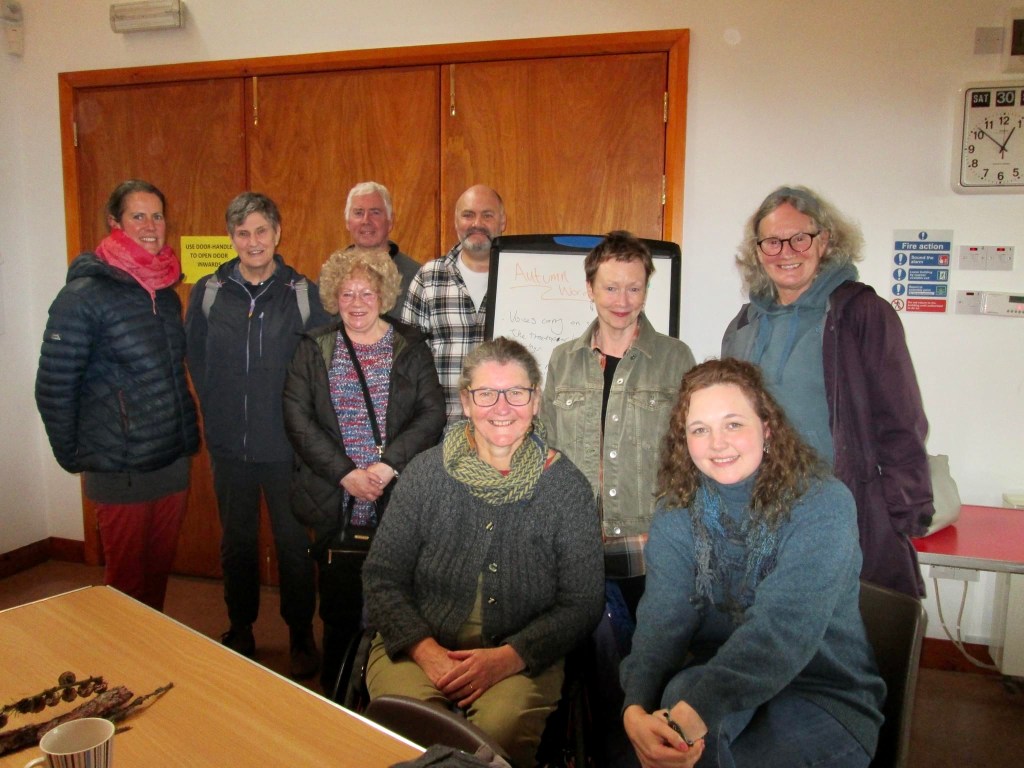
Attendees at the Autumn Words Creative Writing Workshop.
“We came in the afternoon to Slanes Castle, built upon the margin of the sea, so that the walls of one of the towers seem only a continuation of a perpendicular rock, the foot of which is beaten by the waves. To walk round the house seemed impracticable. From the windows the eye wanders over the sea that separates Scotland from Norway, and when the winds beat with violence must enjoy all the terrifick grandeur of the tempestuous ocean.I would not for my amusement wish for a storm; but as storms, whether wished or not, will sometimes happen, I may say, without violation of humanity, that I should willingly look out upon them from Slanes Castle.’
So mused Samuel Johnson who passed this way with his friend and travel companion, James Boswell, in the late summer of 1773 on their journey through Scotland to the Western Isles. Johnson’s account of the trip became the famous A Journey to the Western Islands of Scotland, later followed by Boswell’s The Journal of a Tour to the Hebrides, which brings the irascible Johnson joyfully to life. This being two-hundred-and-fifty-years since their passage through Aberdeenshire on their circuitous route westward, I felt compelled to visit the castle today.
Johnson doesn’t mention staying there, the castle then under the care of the Count of Errol, but he and Boswell spent the night at Slains after an excursion along the coast. It must have been opulently appointed in its day, but it’s a bleak and desolate ruin overlooking the cliffs now, the wind rushing through its empty corridors and doorless openings straight off the sea.
‘I had a most elegant room,’ Boswell writes: ‘but there was a fire in it which blazed: and the sea, to which my windows looked, roared: and the pillows were made with the feathers of some sea-fowl, which had to me a disagreeable smell: so that, by all these causes, I was kept awake a good while.’
In his half-waking, fitful sleep, he imagines the ghost of Lord Kilmarnock who had married into the Erroll title and was beheaded on Tower Hill in 1746 for his part in the Jacobite uprising. Wandering around the castle’s old halls and passageways, I couldn’t help but think of what other ghosts it might be host to.
The original thirteenth-century castle, a fortress built by the Comyn family five miles further along the coast to the south, was forfeited after the Battle of Barra in 1308 to the Hay family after the defeat of the Earl of Buchan, John Comyn, whose troops scattered and fled from the battlefield when Bruce himself appeared waving his standard. The new castle was built in the sixteenth century by Francis Hay, the ninth Earl of Errol, and grew from its original tower house into a Baronial style mansion. At the time of Johnson and Boswell’s visit it was still in the title of the Erroll line, but was sold in 1916 by the twentieth earl, whose finances, following previous generations of lavish spending and an agricultural recession, couldn’t maintain the upkeep.
The castle is most famous today for hosting Bram Stoker in the early part of the twentieth century, who would holiday regularly in nearby Cruden Bay and was thought to have been inspired by its setting. It’s certainly dramatic, and with the tail end of Storm Agnes still bringing the spray up over the rocks and flinging the crows from the castle turrets, I spent some time watching the waves crashing into the cliffs from a window at the northern end of the ruins. I could almost feel Johnson’s breath on me. ‘Well, sir!’ he seemed to be saying. ‘What did I tell you?!’
Later, walking along the cliffs, I watched a solitary cormorant surfing the air between the waves, its dark aquiline shape momentarily vanishing behind crests in the swell. I wondered if it relished a storm, and whether Johnson’s ghost was watching too, looking out from one of the windows in the castle’s now empty rooms.
‘I set off an hour before sunrise. It is still dark: very dark, and I can see very little beyond the dim circle of light from my head torch. The thick scent of pine fills the air as I start up the trail. The presence of trees, melting into the darkness either side of me, are felt rather than seen; the still, almost-full harvest moon having disappeared into the cover of pine branches. A nervous glance behind reveals the comfort of a slowly brightening sky, suffused with faint orange and aquamarine banding toward the rim of an unseen eastern horizon. Amidst gaps in the canopy above, bright and brittle stars vanish and reappear. The tree cover opens a little and the moon’s glow pulls me upward.’
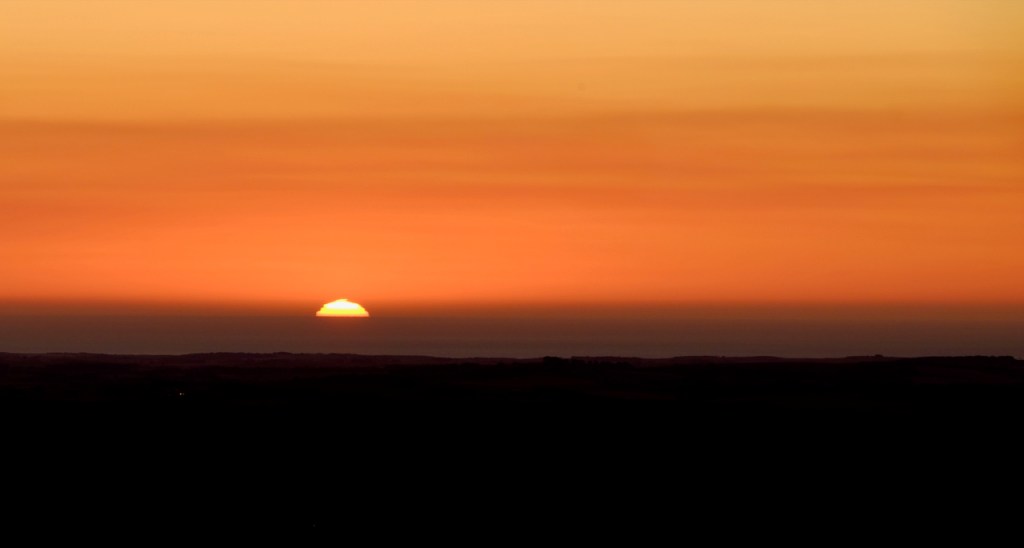
As the Autumn equinox approaches, here in the Northern Hemisphere, I am drawn back to our local hill and this moment from a couple of years ago when I climbed to one of its summits to witness the equinox sunrise. The short essay I wrote about it was published on The Clearing: Little Toller’s online journal of Nature, Landscape and Place. You can read the full piece here, or by clicking on the image above.
Traditionally marking the second harvest, a time to gather in the bounty of late summer signalled by the full moon, the Autumn equinox can also be a time of balance, of reset: a chance to take stock before the long slide into winter. Wishing you all a moment of balance as we begin our journey toward the darkness of the winter months.
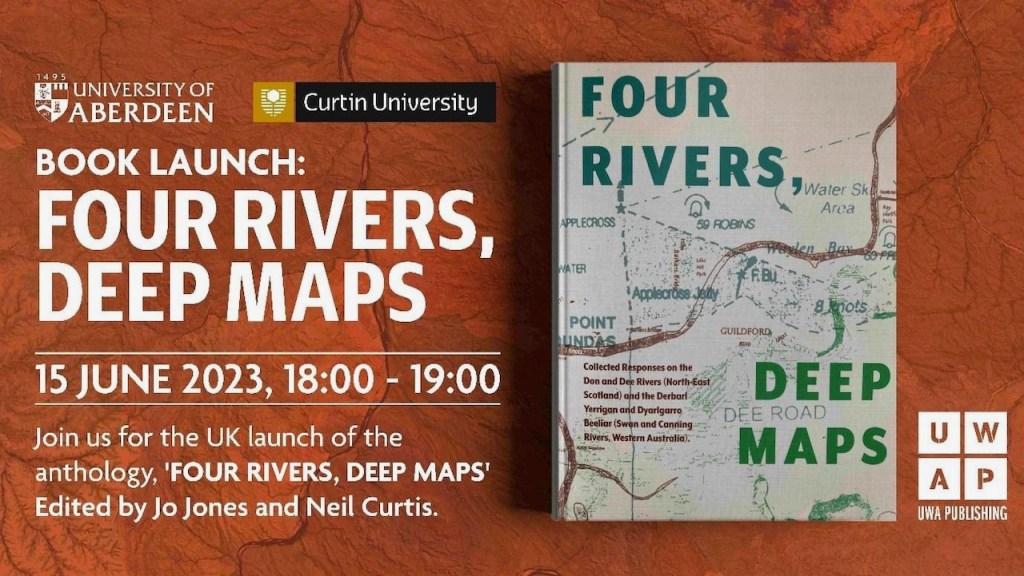
After being published through UWAP in September 2022 and launched initially in Perth, WA, Four Rivers, Deep Maps comes to the UK with a launch event at the University of Aberdeen on Thursday 15th June in the Sir Duncan Rice Library. Click on the image above for details.
The cities – Perth, Australia, and Aberdeen, Scotland – have received relatively little attention as specific geographical–cultural locales. Often perceived as industrial, isolated and lacking romantic association, they nevertheless have rich historical, narrative and creative traditions that characterise interactions between humans and place, particularly along the length of the four rivers.
My own contribution charts the River Don from source to sea, uncovering its ancient sacred associations and exploring how they have shaped the geography and identity of the region through time.
All the contributions of this book are woven together through strands of deep mapping and ideas of place, history and inhabitation. Countercultures seem to return to specific place knowledge that predates industrialisation, whether in the traditional shapes of the Nyoongar knowledge of the Derbarl Yarrigan (Swan River) and Beeliar (Canning River) or the traditions and ancient patterns of Aberdeenshire: we come back to these profound knowledge systems that, in fact, never went away.
Copies of Four Rivers, Deep Maps are in stock at Blackwells and will be available to purchase on the night.
Really excited to be setting up a new Open Book writing group in Aberdeenshire in the coming weeks.
Open Book are a fantastic organisation, set up in 2013 to help build communities through shared reading. Their groups now encompass creative writing and have been set up across Scotland. They are expanding their current provision with a Growth Pilot of 5 further groups in areas not currently served and which I’m very happy to be a part of.



 Groundings