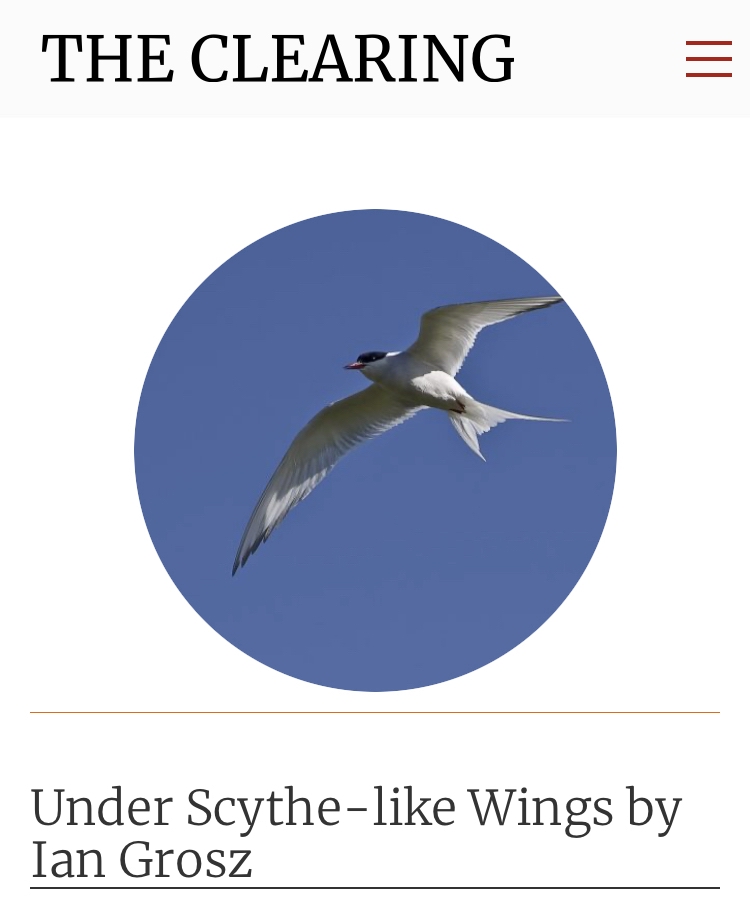
‘The screeching increased, and we found the terns now hovering above our heads: dark, piercing eyes glaring down at us, the flash of razored wings folding in on themselves in a sudden flurry of air and feathers as they dove to drive us off. We stumbled on, wary of our footsteps and continually harried by the terns. Eventually we came across a half-collapsed stone dyke and ducked down behind it, leaving the mass of screaming birds behind and feeling guilty for our intrusion.’
Very happy to have some new writing back on THE CLEARING.
It stems from a trip to Orkney in the summer where I had an encounter with an arctic tern colony, and reflects on the draw of the islands and the potential negative impacts of tourism on Orkney’s wildlife.
THE CLEARING is a journal of landscape, nature and place published by Little Toller based in Dorset and edited by Jon Woolcott, author of Real Dorset.
‘I bend down and trace the outline of each foot in the cool, hardened silt. I can feel the definite impression of the man’s big toe and a ridge of sand that had been pulled up under the ball of the foot as the toes gripped the surface and he pushed his weight forward with each stride. I can feel the outline of the woman’s heel: the rounded edge and then forward into the arch.
“So how old are these prints, again?” I ask.
“About six-thousand years old,” Burns tells me. “Just in that transition between the Mesolithic and the Neolithic.”‘
From ‘Traces’ Archipelago 2.3 edited by Andrew McNeillie and James Macdonald Lockhart, published by The Clutag Press (2024), pp. 107-115.
To say I’m pleased to have writing in these pages is an understatement. I’ve been following Archipelago for years and to be in it is, well, something. All issues of the journal get archived in the Bodleian Library in Oxford so I could be sitting hidden on a library shelf for many more years, yet…
’Traces’ explores the Mesolithic landscapes of the Sefton coast with archaeologist Dr Alison Burns. We search for prehistoric footprints found in fossilised beds of ancient mud along Formby beach, reconstruct the landscapes and lives of the Mesolithic past, and consider the implications of modern day sea level rise.
Also in these pages:
Nicholas Allen, Alex Boyd, Julie Brook, John Bryant, Moyà Cannon, George Chamier, Claire Connolly, Tony Crowley, Gerald Dawe, Tim Ecott, Nick Groom, Kirsty Gunn, Andrew Hadfield, Howell Harris, Ben Keatinge, Angela Leighton, James Macdonald-Lockhart, Edna Longley, Michael Longley, Jamie McKendrick, Garry MacKenzie, Angus Macmillan, Robert Minhinnick, Heather O’Donoghue, Judy O’Kane, John Purser, Alan Riach, Fiona Stafford, Michael Viney, David Wheatley and Lyn Youngson.
One of the great things about researching something academically as well as creatively, is that you get to geek out over your topic at the occasional conference, and I’m really looking forward to attending a conference next week at the University of Eichstätt-Ingolstadt’s Practicing Place Centre in Bavaria.
The conference is multi-disciplinary in nature and focuses on the different ways we practice and make place: ways of ‘doing’ and being. The key note speaker is the renowned geographer Tim Creswell, who is also a published poet with a PhD in creative writing. My creative exploration of landscape and place is underpinned by some of the thinking in cultural geography as well as anthropology, so I’m very interested to hear and to learn from Tim’s opening presentation covering the theme of Routes.
My own presentation comes as part of the ‘Sensing and Storying’ panel following Tim’s opening address, and draws on some of the thinking in anthropology and cultural geography to explore the idea of the presence of absence in the landscape as one way of approaching an understanding of place.
There are six panels of speakers in total, covering the themes of ‘Sensing and Storying’, ‘Contestations’, ‘Imagining and Creating’, ‘Productions and Reproductions’, and ‘Constructing the City.’ I’ve never been to Germany, and with such a packed couple of days exploring how we make and experience Place, it’s a trip I’m really looking forward to.
You can read more about the conference here. Its output will be subsequently published by the centre.
From July 22nd 2022, there will be an exhibition of work created by the Winter Artists in Residence hosted by Island Darkroom over early 2022.
Photographs taken during my research time on the island as part of my own residency will feature in the exhibition along with my thoughts and reflections following my stay. The research was for my PhD and the book that will hopefully come out of it, charting a journey back through the places that have featured in my life to better understand how the landscape can shape a sense of who we are. I was honoured that Island Darkroom drew on some of my writing for the title of the exhibition, and the work featured as a whole seems to chime with this theme.
If you’re in the Western Isles between 22nd July and 20th September, be sure to call in and check it out, with four international artists sharing exhibition space besides my own contribution.
You can find out more about the exhibition and the other events taking place at Island Darkroom by visiting their website and signing up to their newsletter, here.


 Groundings