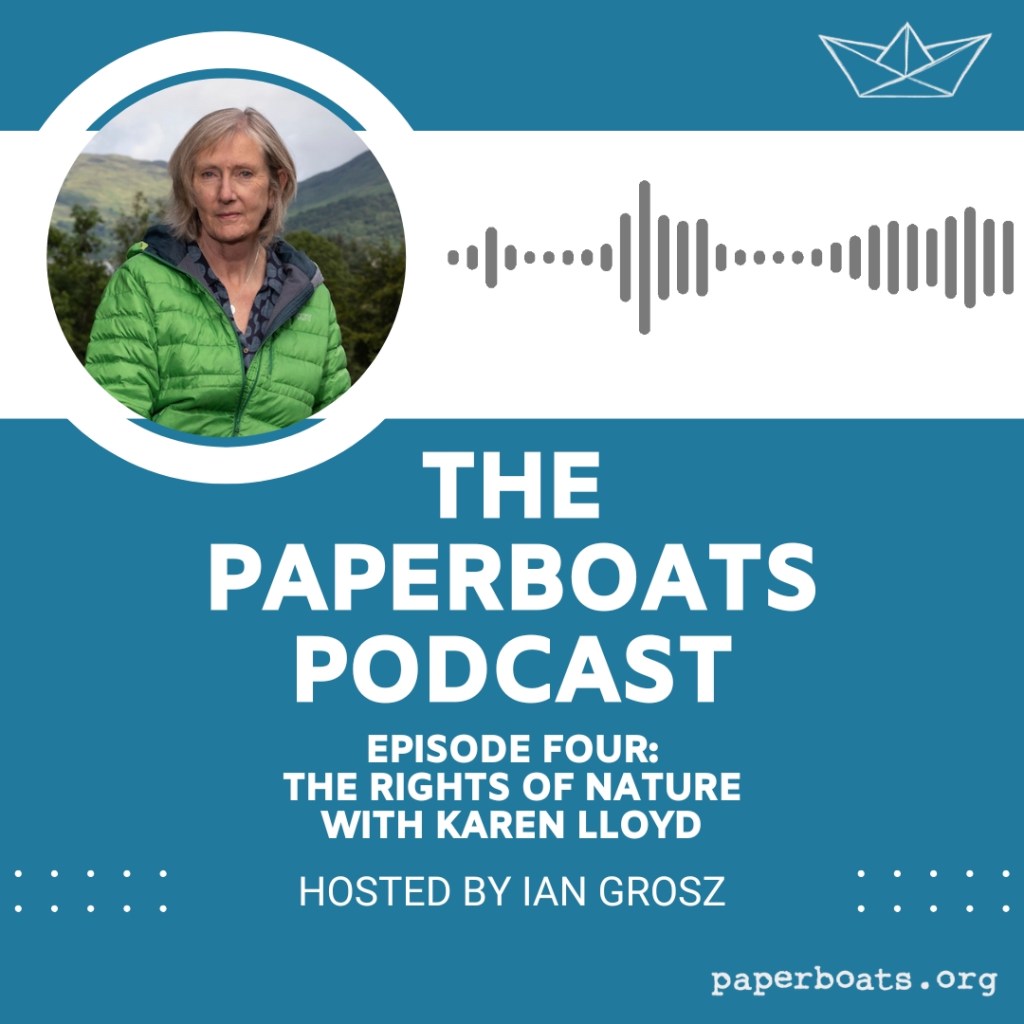
Karen lives on the edge of the Lake District National Park and is Senior Researcher and Writer in Residence at Lancaster University’s Future Places Centre. Her latest book Abundance: Nature in Recovery, is published by Bloomsbury and was longlisted for the Wainwright Prize for Writing in Conservation 2022.
In this episode Karen reads from her essay ‘Inside a Rockpool Shrimp there is a Dying Star‘ and talks about the microplastics problem, the pressures on the Lake District’s vulnerable habitats, the rights of Nature, and how we can protect the most fragile ecosystems in the UK from the impacts of human influence.
Take some time out as we barrel headlong into 2025, and discover a universe in the world of the Rockpool shrimp.
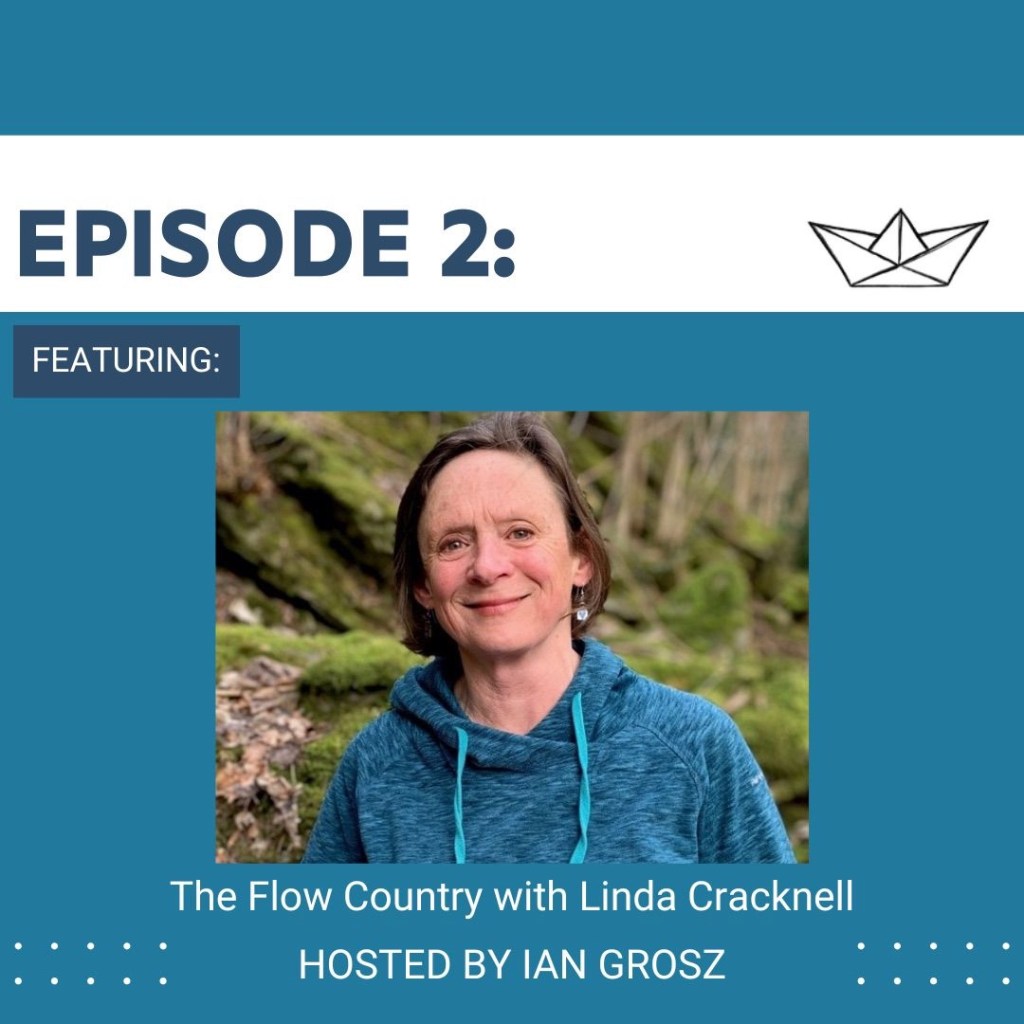
EPISODE 2 OF THE PAPERBOATS PODCAST, WITH LINDA CRACKNELL
Episode 2 of the Paperboats podcast with author Linda Cracknell is available from today.
I talk with Linda about Scotland’s Flow Country, her bookDoubling Back, and how important walking is to her writing practice.
Linda reads an extract from the new edition of Doubling Back, published by Saraband in May 2024 and a wonderful book exploring a range of diverse landscapes, places, and paths as memory.
Linda also highlights how important the peatbogs of Caithness in Sutherland – now a UNESCO World Heritage Site – are in alleviating the impacts of climate change, and how vulnerable they have been to commercial forestry practices and land misuse. She describes her time spent in the Flow Country in writing the new chapter of her book, her life-long relationship with walking, and the importance of landscape and place to her work.
Available across all platforms and streaming now, follow and subscribe to keep up with all future episodes.
If you’re not familiar with Paperboats Writers, they’re a fantastic group of writers working across Scotland (and beyond) to highlight the impacts of climate change, the ecological collapse we’re all witness to, and the things we can do to help bring about positive change.
In each episode I meet with a different writer from the Paperboats collective. We discuss their work, and the issues they write about.
We hear Scotland’s Makar Kathleen Jamie (National Poet for Scotland 2021 – 2024) read her inspirational poem ‘What the Clyde Said, After Cop 26’, discuss the formation of Paperboats Writers, the importance of a Just Transition, and the work of Global Justice Now and the Scottish Rewilding Alliance.
In upcoming episodes I’ll be talking with author Linda Cracknell about the Flow Country and her book Doubling Back, and with Nature Writer and photographer Polly Pullar about the plight of the gannet and Polly’s life-long relationship with wildlife.
Many more fantastic Nature Writers to feature in the coming months, so I hope you’ll give it a listen, and follow and subscribe to keep up with future episodes.
Shorelines are places of ambiguity and exchange – they connect land and sea, places with other places, often far beyond the horizon. They intermingle different zones, habitats, moods, elements, memories. Where does the sea end and the land begin? How do we relate to the shoreline? What does the shore say to us as we negotiate our lives?
I ran a workshop revolving around these themes with a group of writers based in Stonehaven on the Aberdeenshire coast at the weekend. The group is run by poet and short-story writer Alistair Lawrie, who invited me to come along. Alistair evokes place in his work through the use of Doric – a Scot’s dialect that is unique to the northeast of Scotland.
I was keen to draw on the particulars of place in the workshop by focussing on Stonehaven’s shoreline to highlight how it could be a launching point into wider themes, and to encourage new writing. We talked about form and process, and the value of close observation.
Observations can provide the raw material that we write from – the clay that we later mould into shape, and can be used to enrich the context of our work, whether through setting in a story, or enriching poetry and essay with concrete detail. This use of closely observed detail is something the anthropologist Clifford Geertz called ‘thick description’ as it pertained to its use in making field notes during research, but as writers, we can draw from the same principal.
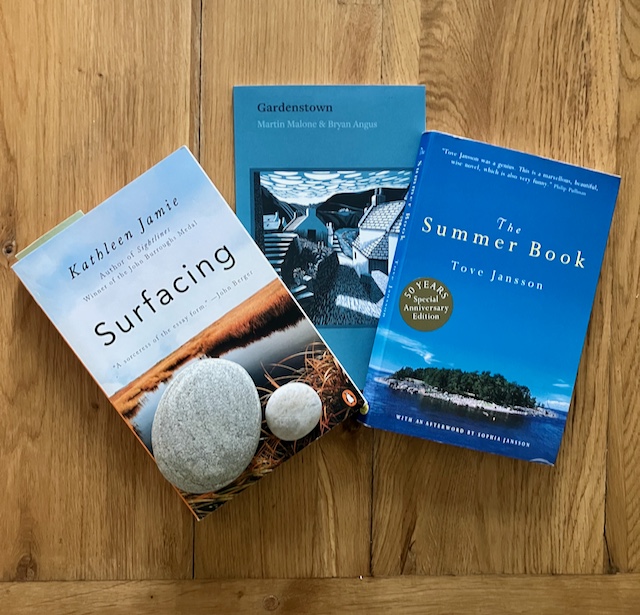
We looked at three pieces of writing that relate to the shoreline by writers who incorporate carefully and closely observed detail into their work, both with constraint and in celebration of a richly descriptive poetic form: Kathleen Jamie’s essay ‘Links of Notland’ in Surfacing, Martin Malone’s opening to his long poem sequence Gardenstown, and ‘The morning Swim’ in Tove Jannson’s The Summer Book.
If you haven’t read all these works yet, I can recommend them, both for how writers can use observation and place as a ‘way in’ to broader and more universal themes – whether that’s the idea of deep time in Kathleen Jamie’s narrative essay, Martin Malone’s exploration of climate change and ecological collapse in the quotidian details of his life in Gamrie, or the cycles of life and death in Jansson’s classic island tale told through the lens of a grandmother’s relationship with her granddaughter – and just as fantastic reads that should be read for simple pleasure alone. All of them ‘form’ favourites of mine, if you’ll excuse the pun…
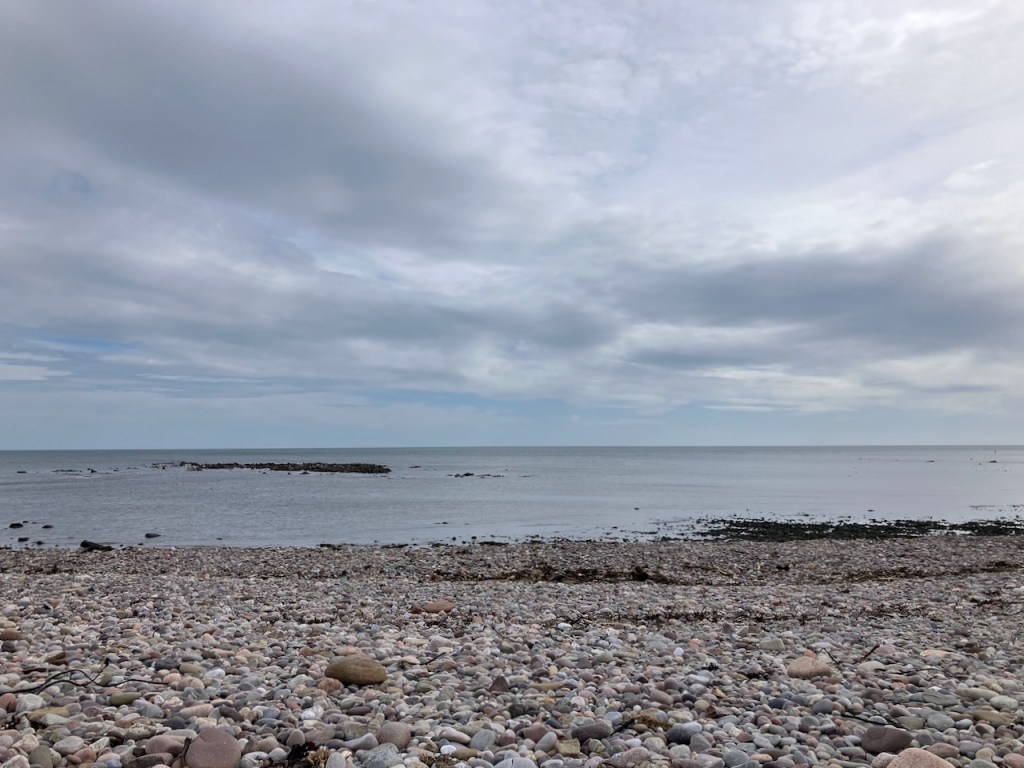
We took these pieces of writing as our starting point and then explored the shoreline. The tide was out and the rocks were exposed a little way offshore, the memory of waves retained in the undulations of the pebble beach, and the record of the winter storms still scattered in neat bands parallel to the shore. People found inspiration in the stones, in the time they held, in the hushing of the low waves and in the calmness and stillness and presence of the sea. They also found inspiration in the life of a busy beachfront on a mild Sunday afternoon: part of the long story of life here – endless, as one person remarked.
The time spent outside – observing, writing, noticing details – reflecting on what the shoreline might say to us – creating space to imagine that conversation – was very productive; and later, after we’d spent time writing and then had some soup, the range of responses were wonderful. They reflected the lives of each individual writer, and all of life, in those moments we had carved out for ourselves.
Writing is often seen as an activity confined to a desk and a chair carried out by a lone thinker in a room, but coming together as writers, taking time to notice the world around us in all its contradiction and rich detail, is sometimes the most fertile ground. Shorelines in particular are rich metaphors for a range of themes more human than we might at first imagine. Spending time there will always reward a writer with the patience to look closely, and in those smallest of details, we might find ourselves tackling surprisingly big questions.
For a fantastic read on noticing and writing that draws on the outdoors, see Linda Cracknell’s In The Moment: Writing Landscape(Saraband, 2023).
‘I bend down and trace the outline of each foot in the cool, hardened silt. I can feel the definite impression of the man’s big toe and a ridge of sand that had been pulled up under the ball of the foot as the toes gripped the surface and he pushed his weight forward with each stride. I can feel the outline of the woman’s heel: the rounded edge and then forward into the arch.
“So how old are these prints, again?” I ask.
“About six-thousand years old,” Burns tells me. “Just in that transition between the Mesolithic and the Neolithic.”‘
From ‘Traces’ Archipelago 2.3 edited by Andrew McNeillie and James Macdonald Lockhart, published by The Clutag Press (2024), pp. 107-115.
To say I’m pleased to have writing in these pages is an understatement. I’ve been following Archipelago for years and to be in it is, well, something. All issues of the journal get archived in the Bodleian Library in Oxford so I could be sitting hidden on a library shelf for many more years, yet…
’Traces’ explores the Mesolithic landscapes of the Sefton coast with archaeologist Dr Alison Burns. We search for prehistoric footprints found in fossilised beds of ancient mud along Formby beach, reconstruct the landscapes and lives of the Mesolithic past, and consider the implications of modern day sea level rise.
Also in these pages:
Nicholas Allen, Alex Boyd, Julie Brook, John Bryant, Moyà Cannon, George Chamier, Claire Connolly, Tony Crowley, Gerald Dawe, Tim Ecott, Nick Groom, Kirsty Gunn, Andrew Hadfield, Howell Harris, Ben Keatinge, Angela Leighton, James Macdonald-Lockhart, Edna Longley, Michael Longley, Jamie McKendrick, Garry MacKenzie, Angus Macmillan, Robert Minhinnick, Heather O’Donoghue, Judy O’Kane, John Purser, Alan Riach, Fiona Stafford, Michael Viney, David Wheatley and Lyn Youngson.



 Groundings