In 2022 I took a walk up everybody’s favourite hill in Aberdeebnshire to witness the autumn equinox sunrise from the summit of Mither Tap – the site of a Pictish hill fort that dominated what was, for the Picts, a sacred landscape.
I wrote an essay about the walk, exploring what the idea of a sacred landscape might mean to us today, which was published on The Clearing – Little Toller’s online journal of Nature, Landscape and Place.
Here I return to the hill as the autumn equinox approached, in the company of BBC Radio Broadcaster Helen Needham. We talk about our connection to landscape and place, and the importance of taking time out from our busy lives to pause and to reflect, and to notice the changing of the seasons.
Extracts from my essay are woven through the recording Helen made as we walked up the hill, following the Maiden Causeway – an ancient track leading to the Pictish fort on the summit of Mither Tap.
You can listen to the podcast here or click on the image above.
Shorelines are places of ambiguity and exchange – they connect land and sea, places with other places, often far beyond the horizon. They intermingle different zones, habitats, moods, elements, memories. Where does the sea end and the land begin? How do we relate to the shoreline? What does the shore say to us as we negotiate our lives?
I ran a workshop revolving around these themes with a group of writers based in Stonehaven on the Aberdeenshire coast at the weekend. The group is run by poet and short-story writer Alistair Lawrie, who invited me to come along. Alistair evokes place in his work through the use of Doric – a Scot’s dialect that is unique to the northeast of Scotland.
I was keen to draw on the particulars of place in the workshop by focussing on Stonehaven’s shoreline to highlight how it could be a launching point into wider themes, and to encourage new writing. We talked about form and process, and the value of close observation.
Observations can provide the raw material that we write from – the clay that we later mould into shape, and can be used to enrich the context of our work, whether through setting in a story, or enriching poetry and essay with concrete detail. This use of closely observed detail is something the anthropologist Clifford Geertz called ‘thick description’ as it pertained to its use in making field notes during research, but as writers, we can draw from the same principal.
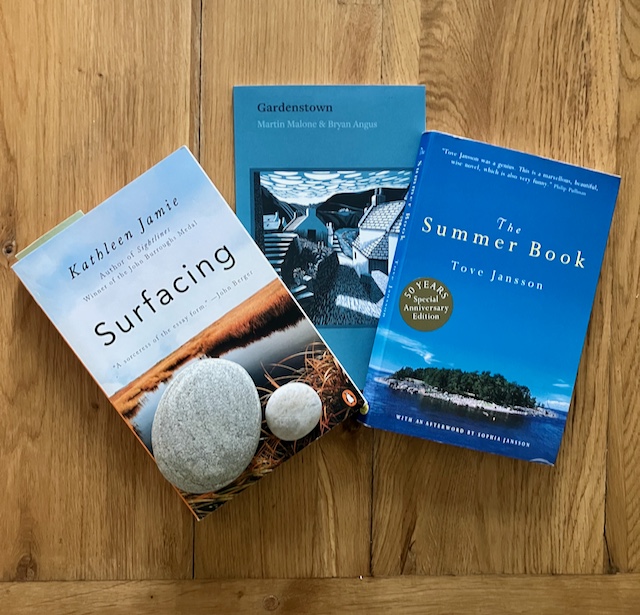
We looked at three pieces of writing that relate to the shoreline by writers who incorporate carefully and closely observed detail into their work, both with constraint and in celebration of a richly descriptive poetic form: Kathleen Jamie’s essay ‘Links of Notland’ in Surfacing, Martin Malone’s opening to his long poem sequence Gardenstown, and ‘The morning Swim’ in Tove Jannson’s The Summer Book.
If you haven’t read all these works yet, I can recommend them, both for how writers can use observation and place as a ‘way in’ to broader and more universal themes – whether that’s the idea of deep time in Kathleen Jamie’s narrative essay, Martin Malone’s exploration of climate change and ecological collapse in the quotidian details of his life in Gamrie, or the cycles of life and death in Jansson’s classic island tale told through the lens of a grandmother’s relationship with her granddaughter – and just as fantastic reads that should be read for simple pleasure alone. All of them ‘form’ favourites of mine, if you’ll excuse the pun…
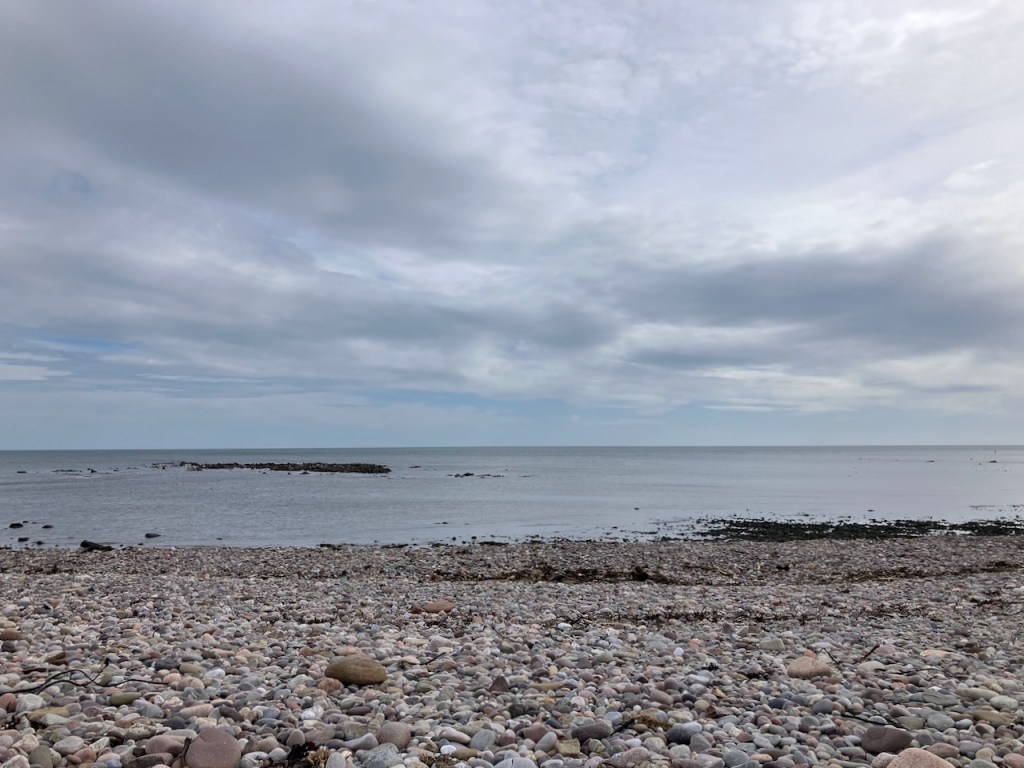
We took these pieces of writing as our starting point and then explored the shoreline. The tide was out and the rocks were exposed a little way offshore, the memory of waves retained in the undulations of the pebble beach, and the record of the winter storms still scattered in neat bands parallel to the shore. People found inspiration in the stones, in the time they held, in the hushing of the low waves and in the calmness and stillness and presence of the sea. They also found inspiration in the life of a busy beachfront on a mild Sunday afternoon: part of the long story of life here – endless, as one person remarked.
The time spent outside – observing, writing, noticing details – reflecting on what the shoreline might say to us – creating space to imagine that conversation – was very productive; and later, after we’d spent time writing and then had some soup, the range of responses were wonderful. They reflected the lives of each individual writer, and all of life, in those moments we had carved out for ourselves.
Writing is often seen as an activity confined to a desk and a chair carried out by a lone thinker in a room, but coming together as writers, taking time to notice the world around us in all its contradiction and rich detail, is sometimes the most fertile ground. Shorelines in particular are rich metaphors for a range of themes more human than we might at first imagine. Spending time there will always reward a writer with the patience to look closely, and in those smallest of details, we might find ourselves tackling surprisingly big questions.
For a fantastic read on noticing and writing that draws on the outdoors, see Linda Cracknell’s In The Moment: Writing Landscape(Saraband, 2023).
In our busy lives, bombarded as we are with news and media and the demands of life and work and family, we very rarely have space to notice the world around us, to pause and to take stock of the passage of time, the changing of the seasons and just where we’re at with ourselves. But writing can help us to do that. It helps us to take notice because it focuses our attention. Linda Cracknell writes: ‘The small weight of a notebook and pen in my pocket is my passport to feeling alive […] The act of writing causes us to refresh our tired ways of noticing.’*
Taking these thoughts as inspiration, I ran a workshop at a local visitor centre at the weekend, first exploring outdoors, encouraging close attention through the conscious use of all the senses and recording our experiences, before coming together in a collaborative space to share what we had seen and felt, writing a group poem with everyone’s input.
The workshop was as much about allowing ourselves that time and space to be, and to notice the world around us, as it was about creative writing; and that experience shared, brought a wonderful sense of connection: with the landscape, with both the past and the present, and with each other.
Paying attention – focussing on the world around us, how we experience it, in that mindful, conscious way – always has the power to connect us with others and a world outside of ourselves. It’s this sense of connection people attending felt the most, I think. It’s certainly what I took away from it, and it was great to see folk who were previously strangers coming together this way in just two short hours.
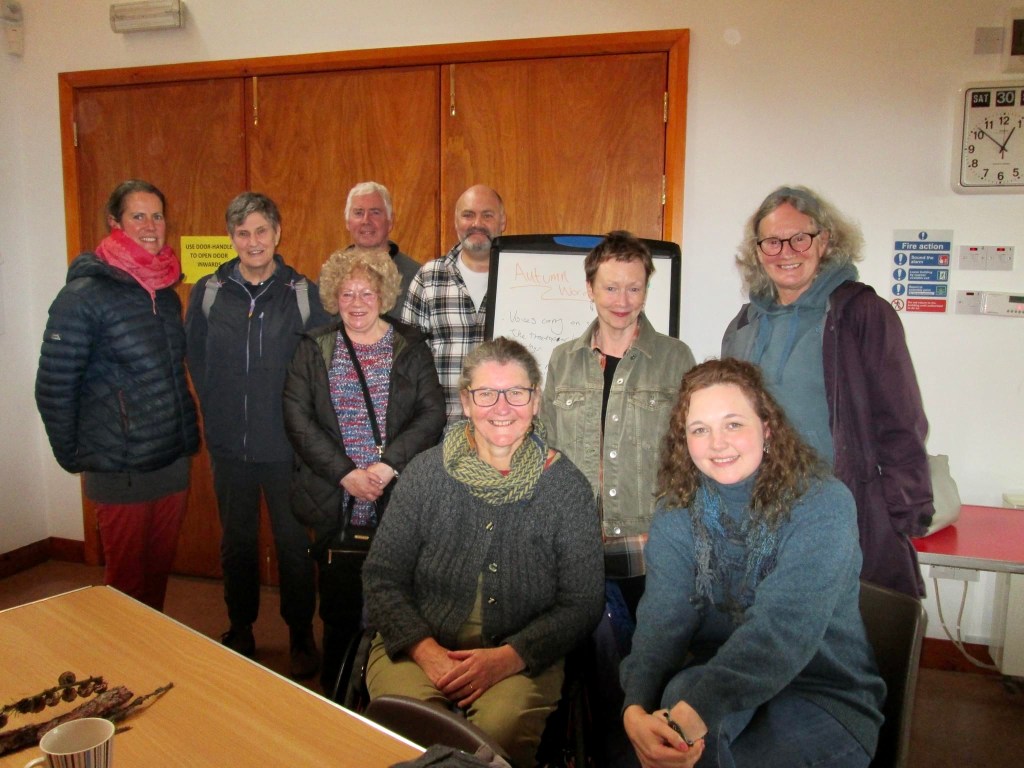
Attendees at the Autumn Words Creative Writing Workshop.
“We came in the afternoon to Slanes Castle, built upon the margin of the sea, so that the walls of one of the towers seem only a continuation of a perpendicular rock, the foot of which is beaten by the waves. To walk round the house seemed impracticable. From the windows the eye wanders over the sea that separates Scotland from Norway, and when the winds beat with violence must enjoy all the terrifick grandeur of the tempestuous ocean.I would not for my amusement wish for a storm; but as storms, whether wished or not, will sometimes happen, I may say, without violation of humanity, that I should willingly look out upon them from Slanes Castle.’
So mused Samuel Johnson who passed this way with his friend and travel companion, James Boswell, in the late summer of 1773 on their journey through Scotland to the Western Isles. Johnson’s account of the trip became the famous A Journey to the Western Islands of Scotland, later followed by Boswell’s The Journal of a Tour to the Hebrides, which brings the irascible Johnson joyfully to life. This being two-hundred-and-fifty-years since their passage through Aberdeenshire on their circuitous route westward, I felt compelled to visit the castle today.
Johnson doesn’t mention staying there, the castle then under the care of the Count of Errol, but he and Boswell spent the night at Slains after an excursion along the coast. It must have been opulently appointed in its day, but it’s a bleak and desolate ruin overlooking the cliffs now, the wind rushing through its empty corridors and doorless openings straight off the sea.
‘I had a most elegant room,’ Boswell writes: ‘but there was a fire in it which blazed: and the sea, to which my windows looked, roared: and the pillows were made with the feathers of some sea-fowl, which had to me a disagreeable smell: so that, by all these causes, I was kept awake a good while.’
In his half-waking, fitful sleep, he imagines the ghost of Lord Kilmarnock who had married into the Erroll title and was beheaded on Tower Hill in 1746 for his part in the Jacobite uprising. Wandering around the castle’s old halls and passageways, I couldn’t help but think of what other ghosts it might be host to.
The original thirteenth-century castle, a fortress built by the Comyn family five miles further along the coast to the south, was forfeited after the Battle of Barra in 1308 to the Hay family after the defeat of the Earl of Buchan, John Comyn, whose troops scattered and fled from the battlefield when Bruce himself appeared waving his standard. The new castle was built in the sixteenth century by Francis Hay, the ninth Earl of Errol, and grew from its original tower house into a Baronial style mansion. At the time of Johnson and Boswell’s visit it was still in the title of the Erroll line, but was sold in 1916 by the twentieth earl, whose finances, following previous generations of lavish spending and an agricultural recession, couldn’t maintain the upkeep.
The castle is most famous today for hosting Bram Stoker in the early part of the twentieth century, who would holiday regularly in nearby Cruden Bay and was thought to have been inspired by its setting. It’s certainly dramatic, and with the tail end of Storm Agnes still bringing the spray up over the rocks and flinging the crows from the castle turrets, I spent some time watching the waves crashing into the cliffs from a window at the northern end of the ruins. I could almost feel Johnson’s breath on me. ‘Well, sir!’ he seemed to be saying. ‘What did I tell you?!’
Later, walking along the cliffs, I watched a solitary cormorant surfing the air between the waves, its dark aquiline shape momentarily vanishing behind crests in the swell. I wondered if it relished a storm, and whether Johnson’s ghost was watching too, looking out from one of the windows in the castle’s now empty rooms.
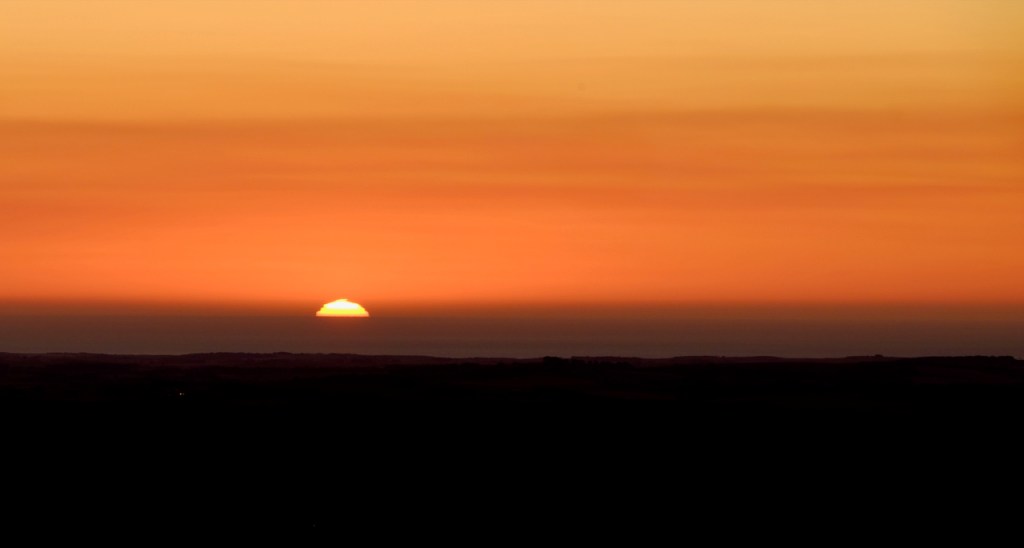
‘I set off an hour before sunrise. It is still dark: very dark, and I can see very little beyond the dim circle of light from my head torch. The thick scent of pine fills the air as I start up the trail. The presence of trees, melting into the darkness either side of me, are felt rather than seen; the still, almost-full harvest moon having disappeared into the cover of pine branches. A nervous glance behind reveals the comfort of a slowly brightening sky, suffused with faint orange and aquamarine banding toward the rim of an unseen eastern horizon. Amidst gaps in the canopy above, bright and brittle stars vanish and reappear. The tree cover opens a little and the moon’s glow pulls me upward.’
As the Autumn equinox approaches, here in the Northern Hemisphere, I am drawn back to our local hill and this moment from a couple of years ago when I climbed to one of its summits to witness the equinox sunrise. The short essay I wrote about it was published on The Clearing: Little Toller’s online journal of Nature, Landscape and Place. You can read the full piece here, or by clicking on the image above.
Traditionally marking the second harvest, a time to gather in the bounty of late summer signalled by the full moon, the Autumn equinox can also be a time of balance, of reset: a chance to take stock before the long slide into winter. Wishing you all a moment of balance as we begin our journey toward the darkness of the winter months.




 Groundings