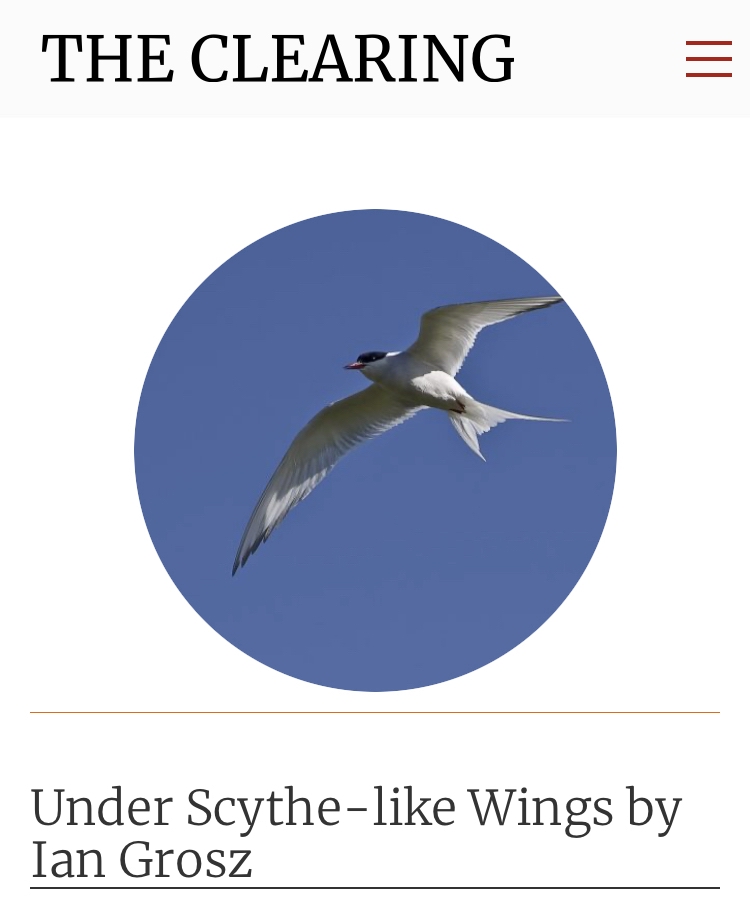
‘The screeching increased, and we found the terns now hovering above our heads: dark, piercing eyes glaring down at us, the flash of razored wings folding in on themselves in a sudden flurry of air and feathers as they dove to drive us off. We stumbled on, wary of our footsteps and continually harried by the terns. Eventually we came across a half-collapsed stone dyke and ducked down behind it, leaving the mass of screaming birds behind and feeling guilty for our intrusion.’
Very happy to have some new writing back on THE CLEARING.
It stems from a trip to Orkney in the summer where I had an encounter with an arctic tern colony, and reflects on the draw of the islands and the potential negative impacts of tourism on Orkney’s wildlife.
THE CLEARING is a journal of landscape, nature and place published by Little Toller based in Dorset and edited by Jon Woolcott, author of Real Dorset.
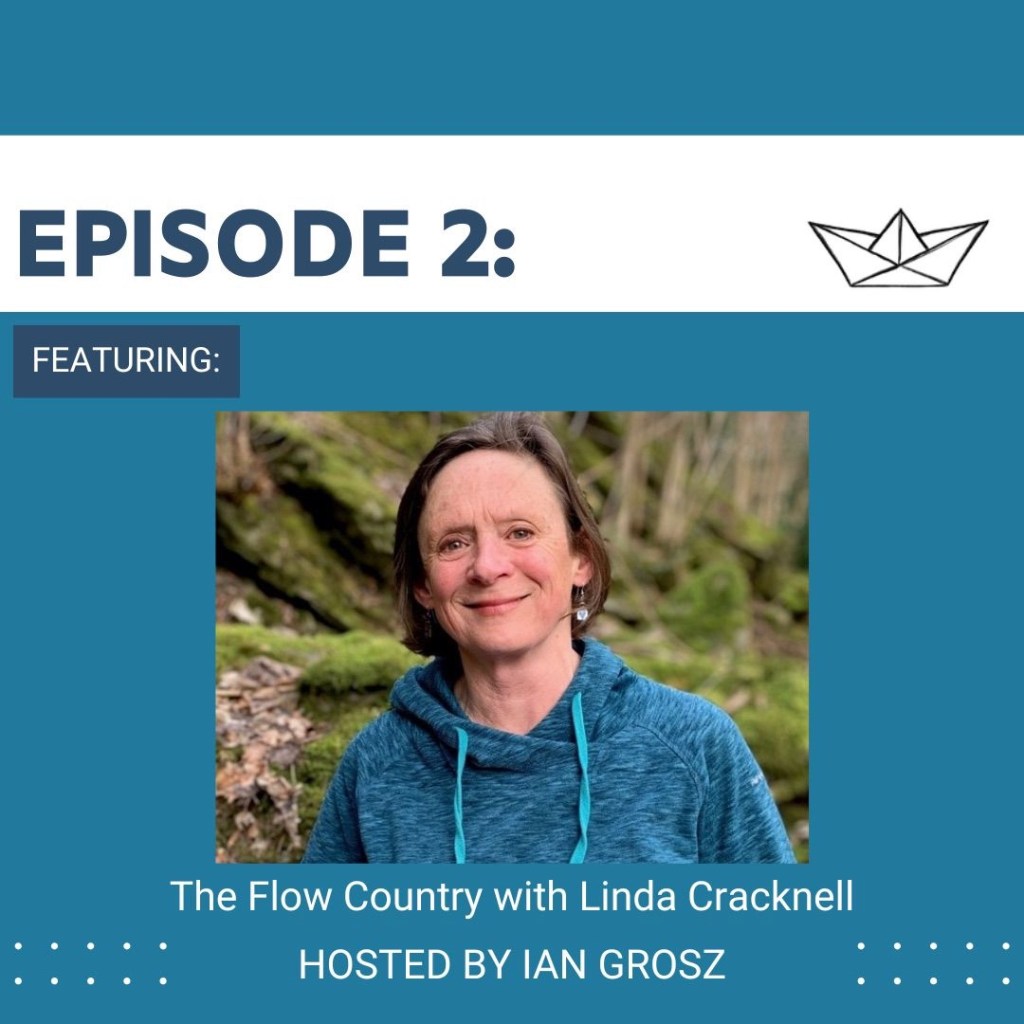
EPISODE 2 OF THE PAPERBOATS PODCAST, WITH LINDA CRACKNELL
Episode 2 of the Paperboats podcast with author Linda Cracknell is available from today.
I talk with Linda about Scotland’s Flow Country, her bookDoubling Back, and how important walking is to her writing practice.
Linda reads an extract from the new edition of Doubling Back, published by Saraband in May 2024 and a wonderful book exploring a range of diverse landscapes, places, and paths as memory.
Linda also highlights how important the peatbogs of Caithness in Sutherland – now a UNESCO World Heritage Site – are in alleviating the impacts of climate change, and how vulnerable they have been to commercial forestry practices and land misuse. She describes her time spent in the Flow Country in writing the new chapter of her book, her life-long relationship with walking, and the importance of landscape and place to her work.
Available across all platforms and streaming now, follow and subscribe to keep up with all future episodes.
If you’re not familiar with Paperboats Writers, they’re a fantastic group of writers working across Scotland (and beyond) to highlight the impacts of climate change, the ecological collapse we’re all witness to, and the things we can do to help bring about positive change.
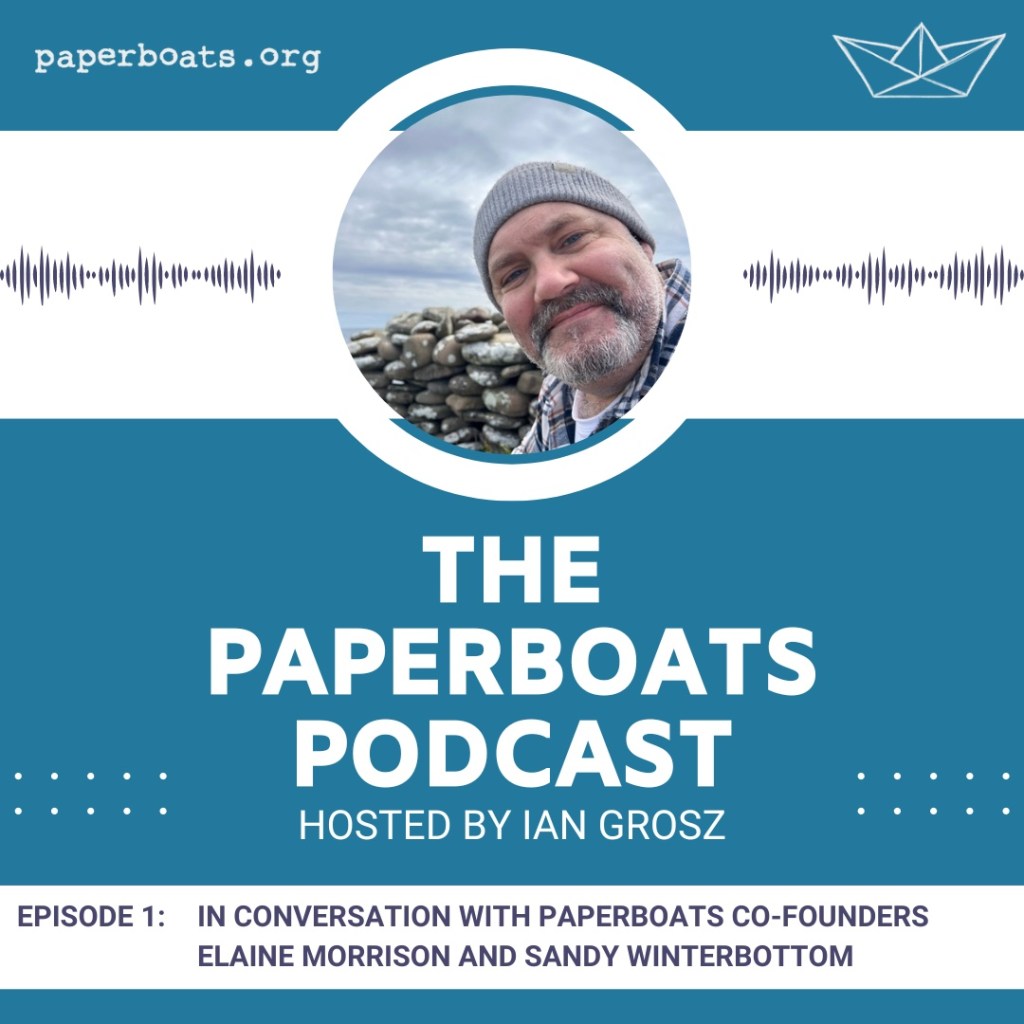
In each episode I meet with a different writer from the Paperboats collective. We discuss their work, and the issues they write about.
We hear Scotland’s Makar Kathleen Jamie (National Poet for Scotland 2021 – 2024) read her inspirational poem ‘What the Clyde Said, After Cop 26’, discuss the formation of Paperboats Writers, the importance of a Just Transition, and the work of Global Justice Now and the Scottish Rewilding Alliance.
In upcoming episodes I’ll be talking with author Linda Cracknell about the Flow Country and her book Doubling Back, and with Nature Writer and photographer Polly Pullar about the plight of the gannet and Polly’s life-long relationship with wildlife.
Many more fantastic Nature Writers to feature in the coming months, so I hope you’ll give it a listen, and follow and subscribe to keep up with future episodes.
In 2022 I took a walk up everybody’s favourite hill in Aberdeebnshire to witness the autumn equinox sunrise from the summit of Mither Tap – the site of a Pictish hill fort that dominated what was, for the Picts, a sacred landscape.
I wrote an essay about the walk, exploring what the idea of a sacred landscape might mean to us today, which was published on The Clearing – Little Toller’s online journal of Nature, Landscape and Place.
Here I return to the hill as the autumn equinox approached, in the company of BBC Radio Broadcaster Helen Needham. We talk about our connection to landscape and place, and the importance of taking time out from our busy lives to pause and to reflect, and to notice the changing of the seasons.
Extracts from my essay are woven through the recording Helen made as we walked up the hill, following the Maiden Causeway – an ancient track leading to the Pictish fort on the summit of Mither Tap.
You can listen to the podcast here or click on the image above.
Shorelines are places of ambiguity and exchange – they connect land and sea, places with other places, often far beyond the horizon. They intermingle different zones, habitats, moods, elements, memories. Where does the sea end and the land begin? How do we relate to the shoreline? What does the shore say to us as we negotiate our lives?
I ran a workshop revolving around these themes with a group of writers based in Stonehaven on the Aberdeenshire coast at the weekend. The group is run by poet and short-story writer Alistair Lawrie, who invited me to come along. Alistair evokes place in his work through the use of Doric – a Scot’s dialect that is unique to the northeast of Scotland.
I was keen to draw on the particulars of place in the workshop by focussing on Stonehaven’s shoreline to highlight how it could be a launching point into wider themes, and to encourage new writing. We talked about form and process, and the value of close observation.
Observations can provide the raw material that we write from – the clay that we later mould into shape, and can be used to enrich the context of our work, whether through setting in a story, or enriching poetry and essay with concrete detail. This use of closely observed detail is something the anthropologist Clifford Geertz called ‘thick description’ as it pertained to its use in making field notes during research, but as writers, we can draw from the same principal.
We looked at three pieces of writing that relate to the shoreline by writers who incorporate carefully and closely observed detail into their work, both with constraint and in celebration of a richly descriptive poetic form: Kathleen Jamie’s essay ‘Links of Notland’ in Surfacing, Martin Malone’s opening to his long poem sequence Gardenstown, and ‘The morning Swim’ in Tove Jannson’s The Summer Book.
If you haven’t read all these works yet, I can recommend them, both for how writers can use observation and place as a ‘way in’ to broader and more universal themes – whether that’s the idea of deep time in Kathleen Jamie’s narrative essay, Martin Malone’s exploration of climate change and ecological collapse in the quotidian details of his life in Gamrie, or the cycles of life and death in Jansson’s classic island tale told through the lens of a grandmother’s relationship with her granddaughter – and just as fantastic reads that should be read for simple pleasure alone. All of them ‘form’ favourites of mine, if you’ll excuse the pun…
We took these pieces of writing as our starting point and then explored the shoreline. The tide was out and the rocks were exposed a little way offshore, the memory of waves retained in the undulations of the pebble beach, and the record of the winter storms still scattered in neat bands parallel to the shore. People found inspiration in the stones, in the time they held, in the hushing of the low waves and in the calmness and stillness and presence of the sea. They also found inspiration in the life of a busy beachfront on a mild Sunday afternoon: part of the long story of life here – endless, as one person remarked.
The time spent outside – observing, writing, noticing details – reflecting on what the shoreline might say to us – creating space to imagine that conversation – was very productive; and later, after we’d spent time writing and then had some soup, the range of responses were wonderful. They reflected the lives of each individual writer, and all of life, in those moments we had carved out for ourselves.
Writing is often seen as an activity confined to a desk and a chair carried out by a lone thinker in a room, but coming together as writers, taking time to notice the world around us in all its contradiction and rich detail, is sometimes the most fertile ground. Shorelines in particular are rich metaphors for a range of themes more human than we might at first imagine. Spending time there will always reward a writer with the patience to look closely, and in those smallest of details, we might find ourselves tackling surprisingly big questions.
For a fantastic read on noticing and writing that draws on the outdoors, see Linda Cracknell’s In The Moment: Writing Landscape(Saraband, 2023).