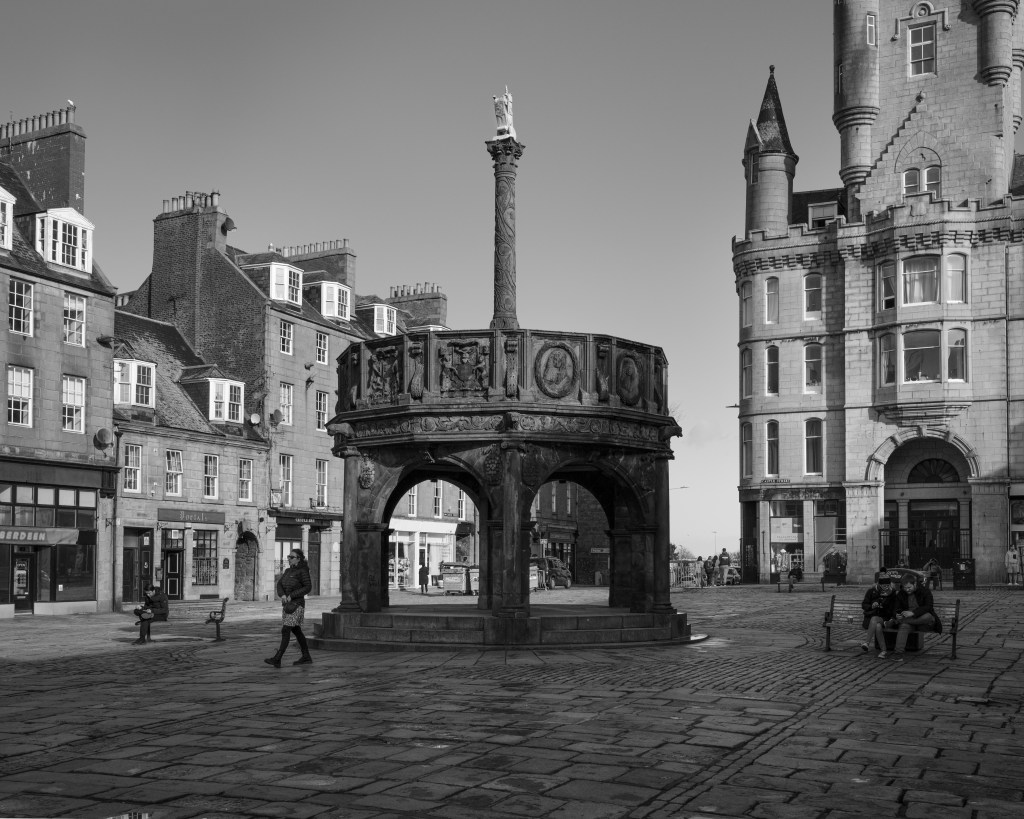
Aberdeen’s Castlegate – Image and Copyright Steve Smith
Our relationships with place are nearly always expressed through story, and this is what fascinates me most about what it is that makes a place, a place – the unique community stories that come out of any given location.
For the last 9 months I’ve been working on a pilot project commissioned by Aberdeen City Council through Historic Env. Scotland’s Heritage and Place Programme. The project aims to celebrate, record, and reveal the historic and contemporary stories that make up the Castlegate’s unique sense of place in the east end of Aberdeen city centre, and to capture the social history of the area at a time when the city is on the cusp of change.
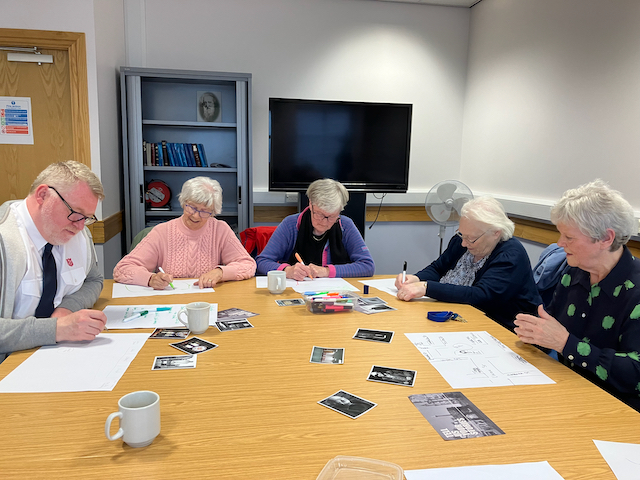
I ran a series of community-based workshops exploring local heritage and relationships with place, and, working alongside the project photographer, conducted audio-recorded interviews to capture a sample of individual experiences relating to the Castlegate and its heritage.
We opened an exhibition at Aberdeen Arts Centre to showcase some of the photography for those who feature in the project, and we worked with artist and filmmaker Callum Kellie and a digital surveying and software company to launch an interactive online platform and digital map to house some of the material gathered, which you can explore at the link below.
We’ve only scratched the surface, but we hope we’ll have opportunity to build on the work done so far to capture a sense of a city that is both informed by its past and working hard to rewrite its future.
Shorelines are places of ambiguity and exchange – they connect land and sea, places with other places, often far beyond the horizon. They intermingle different zones, habitats, moods, elements, memories. Where does the sea end and the land begin? How do we relate to the shoreline? What does the shore say to us as we negotiate our lives?
I ran a workshop revolving around these themes with a group of writers based in Stonehaven on the Aberdeenshire coast at the weekend. The group is run by poet and short-story writer Alistair Lawrie, who invited me to come along. Alistair evokes place in his work through the use of Doric – a Scot’s dialect that is unique to the northeast of Scotland.
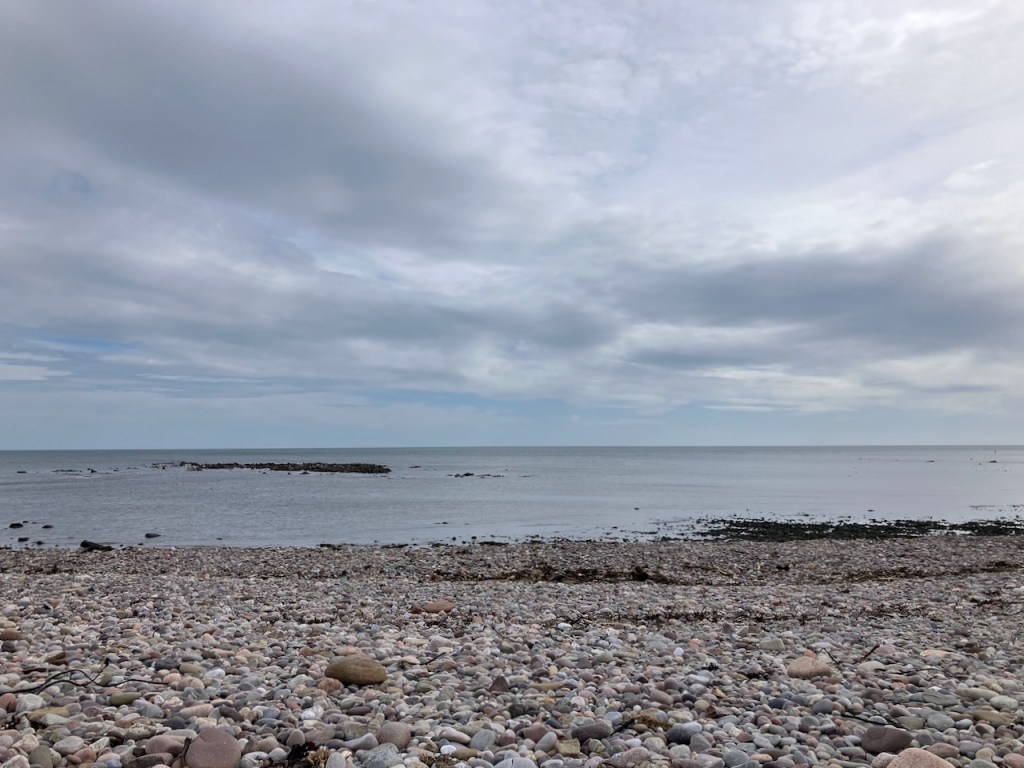
I was keen to draw on the particulars of place in the workshop by focussing on Stonehaven’s shoreline to highlight how it could be a launching point into wider themes, and to encourage new writing. We talked about form and process, and the value of close observation.
Observations can provide the raw material that we write from – the clay that we later mould into shape, and can be used to enrich the context of our work, whether through setting in a story, or enriching poetry and essay with concrete detail. This use of closely observed detail is something the anthropologist Clifford Geertz called ‘thick description’ as it pertained to its use in making field notes during research, but as writers, we can draw from the same principal.
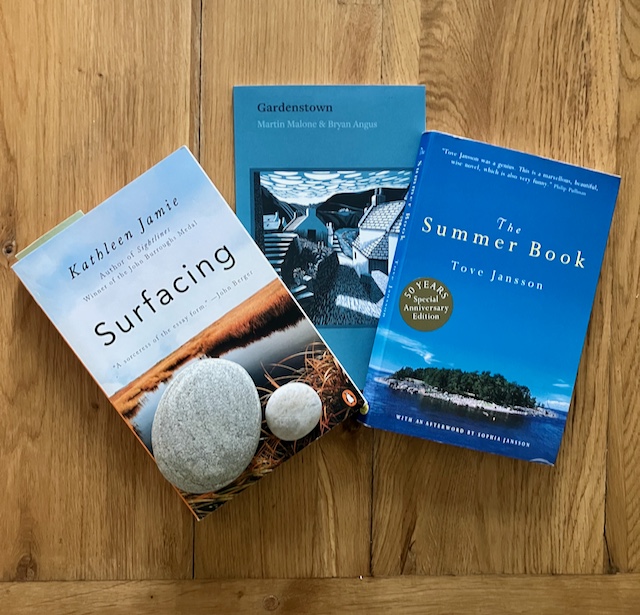
We looked at three pieces of writing that relate to the shoreline by writers who incorporate carefully and closely observed detail into their work, both with constraint and in celebration of a richly descriptive poetic form: Kathleen Jamie’s essay ‘Links of Notland’ in Surfacing, Martin Malone’s opening to his long poem sequence Gardenstown, and ‘The morning Swim’ in Tove Jannson’s The Summer Book.
If you haven’t read all these works yet, I can recommend them, both for how writers can use observation and place as a ‘way in’ to broader and more universal themes – whether that’s the idea of deep time in Kathleen Jamie’s narrative essay, Martin Malone’s exploration of climate change and ecological collapse in the quotidian details of his life in Gamrie, or the cycles of life and death in Jansson’s classic island tale told through the lens of a grandmother’s relationship with her granddaughter – and just as fantastic reads that should be read for simple pleasure alone. All of them ‘form’ favourites of mine, if you’ll excuse the pun…
We took these pieces of writing as our starting point and then explored the shoreline. The tide was out and the rocks were exposed a little way offshore, the memory of waves retained in the undulations of the pebble beach, and the record of the winter storms still scattered in neat bands parallel to the shore. People found inspiration in the stones, in the time they held, in the hushing of the low waves and in the calmness and stillness and presence of the sea. They also found inspiration in the life of a busy beachfront on a mild Sunday afternoon: part of the long story of life here – endless, as one person remarked.
The time spent outside – observing, writing, noticing details – reflecting on what the shoreline might say to us – creating space to imagine that conversation – was very productive; and later, after we’d spent time writing and then had some soup, the range of responses were wonderful. They reflected the lives of each individual writer, and all of life, in those moments we had carved out for ourselves.
Writing is often seen as an activity confined to a desk and a chair carried out by a lone thinker in a room, but coming together as writers, taking time to notice the world around us in all its contradiction and rich detail, is sometimes the most fertile ground. Shorelines in particular are rich metaphors for a range of themes more human than we might at first imagine. Spending time there will always reward a writer with the patience to look closely, and in those smallest of details, we might find ourselves tackling surprisingly big questions.
For a fantastic read on noticing and writing that draws on the outdoors, see Linda Cracknell’s In The Moment: Writing Landscape(Saraband, 2023).
As the western calendar year comes to a close, it’s a natural time to look back and reflect on the previous twelve months. It’s been a significant year for me on a personal level. I turned fifty early in the second quarter of 2023 – a significant event for anybody – and I successfully defended my PhD thesis early in November, which marked the culmination of a long process of research, writing and reflection that helped answer questions that have occupied my thoughts for many years: questions of place, of identity, of how the landscape shapes our lives.
I have been able to explore these questions both creatively and academically, and the submission and accession of my thesis – comprised of a book-length work of creative nonfiction alongside a critical commentary – closes a significant period in my life whilst opening up another. The time spent working toward the PhD signifies a period of deep change and transition: from a former life as a helicopter pilot largely servicing the offshore oil and gas industry toward a new life that places my feet firmly on the ground, encompassing and embracing community and working in a way that is less certain but offers more freedom and is more in line with my values and the aspirations I have now.
This year has been one where I’ve seen hard work begin to pay off and a future direction begin to take shape, replacing the uncertainty that came with the end of a career and dominated my life as I embarked on doctoral study in the midst of a pandemic. It is a year that leaves me feeling hopeful and positive as I go forward, despite all the world-changing events that this same period has also been witness to.
As a writer, I have seen some of my writing find a home with Stravaig, Hinterlandnonfictionmagazine and, this coming spring, one of the chapters from my PhD will be published in Archipelago, a literary journal I have long admired. I’m pleased that my approach to questions of place will also feature in an anthology of academic writing through the University of Eichstätt-Ingolstadt’s Practicing PlaceCentre, due for publication in 2024. I was also very happy to have had writing published in the PaperboatsZine, for which I took part in a launchevent at the University of Stirling.
Beyond my own writing, in September I ran an outdoorcreativewriting workshop, helping people engage with their surroundings and fostering a sense of togetherness. Earlier in the year I became involved with the charity OpenBook, running a pilot creative writing group over the spring and summer that has become an established, monthly group as part of Open Book’s Scotland-wide Community Project. Seeing people develop in confidence and find their own voice in a supportive group setting is something that is hugely rewarding and I look forward now to taking the group – just one of many Open Book groups across the country – into 2024.
As I head into the New Year I will also embark on a significant community engagement project, working in collaboration and consultation on commission to explore how people feel about where they live and documenting community story and memory. It’s a role I hope will expand and flourish through 2024 and beyond.
What can we do but go forward? Uncertainty and change will always run side by side with our lives. 2023 has shown me that, on a personal level at least, positive change is possible, and that, if change is needed, it is worth living with the uncertainty that comes with not knowing what the outcomes might be. Despite the fears, taking those first steps toward an uncertain future is important. The change that you walk toward, the change that you need, will find you.
In our busy lives, bombarded as we are with news and media and the demands of life and work and family, we very rarely have space to notice the world around us, to pause and to take stock of the passage of time, the changing of the seasons and just where we’re at with ourselves. But writing can help us to do that. It helps us to take notice because it focuses our attention. Linda Cracknell writes: ‘The small weight of a notebook and pen in my pocket is my passport to feeling alive […] The act of writing causes us to refresh our tired ways of noticing.’*
Taking these thoughts as inspiration, I ran a workshop at a local visitor centre at the weekend, first exploring outdoors, encouraging close attention through the conscious use of all the senses and recording our experiences, before coming together in a collaborative space to share what we had seen and felt, writing a group poem with everyone’s input.
The workshop was as much about allowing ourselves that time and space to be, and to notice the world around us, as it was about creative writing; and that experience shared, brought a wonderful sense of connection: with the landscape, with both the past and the present, and with each other.
Paying attention – focussing on the world around us, how we experience it, in that mindful, conscious way – always has the power to connect us with others and a world outside of ourselves. It’s this sense of connection people attending felt the most, I think. It’s certainly what I took away from it, and it was great to see folk who were previously strangers coming together this way in just two short hours.
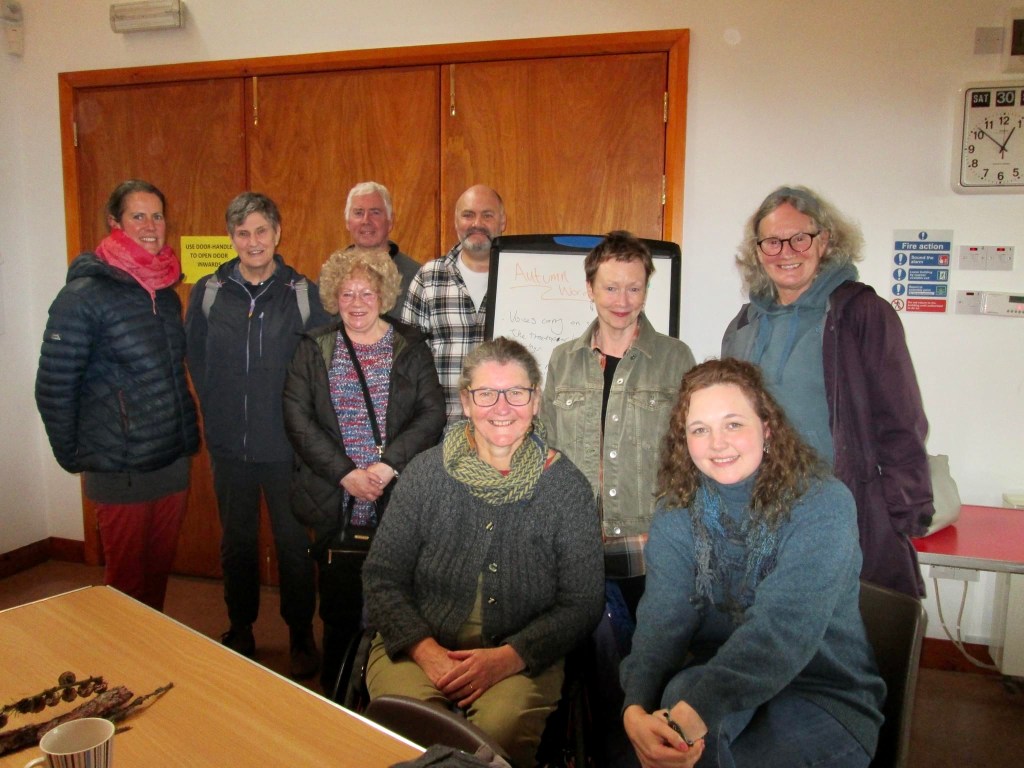
Attendees at the Autumn Words Creative Writing Workshop.
After the successful completion of the growth pilot earlier this year, and following a successful funding bid through Creative Scotland, Open Book Reading have announced that they can support all the groups that took part in the pilot, and so I’m delighted to be able to continue the work of the charity through leading a group in partnership with Live Life Aberdeenshire.
The wider community project runs from October this year to September next, and will consist of eight supported sessions exploring stories and poems and nurturing a supportive environment to try creative writing. We’ll also be visiting a literary festival together and fostering a sense of community through the shared enjoyment of literature and poetry.



 Groundings