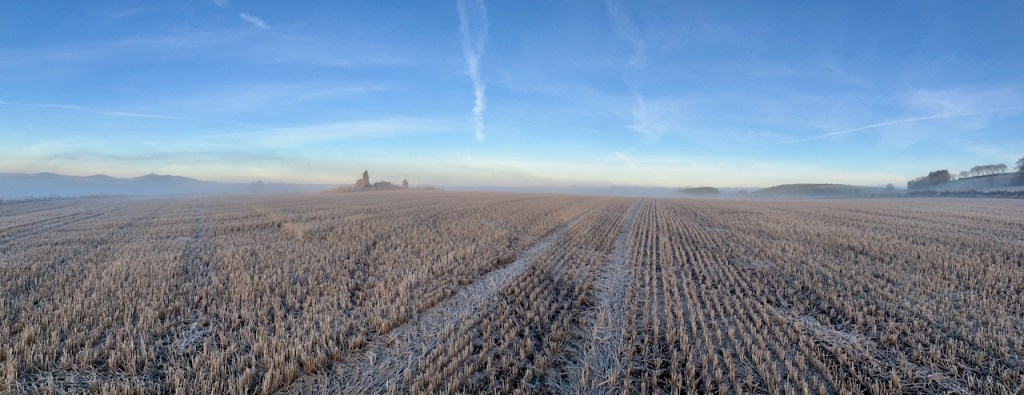
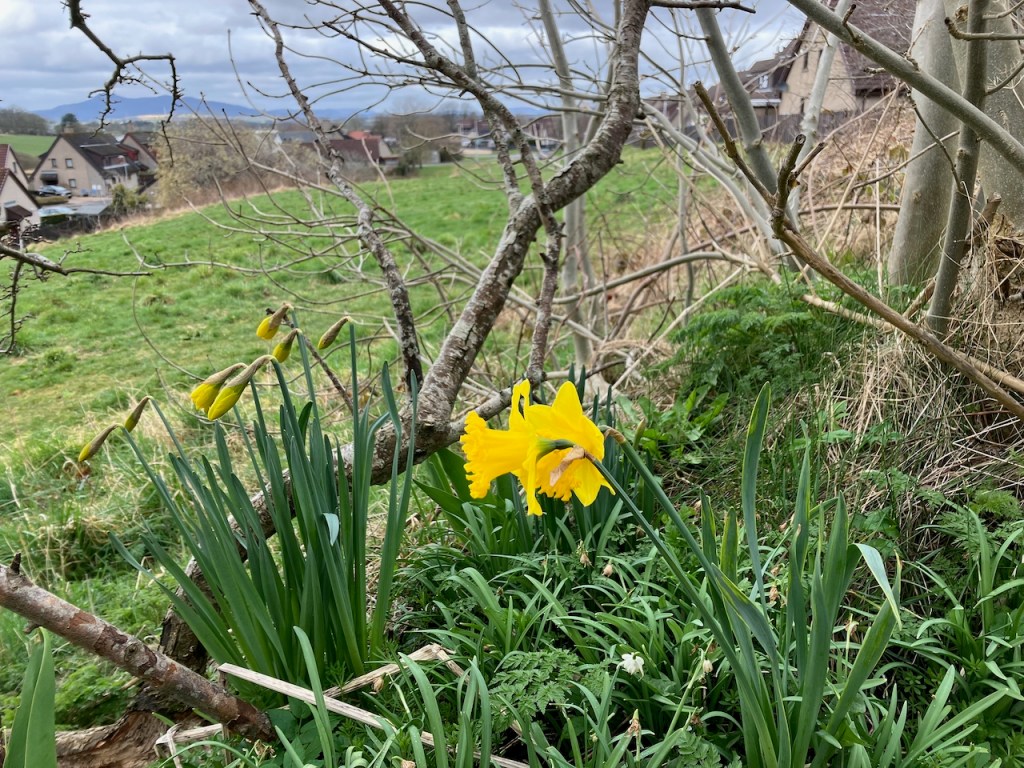
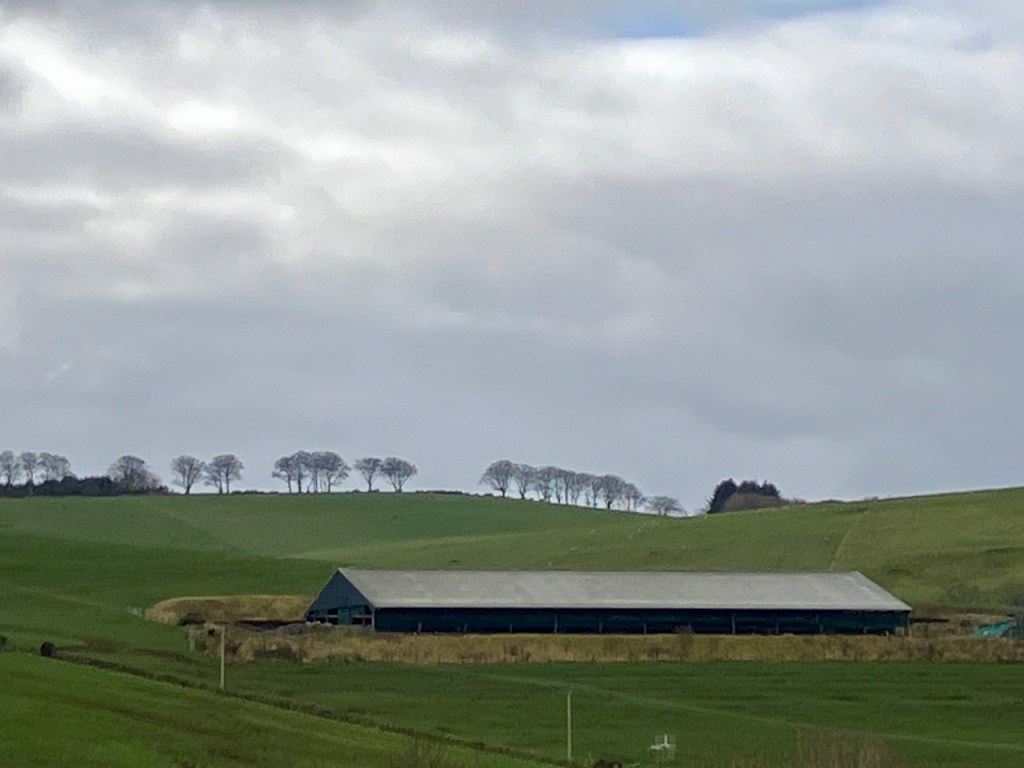
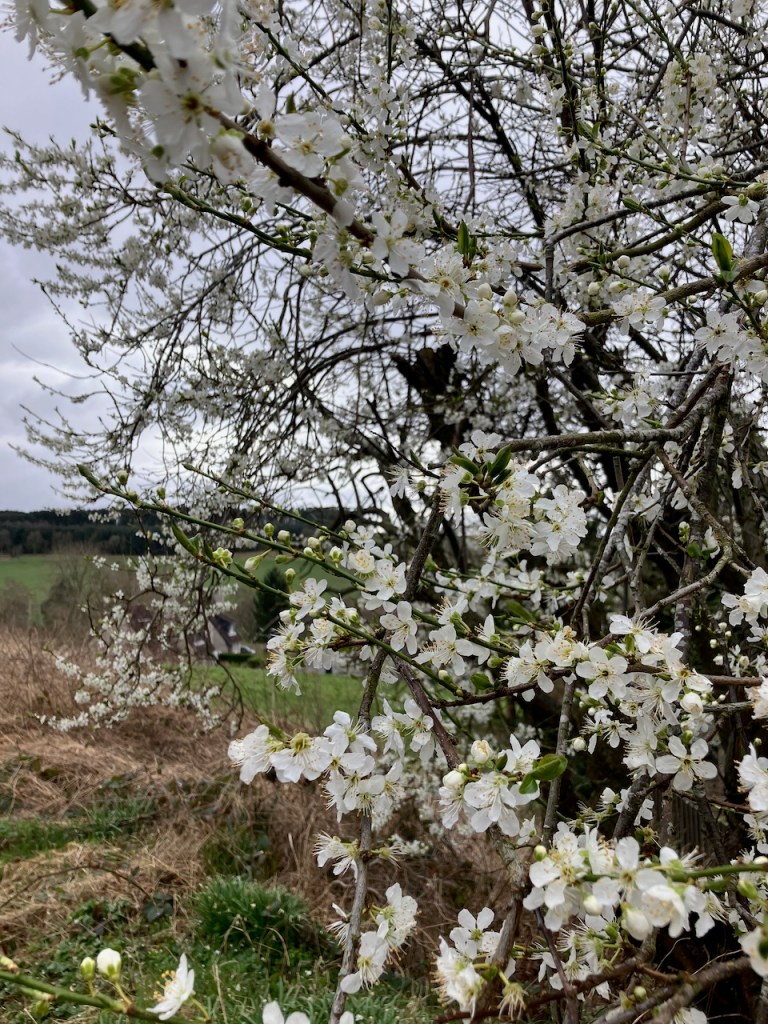
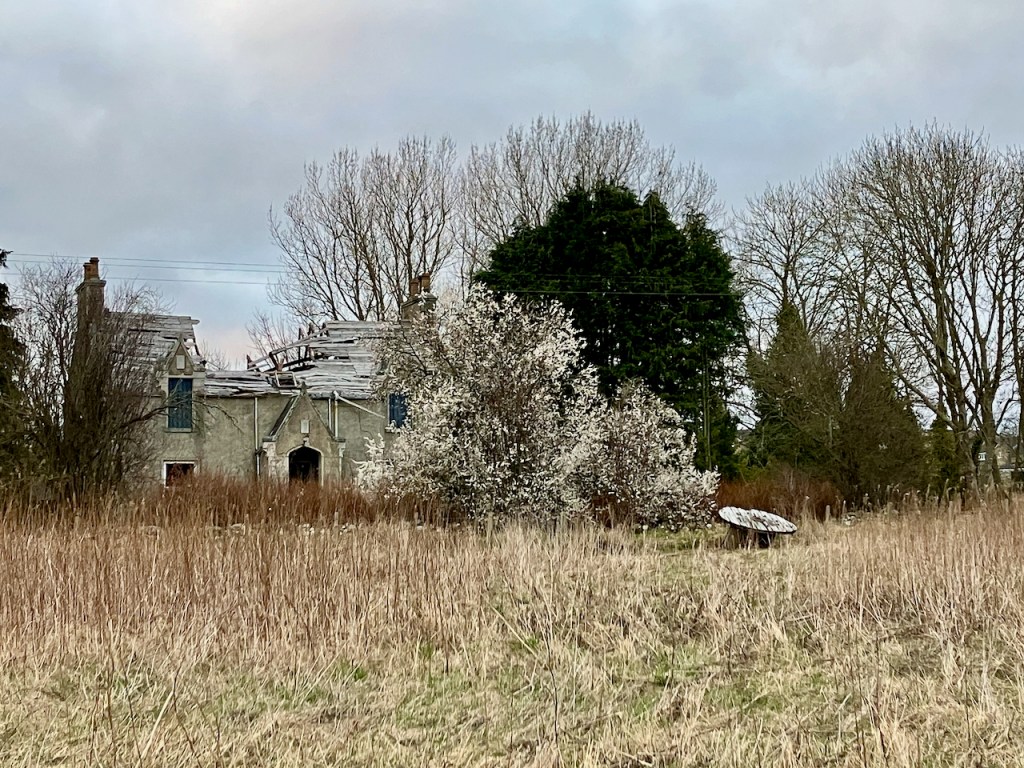
Half-forgotten standing stones, abandoned farm houses, early blossom, late daffodils – trees that always transport me to elsewheres.
All way-markers of the passage of time and the signatures of place.
It always gently surprises me how much walking connects me to place – the sense of time and connection to those that have gone before us – and to other places through memory and imagination.
I’ve been walking this area for years, now, but it still rewards me. As I walk, I remake the path and the path, in turn, remakes me, directing my movements through the landscape, shaping the way I experience it and reaffirming where and who I am.
To reach any destination, we must first place ourselves in an imagined future. To go somewhere we have already been, we place the self in both an imagined future and the reconstructed past. We experience the past, the present and the future simultaneously, creatures bound by time but able to traverse its different states, merging the self of the past, the present and the future in a continuous state of reinvention and renewal. In this way, wayfaring is a collaboration, an act of co-creation between the wayfarer and the way.
Pleasing, then, to see the signs of spring, the decay and the new life – the little changes we can witness in a landscape – and to feel truly grateful to be here, anchored by the things that give me my place in the world.
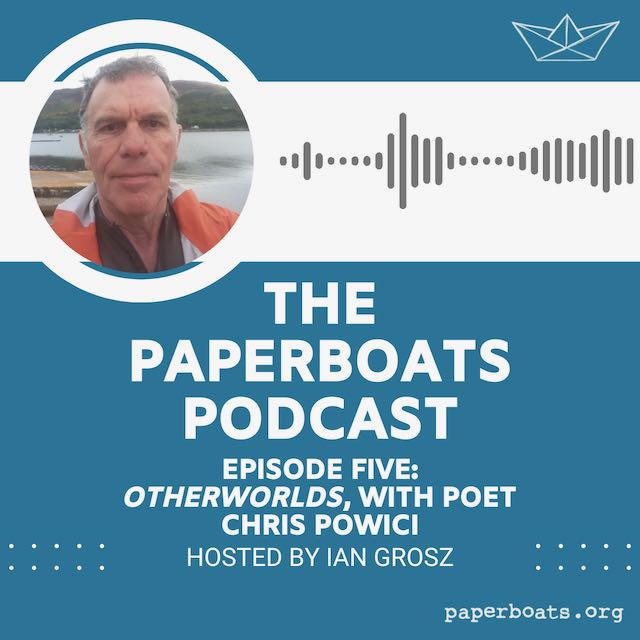
Episode 5 of the Paperboats Podcast features poet Chris Powici
Chris lives in Perthshire in Scotland. He taught creative writing for many years at the University of Stirling and the Open University, but is now focussed on his own writing as a poet and essayist. His work mostly explores the overlap between the human and natural worlds.
Chris is also co-editor of New Writing Scotland and one of the key people behind the formation of the Paperboats Writers collective. In this episode he talks about his involvement with Paperboats, his thoughts on the role of the writer in the climate and ecological emergency, and the importance of affirming the world around us through the ‘otherworlds’ of our imagination.
Chis reads ‘Night Fishing’ and ‘Deer’ from his first poetry collection, This Weight of Light (Red Squirrel Press, 2015) and ‘Loch Striven’ from Issue 1 of the Paperboats Zine. His latest poetry collection is Look, Breathe, published by Red Squirrel Press.
“We came in the afternoon to Slanes Castle, built upon the margin of the sea, so that the walls of one of the towers seem only a continuation of a perpendicular rock, the foot of which is beaten by the waves. To walk round the house seemed impracticable. From the windows the eye wanders over the sea that separates Scotland from Norway, and when the winds beat with violence must enjoy all the terrifick grandeur of the tempestuous ocean.I would not for my amusement wish for a storm; but as storms, whether wished or not, will sometimes happen, I may say, without violation of humanity, that I should willingly look out upon them from Slanes Castle.’
So mused Samuel Johnson who passed this way with his friend and travel companion, James Boswell, in the late summer of 1773 on their journey through Scotland to the Western Isles. Johnson’s account of the trip became the famous A Journey to the Western Islands of Scotland, later followed by Boswell’s The Journal of a Tour to the Hebrides, which brings the irascible Johnson joyfully to life. This being two-hundred-and-fifty-years since their passage through Aberdeenshire on their circuitous route westward, I felt compelled to visit the castle today.
Johnson doesn’t mention staying there, the castle then under the care of the Count of Errol, but he and Boswell spent the night at Slains after an excursion along the coast. It must have been opulently appointed in its day, but it’s a bleak and desolate ruin overlooking the cliffs now, the wind rushing through its empty corridors and doorless openings straight off the sea.
‘I had a most elegant room,’ Boswell writes: ‘but there was a fire in it which blazed: and the sea, to which my windows looked, roared: and the pillows were made with the feathers of some sea-fowl, which had to me a disagreeable smell: so that, by all these causes, I was kept awake a good while.’
In his half-waking, fitful sleep, he imagines the ghost of Lord Kilmarnock who had married into the Erroll title and was beheaded on Tower Hill in 1746 for his part in the Jacobite uprising. Wandering around the castle’s old halls and passageways, I couldn’t help but think of what other ghosts it might be host to.
The original thirteenth-century castle, a fortress built by the Comyn family five miles further along the coast to the south, was forfeited after the Battle of Barra in 1308 to the Hay family after the defeat of the Earl of Buchan, John Comyn, whose troops scattered and fled from the battlefield when Bruce himself appeared waving his standard. The new castle was built in the sixteenth century by Francis Hay, the ninth Earl of Errol, and grew from its original tower house into a Baronial style mansion. At the time of Johnson and Boswell’s visit it was still in the title of the Erroll line, but was sold in 1916 by the twentieth earl, whose finances, following previous generations of lavish spending and an agricultural recession, couldn’t maintain the upkeep.
The castle is most famous today for hosting Bram Stoker in the early part of the twentieth century, who would holiday regularly in nearby Cruden Bay and was thought to have been inspired by its setting. It’s certainly dramatic, and with the tail end of Storm Agnes still bringing the spray up over the rocks and flinging the crows from the castle turrets, I spent some time watching the waves crashing into the cliffs from a window at the northern end of the ruins. I could almost feel Johnson’s breath on me. ‘Well, sir!’ he seemed to be saying. ‘What did I tell you?!’
Later, walking along the cliffs, I watched a solitary cormorant surfing the air between the waves, its dark aquiline shape momentarily vanishing behind crests in the swell. I wondered if it relished a storm, and whether Johnson’s ghost was watching too, looking out from one of the windows in the castle’s now empty rooms.
Really excited to be setting up a new Open Book writing group in Aberdeenshire in the coming weeks.
Open Book are a fantastic organisation, set up in 2013 to help build communities through shared reading. Their groups now encompass creative writing and have been set up across Scotland. They are expanding their current provision with a Growth Pilot of 5 further groups in areas not currently served and which I’m very happy to be a part of.
Looking back over a busy year that started on the Isle of Lewis. My trip was delayed because of the storms in January, but the beginning of the year saw me spending ten days with Island Darkroom: a great opportunity that really helped my project find its feet.
In February the world changed of course, with Russia’s invasion of Ukraine, which continues to mar the world with violence, loss and sadness, and it’s difficult to believe that this terrible war has dragged on now for almost a year. All we can do is hope for a resolution in 2023 that will end the needless suffering as the people of Ukraine continue to be an inspiration.
In May I read work at a symposium with The Sir Herbert Grierson Centre, and in September I gave a workshop on writing Landscape and Place as part of the 2022 Wayword Lit. Arts festival. In November I gave a paper at the University of Eichstätt-Ingolstadt for the Practicing Place conference.
Finally, my work featured in the long awaited book Four Rivers:Deep Mapswith a chapter on the River Don, tracing its sacred associations from source to sea and exploring how they have shaped the area’s geography and identity over time. The book was published by UWAP in late September.
I’m nearing the end of my major work-in-progress now and hope to get it out there next year which looks set to be as busy as the last, with some teaching work lined up, and hopefully an academic publication on my research and a further conference in the summer. Beyond that I hope to do some more workshops and get my thesis in on time!
Wishing you all the very best for the year ahead and hoping the world finds itself a little kinder in 2023.


 Groundings