The Moor, the Sea, the Sky

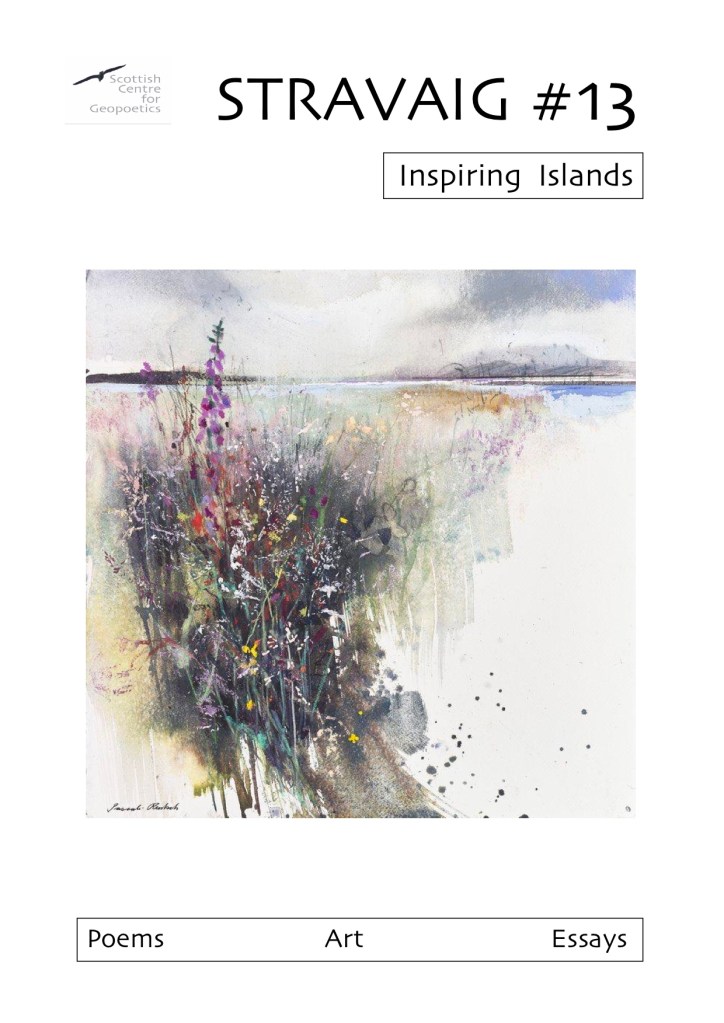
I’m delighted to have an essay included in the latest issue of Stravaig: an online journal for the Scottish Centre for Geopoetics.

Based on the thinking and writings of Kenneth White, the centre describes Geopoetics as being ‘deeply critical of Western thinking and practice over the last 2500 years and its separation of human beings from the rest of the natural world, and proposes instead that the universe is a potentially integral whole, and that the various domains into which knowledge has been separated can be unified by a poetics which places the planet Earth at the centre of experience.

It seeks a new or renewed sense of world, a sense of space, light and energy [and] also seeks to express that sensitive and intelligent contact with the world by means of a poetics i.e. a language drawn from a way of being which attempts to express reality in different ways e.g. oral expression, writing, visual arts, music, and in combinations of different art forms, sciences and thinking.’

Geopoetics is by nature, interdisciplinary, and engages with a broad range of practitioners in the arts and sciences, bringing ways of expressing the world together through both the journal and regular symposiums, seminars, workshops and retreats.

My essay ‘The Moor, the Sea, the Sky’ is a development of earlier work first featuring on Elsewhere: A Journal of Place in 2022, and comes out of my residency with Island Dark Room in the February of that year as part of my wider PhD research. It explores the moorland of Lewis both symbolically through the work of Lewis poet Iain Crichton Smith, and viscerally through my own experience in context with the thinking of anthropologist Tim Ingold.

You can read the essay by downloading Stravaig 13 here.
Fields of Meaning

The latest podcast from the postgraduate community at Aberdeen University’s School of Language, Literature, Music and Visual Culture where I interview author Eden Unger Bowditch with fellow creative writer Jane Hughes.

Eden talks about her novel in progress Two-Hundred-and-Fifty Years at Home and her thesis Fields of Meaning which examines the role of ambiguity in the literary text. You can listen to it through clicking on the image above or find it on your preferred podcast platform.

What I’m Reading

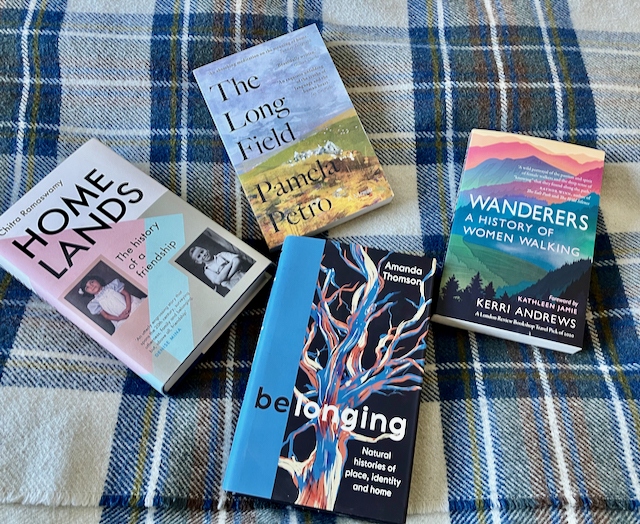
I’m a day late for International Women’s Day, but this collection of great books by wonderful women authors all offer thoughtful and enlightening perspectives on landscapes, belonging, and the nature of home and homelands. I was lucky enough to hear Chitra Ramaswamy, Kerri Andrews and Amanda Thomson read and discuss their work at Pitlochry Theatre’s Winter Words Festival last month, and I’ve been following the trajectory of Pamela Petro’s The Long Field since being published, with a new paperback edition just out.

Kerri’s entertaining, funny and at times, moving book, re-writes the canon on mountain literature, and the place of women writers within it, while Pamela Petro’s Long Field is a deep exploration of longing, language and identity. Amanda Thomson’s book weaves personal narratives of place and self through the forests of Abernethy, and Chitra Ramaswamy’s book is an exploration of borders and identities through a poignant and very moving account of her long standing friendship with two Holocaust survivors.

Each of these books explore place and identity in different ways, and speak to us at a time when both of these things are at the fore in the national and global narratives that are reshaping our world.

Great books by great women writers.

The Don: A Sacred River

“Ian Grosz takes the reader on a journey, often on foot, to the half-hidden spiritual locales of the Don. Replete with historical and archaeological resonance, his journey through road, trail, stream and field is an elemental dance of often elusive elements. Spiritual faith as a palimpsest of earth, rock, water and culture remains a central theme as he leads us through histories of Gaelic saints, Pictish stones, cairns and Aberdeenshire stone circles with their distinctive recumbent stone. Places of transformation and spirituality are never far away from the divine river. The ancient goddess endures in a looping and recursive movement that exists differently from linear formulations of time and space.”

Neil Curtis and Jo Jones, Introduction, Four Rivers, Deep Maps, pp. 21-22.

The book Four Rivers: Deep Maps was published by UWAP and had an official launch early in Nov. There will be a second launch in the UK in the first quarter of 2023. The book has a diverse range of creative and scholarly responses to the two regions of Perth, WA, and Aberdeenshire. My own contribution is reviewed here by Neil Curtis in the book’s introduction:

UK stockists may be available next year, but if that’s piqued your interest, you can order the book directly from the publishers. Click on the image to go direct to UWAP for this and their other titles.