
“We came in the afternoon to Slanes Castle, built upon the margin of the sea, so that the walls of one of the towers seem only a continuation of a perpendicular rock, the foot of which is beaten by the waves. To walk round the house seemed impracticable. From the windows the eye wanders over the sea that separates Scotland from Norway, and when the winds beat with violence must enjoy all the terrifick grandeur of the tempestuous ocean.I would not for my amusement wish for a storm; but as storms, whether wished or not, will sometimes happen, I may say, without violation of humanity, that I should willingly look out upon them from Slanes Castle.’
So mused Samuel Johnson who passed this way with his friend and travel companion, James Boswell, in the late summer of 1773 on their journey through Scotland to the Western Isles. Johnson’s account of the trip became the famous A Journey to the Western Islands of Scotland, later followed by Boswell’s The Journal of a Tour to the Hebrides, which brings the irascible Johnson joyfully to life. This being two-hundred-and-fifty-years since their passage through Aberdeenshire on their circuitous route westward, I felt compelled to visit the castle today.
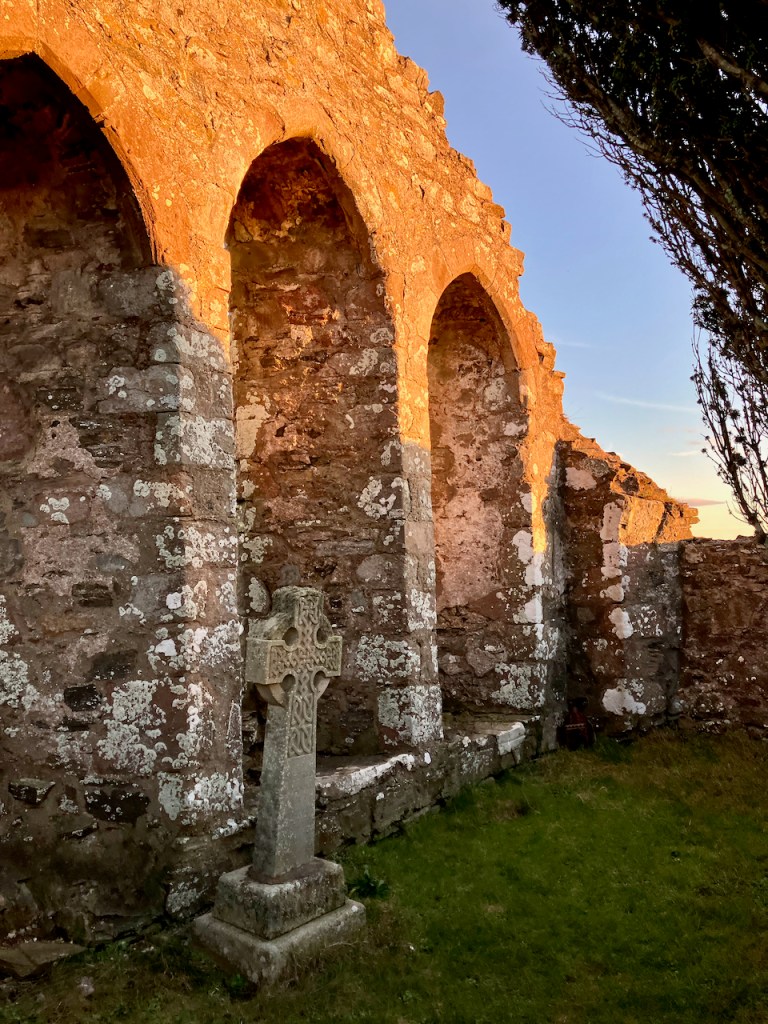
Johnson doesn’t mention staying there, the castle then under the care of the Count of Errol, but he and Boswell spent the night at Slains after an excursion along the coast. It must have been opulently appointed in its day, but it’s a bleak and desolate ruin overlooking the cliffs now, the wind rushing through its empty corridors and doorless openings straight off the sea.
‘I had a most elegant room,’ Boswell writes: ‘but there was a fire in it which blazed: and the sea, to which my windows looked, roared: and the pillows were made with the feathers of some sea-fowl, which had to me a disagreeable smell: so that, by all these causes, I was kept awake a good while.’
In his half-waking, fitful sleep, he imagines the ghost of Lord Kilmarnock who had married into the Erroll title and was beheaded on Tower Hill in 1746 for his part in the Jacobite uprising. Wandering around the castle’s old halls and passageways, I couldn’t help but think of what other ghosts it might be host to.
The original thirteenth-century castle, a fortress built by the Comyn family five miles further along the coast to the south, was forfeited after the Battle of Barra in 1308 to the Hay family after the defeat of the Earl of Buchan, John Comyn, whose troops scattered and fled from the battlefield when Bruce himself appeared waving his standard. The new castle was built in the sixteenth century by Francis Hay, the ninth Earl of Errol, and grew from its original tower house into a Baronial style mansion. At the time of Johnson and Boswell’s visit it was still in the title of the Erroll line, but was sold in 1916 by the twentieth earl, whose finances, following previous generations of lavish spending and an agricultural recession, couldn’t maintain the upkeep.
The castle is most famous today for hosting Bram Stoker in the early part of the twentieth century, who would holiday regularly in nearby Cruden Bay and was thought to have been inspired by its setting. It’s certainly dramatic, and with the tail end of Storm Agnes still bringing the spray up over the rocks and flinging the crows from the castle turrets, I spent some time watching the waves crashing into the cliffs from a window at the northern end of the ruins. I could almost feel Johnson’s breath on me. ‘Well, sir!’ he seemed to be saying. ‘What did I tell you?!’
Later, walking along the cliffs, I watched a solitary cormorant surfing the air between the waves, its dark aquiline shape momentarily vanishing behind crests in the swell. I wondered if it relished a storm, and whether Johnson’s ghost was watching too, looking out from one of the windows in the castle’s now empty rooms.

 Groundings