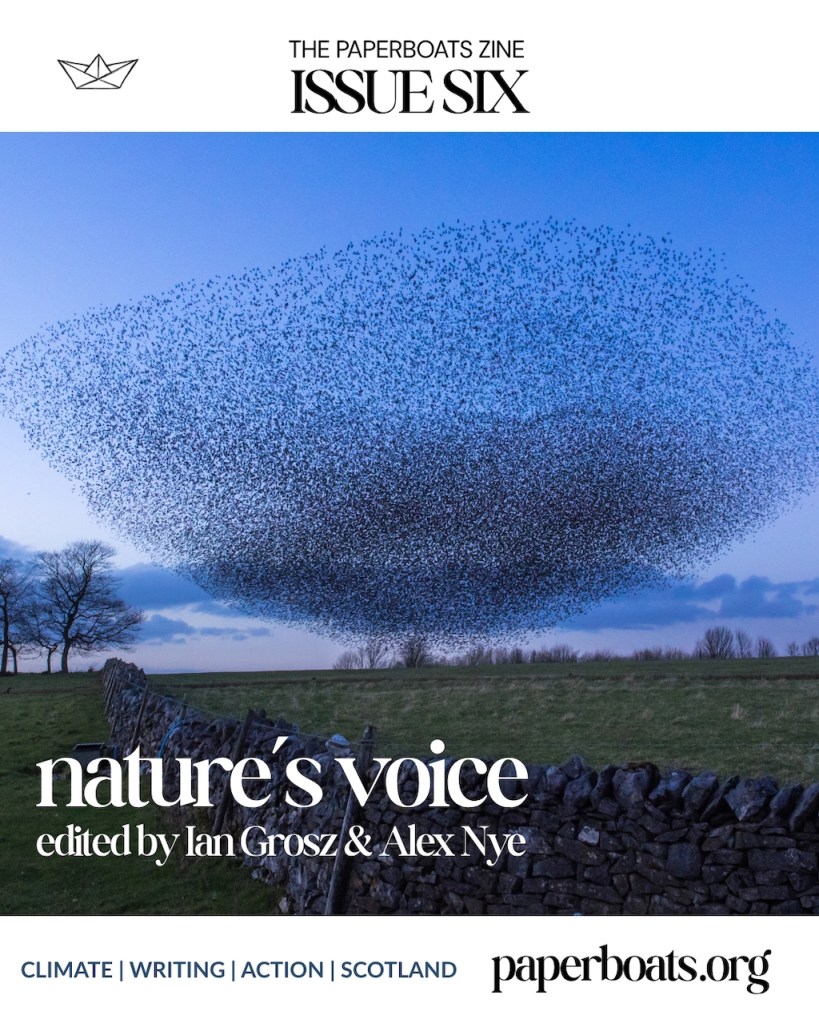
The issue incudes such a great range of thought-provoking writing by a diverse group of wonderful writers, all responding to the issue theme of ‘Nature’s Voice’ in inspiring and imaginative ways.
In poetry and prose, our contributors bear witness to the vulnerability of birds and other animals; the human impacts on climate and environment; hear the imagined song of trees; give voice to glaciers and storms, mosses and lichen. We learn of grass-roots efforts to respond to the threat of extinction, and we recognise the need to pause and to listen, to take note and act before it is too late.
We are particularly delighted to feature specially commissioned work by poet, artist and curator, Madhu Raghavendra, who was awarded the Charles Wallace Writing Fellowship at Stirling University in 2024.His opening poem ‘Orbit’ sets the scene and encapsulates the themes of this issue perfectly.
Please do grab a cuppa and enjoy a great read by going to the link below.
‘I was left breathless by the wind – and the view – and Lewis took on a suddenly different feel: an awe-inspiring island of sense and frightening clarity; a lost world of elements; a dreamed-of place caught between sea and sky.’
A new essay on The Clearing – Little Toller Books’ online journal of Nature, Landscape and Place.
‘Between Sea and Sky’ comes out of a research trip to Lewis back in 2022 and explores the changing land use on the islands. I met with a modern day crofter who, like many new generation crofters, is moving away from traditional crofting practices and using her land to plant native woodland instead of keeping livestock. She talked movingly about her experience relocating to and living on the islands, and of the deep connection she has found with the land.
I had a great stay on Lewis and wrote a lot about my time there – it was a homecoming of sorts – a return – having lived in Stornoway for a while back in the mid-noughties. It’s not an easy place to live, especially as an incomer, but it’s a place I keep going back to.
Thanks as ever to editor Jon Woolcott and to crofter Susanne Erbida for taking time to meet with me during my visit.
You can read the essay through the link below. I’d love to hear what you think of it.
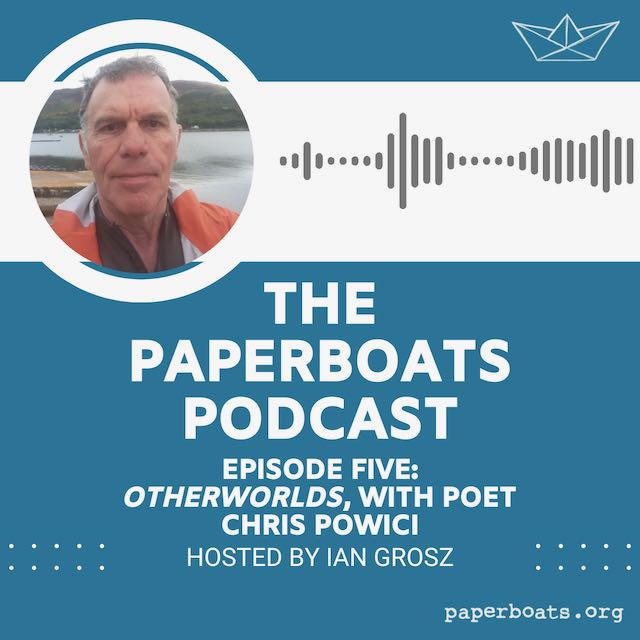
Episode 5 of the Paperboats Podcast features poet Chris Powici
Chris lives in Perthshire in Scotland. He taught creative writing for many years at the University of Stirling and the Open University, but is now focussed on his own writing as a poet and essayist. His work mostly explores the overlap between the human and natural worlds.
Chris is also co-editor of New Writing Scotland and one of the key people behind the formation of the Paperboats Writers collective. In this episode he talks about his involvement with Paperboats, his thoughts on the role of the writer in the climate and ecological emergency, and the importance of affirming the world around us through the ‘otherworlds’ of our imagination.
Chis reads ‘Night Fishing’ and ‘Deer’ from his first poetry collection, This Weight of Light (Red Squirrel Press, 2015) and ‘Loch Striven’ from Issue 1 of the Paperboats Zine. His latest poetry collection is Look, Breathe, published by Red Squirrel Press.
Shorelines are places of ambiguity and exchange – they connect land and sea, places with other places, often far beyond the horizon. They intermingle different zones, habitats, moods, elements, memories. Where does the sea end and the land begin? How do we relate to the shoreline? What does the shore say to us as we negotiate our lives?
I ran a workshop revolving around these themes with a group of writers based in Stonehaven on the Aberdeenshire coast at the weekend. The group is run by poet and short-story writer Alistair Lawrie, who invited me to come along. Alistair evokes place in his work through the use of Doric – a Scot’s dialect that is unique to the northeast of Scotland.
I was keen to draw on the particulars of place in the workshop by focussing on Stonehaven’s shoreline to highlight how it could be a launching point into wider themes, and to encourage new writing. We talked about form and process, and the value of close observation.
Observations can provide the raw material that we write from – the clay that we later mould into shape, and can be used to enrich the context of our work, whether through setting in a story, or enriching poetry and essay with concrete detail. This use of closely observed detail is something the anthropologist Clifford Geertz called ‘thick description’ as it pertained to its use in making field notes during research, but as writers, we can draw from the same principal.
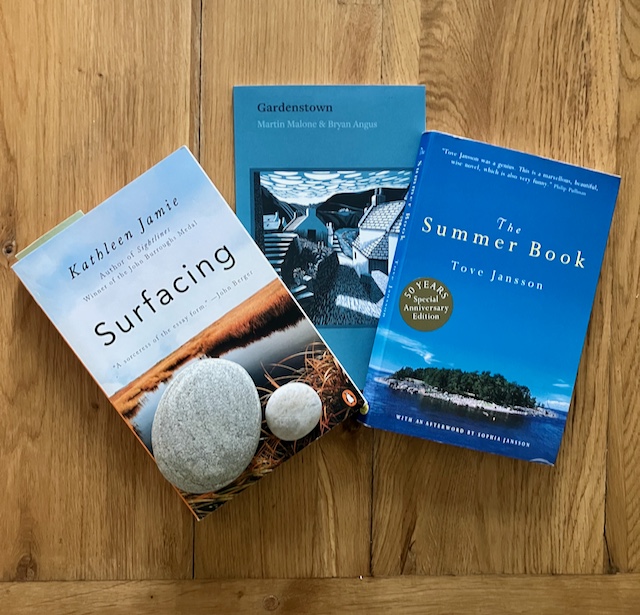
We looked at three pieces of writing that relate to the shoreline by writers who incorporate carefully and closely observed detail into their work, both with constraint and in celebration of a richly descriptive poetic form: Kathleen Jamie’s essay ‘Links of Notland’ in Surfacing, Martin Malone’s opening to his long poem sequence Gardenstown, and ‘The morning Swim’ in Tove Jannson’s The Summer Book.
If you haven’t read all these works yet, I can recommend them, both for how writers can use observation and place as a ‘way in’ to broader and more universal themes – whether that’s the idea of deep time in Kathleen Jamie’s narrative essay, Martin Malone’s exploration of climate change and ecological collapse in the quotidian details of his life in Gamrie, or the cycles of life and death in Jansson’s classic island tale told through the lens of a grandmother’s relationship with her granddaughter – and just as fantastic reads that should be read for simple pleasure alone. All of them ‘form’ favourites of mine, if you’ll excuse the pun…
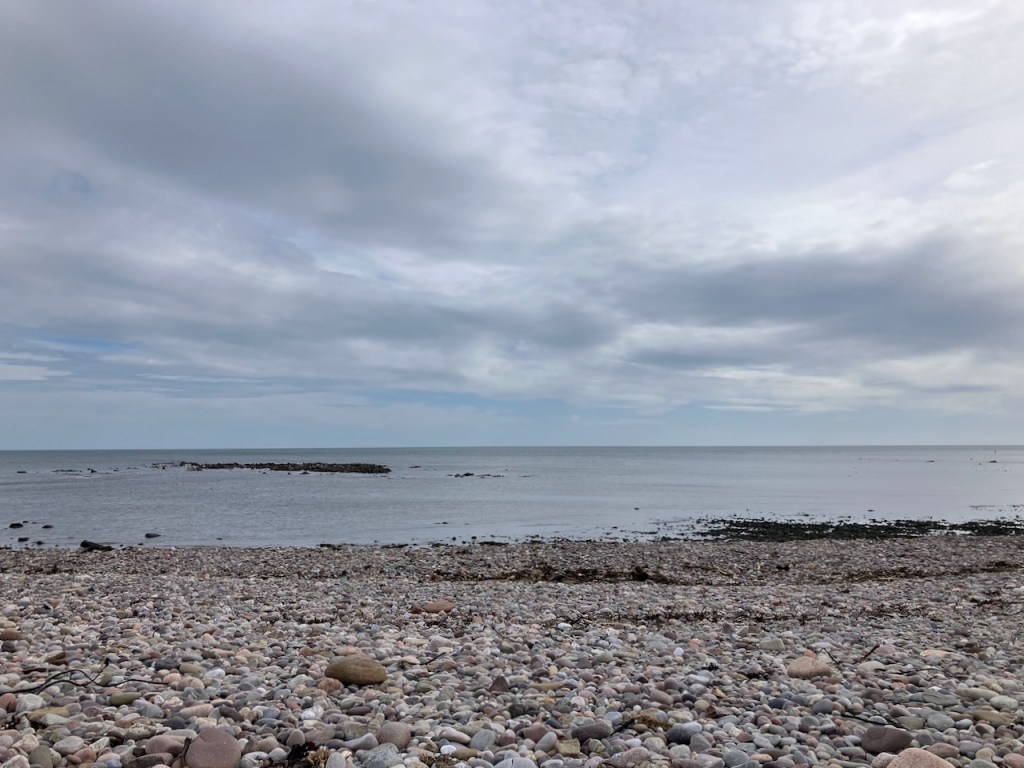
We took these pieces of writing as our starting point and then explored the shoreline. The tide was out and the rocks were exposed a little way offshore, the memory of waves retained in the undulations of the pebble beach, and the record of the winter storms still scattered in neat bands parallel to the shore. People found inspiration in the stones, in the time they held, in the hushing of the low waves and in the calmness and stillness and presence of the sea. They also found inspiration in the life of a busy beachfront on a mild Sunday afternoon: part of the long story of life here – endless, as one person remarked.
The time spent outside – observing, writing, noticing details – reflecting on what the shoreline might say to us – creating space to imagine that conversation – was very productive; and later, after we’d spent time writing and then had some soup, the range of responses were wonderful. They reflected the lives of each individual writer, and all of life, in those moments we had carved out for ourselves.
Writing is often seen as an activity confined to a desk and a chair carried out by a lone thinker in a room, but coming together as writers, taking time to notice the world around us in all its contradiction and rich detail, is sometimes the most fertile ground. Shorelines in particular are rich metaphors for a range of themes more human than we might at first imagine. Spending time there will always reward a writer with the patience to look closely, and in those smallest of details, we might find ourselves tackling surprisingly big questions.
For a fantastic read on noticing and writing that draws on the outdoors, see Linda Cracknell’s In The Moment: Writing Landscape(Saraband, 2023).
After the successful completion of the growth pilot earlier this year, and following a successful funding bid through Creative Scotland, Open Book Reading have announced that they can support all the groups that took part in the pilot, and so I’m delighted to be able to continue the work of the charity through leading a group in partnership with Live Life Aberdeenshire.
The wider community project runs from October this year to September next, and will consist of eight supported sessions exploring stories and poems and nurturing a supportive environment to try creative writing. We’ll also be visiting a literary festival together and fostering a sense of community through the shared enjoyment of literature and poetry.



 Groundings