A Time of Balance

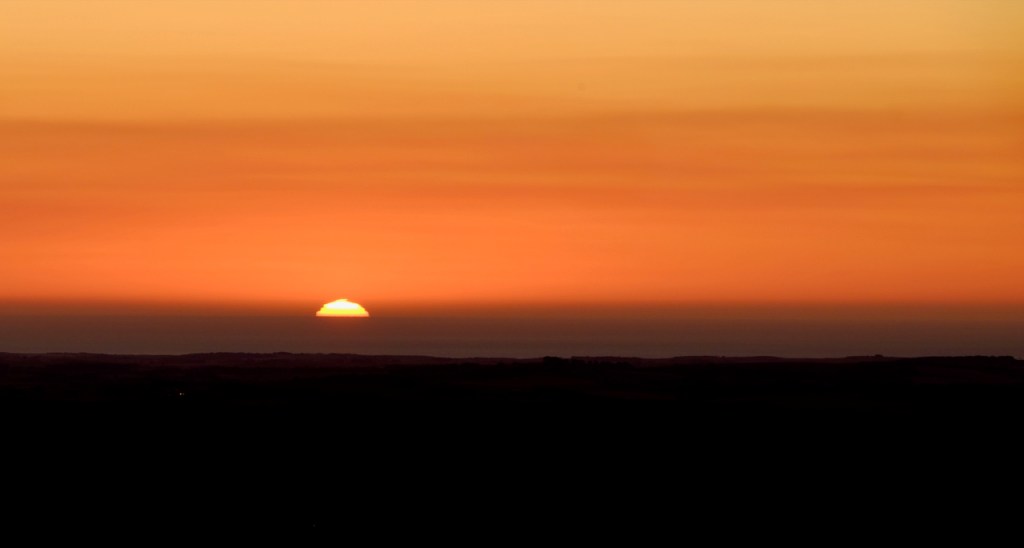
‘I set off an hour before sunrise. It is still dark: very dark, and I can see very little beyond the dim circle of light from my head torch. The thick scent of pine fills the air as I start up the trail. The presence of trees, melting into the darkness either side of me, are felt rather than seen; the still, almost-full harvest moon having disappeared into the cover of pine branches. A nervous glance behind reveals the comfort of a slowly brightening sky, suffused with faint orange and aquamarine banding toward the rim of an unseen eastern horizon. Amidst gaps in the canopy above, bright and brittle stars vanish and reappear. The tree cover opens a little and the moon’s glow pulls me upward.’

As the Autumn equinox approaches, here in the Northern Hemisphere, I am drawn back to our local hill and this moment from a couple of years ago when I climbed to one of its summits to witness the equinox sunrise. The short essay I wrote about it was published on The Clearing: Little Toller’s online journal of Nature, Landscape and Place. You can read the full piece here, or by clicking on the image above.

Traditionally marking the second harvest, a time to gather in the bounty of late summer signalled by the full moon, the Autumn equinox can also be a time of balance, of reset: a chance to take stock before the long slide into winter. Wishing you all a moment of balance as we begin our journey toward the darkness of the winter months.
Moving Forward

There’s a famous quote by Mark Twain. You know the one: 

“Twenty years from now, you will be more disappointed by the things you did not do than the things you did. So throw off the bowlines. Sail away from the safe harbor. Catch the trade winds in your sails. Explore. Dream. Discover.” 

This kept surfacing and resurfacing in my thoughts when, in 2017, I left my job to study anthropology and then creative writing. Six years on I have submitted my PhD thesis – a work of narrative nonfiction with commentary exploring how landscapes shape us, and what it might mean to belong. 

It’s not the PhD that counts, of course, but the journey to get there, for ‘it is better to travel hopefully than to arrive,’ as that other famous writer Robert Louis Stevenson told us. And it has been a journey – fraught with uncertainty and waymarked by personal crisis and self discovery. 

I’ve learned that we are many things, and that the narratives we write for ourselves can change unexpectedly – by both accident and design, and that who we thought we were is not set in stone, but a continual process of renewal and re-creation: a perpetual becoming framed by an evolving understanding. 

Places frame our lives – map out our histories and identities through the landscapes in which we live. The journey I’ve taken and the people I have spoken to have shown me that. We come to know self through place, through all the entanglements and histories that reach out into the wider world. 

I still face uncertainty and there will continue to be change: both driven and unexpected. I guess learning to embrace those things in life is part of what Mark Twain was getting at. 

The Moor, the Sea, the Sky

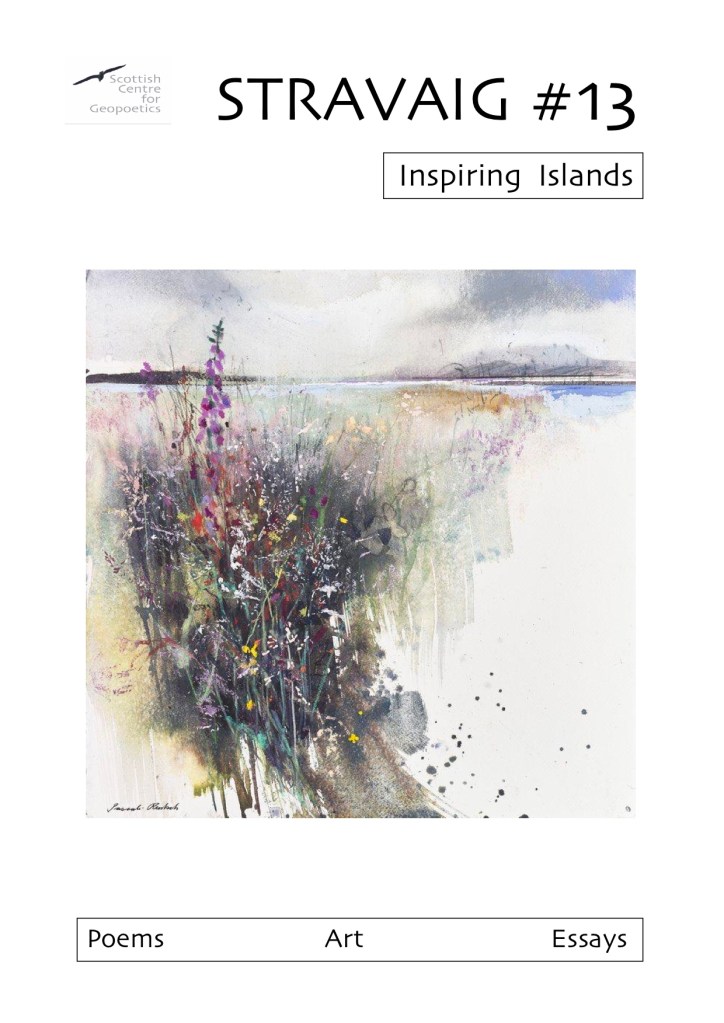
I’m delighted to have an essay included in the latest issue of Stravaig: an online journal for the Scottish Centre for Geopoetics.

Based on the thinking and writings of Kenneth White, the centre describes Geopoetics as being ‘deeply critical of Western thinking and practice over the last 2500 years and its separation of human beings from the rest of the natural world, and proposes instead that the universe is a potentially integral whole, and that the various domains into which knowledge has been separated can be unified by a poetics which places the planet Earth at the centre of experience.

It seeks a new or renewed sense of world, a sense of space, light and energy [and] also seeks to express that sensitive and intelligent contact with the world by means of a poetics i.e. a language drawn from a way of being which attempts to express reality in different ways e.g. oral expression, writing, visual arts, music, and in combinations of different art forms, sciences and thinking.’

Geopoetics is by nature, interdisciplinary, and engages with a broad range of practitioners in the arts and sciences, bringing ways of expressing the world together through both the journal and regular symposiums, seminars, workshops and retreats.

My essay ‘The Moor, the Sea, the Sky’ is a development of earlier work first featuring on Elsewhere: A Journal of Place in 2022, and comes out of my residency with Island Dark Room in the February of that year as part of my wider PhD research. It explores the moorland of Lewis both symbolically through the work of Lewis poet Iain Crichton Smith, and viscerally through my own experience in context with the thinking of anthropologist Tim Ingold.

You can read the essay by downloading Stravaig 13 here.

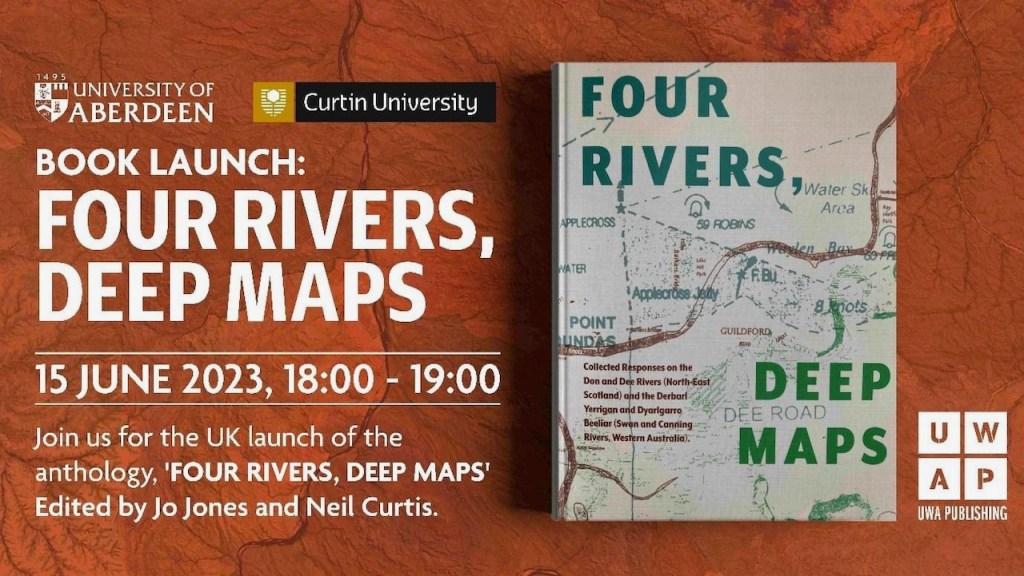
Four Rivers, Deep Maps UK Launch

After being published through UWAP in September 2022 and launched initially in Perth, WA, Four Rivers, Deep Maps comes to the UK with a launch event at the University of Aberdeen on Thursday 15th June in the Sir Duncan Rice Library. Click on the image above for details.

The cities – Perth, Australia, and Aberdeen, Scotland – have received relatively little attention as specific geographical–cultural locales. Often perceived as industrial, isolated and lacking romantic association, they nevertheless have rich historical, narrative and creative traditions that characterise interactions between humans and place, particularly along the length of the four rivers.

My own contribution charts the River Don from source to sea, uncovering its ancient sacred associations and exploring how they have shaped the geography and identity of the region through time.

All the contributions of this book are woven together through strands of deep mapping and ideas of place, history and inhabitation. Countercultures seem to return to specific place knowledge that predates industrialisation, whether in the traditional shapes of the Nyoongar knowledge of the Derbarl Yarrigan (Swan River) and Beeliar (Canning River) or the traditions and ancient patterns of Aberdeenshire: we come back to these profound knowledge systems that, in fact, never went away.

Copies of Four Rivers, Deep Maps are in stock at Blackwells and will be available to purchase on the night.

What I’m Reading

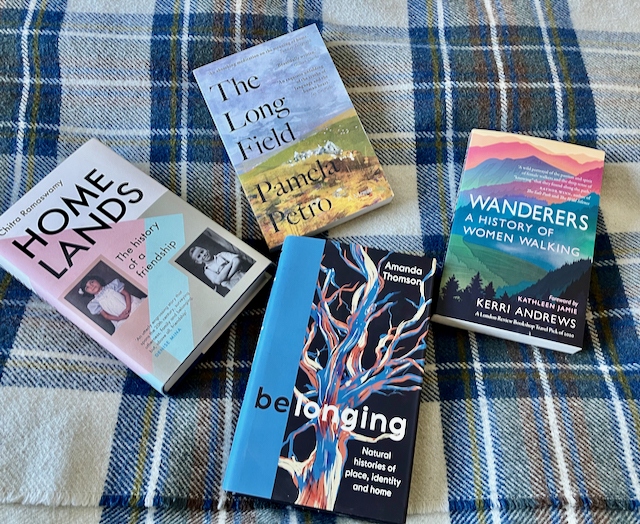
I’m a day late for International Women’s Day, but this collection of great books by wonderful women authors all offer thoughtful and enlightening perspectives on landscapes, belonging, and the nature of home and homelands. I was lucky enough to hear Chitra Ramaswamy, Kerri Andrews and Amanda Thomson read and discuss their work at Pitlochry Theatre’s Winter Words Festival last month, and I’ve been following the trajectory of Pamela Petro’s The Long Field since being published, with a new paperback edition just out.

Kerri’s entertaining, funny and at times, moving book, re-writes the canon on mountain literature, and the place of women writers within it, while Pamela Petro’s Long Field is a deep exploration of longing, language and identity. Amanda Thomson’s book weaves personal narratives of place and self through the forests of Abernethy, and Chitra Ramaswamy’s book is an exploration of borders and identities through a poignant and very moving account of her long standing friendship with two Holocaust survivors.

Each of these books explore place and identity in different ways, and speak to us at a time when both of these things are at the fore in the national and global narratives that are reshaping our world.

Great books by great women writers.