A Day for Nature

I was delighted to be a part of the Paperboats e-zine 2 launch which featured in the University of Stirling’s symposium ‘A Day for Nature’, organised by poet and Teaching Fellow Dr Chris Powici to celebrate, and advocate for, the natural world.

The event featured a panel of speakers including conservationists and Nature Writers Polly Puller and Tom Bowser of the Argaty Red Kites project, broadcaster and author Rebecca Smith, historian Dr Catherine Mills, and vice president of the university student Earth and Environment Society Ivet Stancheva. Each of the panelists gave fascinating talks about changes in the landscape over time from their different perspectives with a Q+A.

The Paperboats E-Zine is edited by Chris Powici and Kathleen Jamie and features work by writers from across Scotland and beyond concerned about our mounting ecological crises. The paperboats name and its inclusive, non-disruptive activism, has been inspired by Jamie’s poem written as Scottish Makar in response to the commitments of COP26, where, in the final verse, the poet speaks as the river Clyde.

“I heard the beautiful promises…
and, sure, I’m a river,
but I can take a side.
From this day, I’d rather keep afloat,
like wee folded paper boats,
the hopes of the young folk
chanting at my bank,
fear in their spring-bright eyes
so hear this:
          fail them, and I will rise.”

You can read the full poem here.

Despite the promises made, our politicians are failing us, and Paperboats aims to send a message on Thursday 23rd November 2023 by gathering outside the Scottish Parliament to deliver 1000 Paperboats, 1000 Climate Hopes, to demand that MSPs of all parties come together to deliver on their promises and a just transition to green energy.

The event will feature poetry from Kathleen Jamie and music from Karine Polwart.

To read the Paperboats E-Zine, go to Paperboats Writings.

Taking Notice

In our busy lives, bombarded as we are with news and media and the demands of life and work and family, we very rarely have space to notice the world around us, to pause and to take stock of the passage of time, the changing of the seasons and just where we’re at with ourselves. But writing can help us to do that. It helps us to take notice because it focuses our attention. Linda Cracknell writes: ‘The small weight of a notebook and pen in my pocket is my passport to feeling alive […] The act of writing causes us to refresh our tired ways of noticing.’*

Taking these thoughts as inspiration, I ran a workshop at a local visitor centre at the weekend, first exploring outdoors, encouraging close attention through the conscious use of all the senses and recording our experiences, before coming together in a collaborative space to share what we had seen and felt, writing a group poem with everyone’s input.

The workshop was as much about allowing ourselves that time and space to be, and to notice the world around us, as it was about creative writing; and that experience shared, brought a wonderful sense of connection: with the landscape, with both the past and the present, and with each other.

Paying attention – focussing on the world around us, how we experience it, in that mindful, conscious way – always has the power to connect us with others and a world outside of ourselves. It’s this sense of connection people attending felt the most, I think. It’s certainly what I took away from it, and it was great to see folk who were previously strangers coming together this way in just two short hours.

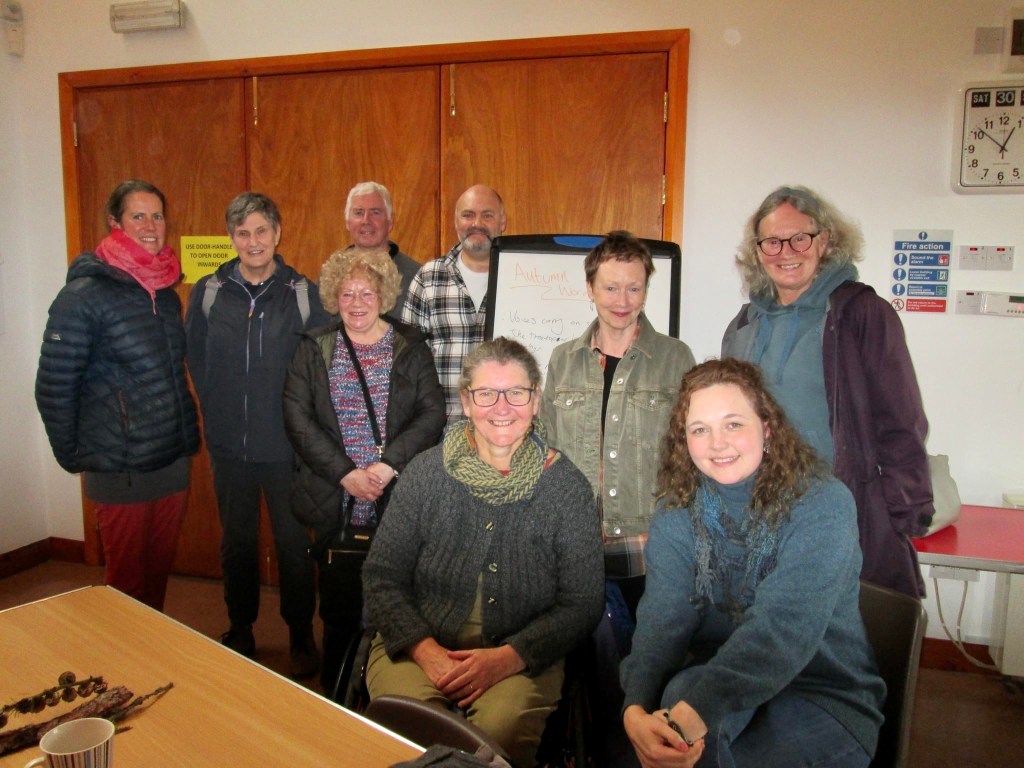
Attendees at the Autumn Words Creative Writing Workshop.

* Linda Cracknell, ‘Script and Scrape’, in Writing Landscape: Taking Note, Making Notes – In The Moment (Glasgow: Saraband, 2023), pp. 1-10, p.3.

A Time of Balance

‘I set off an hour before sunrise. It is still dark: very dark, and I can see very little beyond the dim circle of light from my head torch. The thick scent of pine fills the air as I start up the trail. The presence of trees, melting into the darkness either side of me, are felt rather than seen; the still, almost-full harvest moon having disappeared into the cover of pine branches. A nervous glance behind reveals the comfort of a slowly brightening sky, suffused with faint orange and aquamarine banding toward the rim of an unseen eastern horizon. Amidst gaps in the canopy above, bright and brittle stars vanish and reappear. The tree cover opens a little and the moon’s glow pulls me upward.’

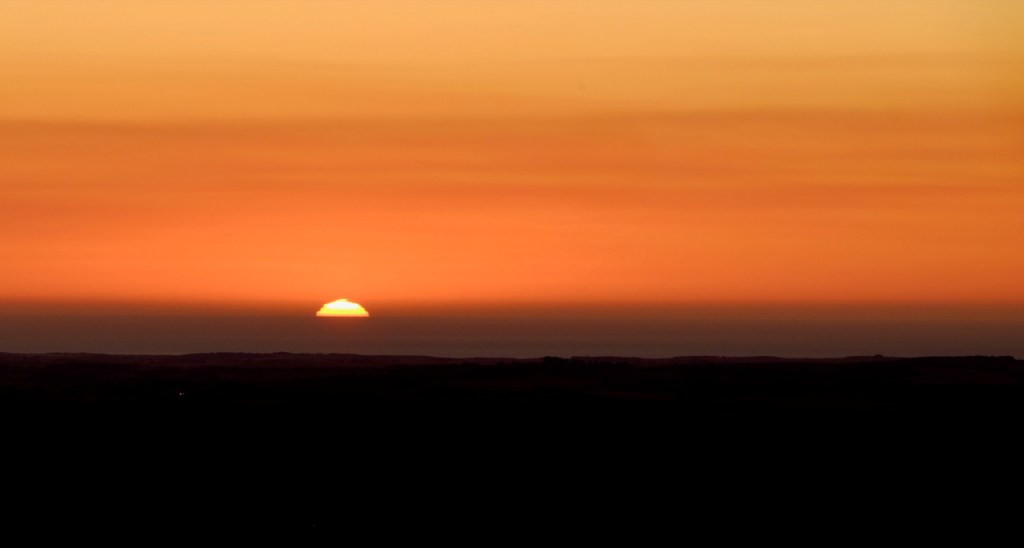
As the Autumn equinox approaches, here in the Northern Hemisphere, I am drawn back to our local hill and this moment from a couple of years ago when I climbed to one of its summits to witness the equinox sunrise. The short essay I wrote about it was published on The Clearing: Little Toller’s online journal of Nature, Landscape and Place. You can read the full piece here, or by clicking on the image above.

Traditionally marking the second harvest, a time to gather in the bounty of late summer signalled by the full moon, the Autumn equinox can also be a time of balance, of reset: a chance to take stock before the long slide into winter. Wishing you all a moment of balance as we begin our journey toward the darkness of the winter months.

Sacred Mountain


‘I become only breath; movement; the sound of my feet crunching along the trail, vaguely aware of the dawn chasing behind me.’

Along with Elsewhere: A Journal of Place, a publication that I have followed and admired for a long time is The Clearing edited by Jon Woolcott of Little Toller Books, an online journal of nature, landscape and place and a natural home for my interests, so I’m really pleased to have a piece feature.

‘Sacred Mountain’ takes the reader on a walk to the summit of an iconic hill that defines my local landscape to watch the Autumn Equinox sunrise, exploring notions of the sacred and what it might mean to us. You can read ‘Sacred Mountain’ HERE.