If you’re not familiar with Paperboats Writers, they’re a fantastic group of writers working across Scotland (and beyond) to highlight the impacts of climate change, the ecological collapse we’re all witness to, and the things we can do to help bring about positive change.
In each episode I meet with a different writer from the Paperboats collective. We discuss their work, and the issues they write about.
We hear Scotland’s Makar Kathleen Jamie (National Poet for Scotland 2021 – 2024) read her inspirational poem ‘What the Clyde Said, After Cop 26’, discuss the formation of Paperboats Writers, the importance of a Just Transition, and the work of Global Justice Now and the Scottish Rewilding Alliance.
In upcoming episodes I’ll be talking with author Linda Cracknell about the Flow Country and her book Doubling Back, and with Nature Writer and photographer Polly Pullar about the plight of the gannet and Polly’s life-long relationship with wildlife.
Many more fantastic Nature Writers to feature in the coming months, so I hope you’ll give it a listen, and follow and subscribe to keep up with future episodes.
Shorelines are places of ambiguity and exchange – they connect land and sea, places with other places, often far beyond the horizon. They intermingle different zones, habitats, moods, elements, memories. Where does the sea end and the land begin? How do we relate to the shoreline? What does the shore say to us as we negotiate our lives?
I ran a workshop revolving around these themes with a group of writers based in Stonehaven on the Aberdeenshire coast at the weekend. The group is run by poet and short-story writer Alistair Lawrie, who invited me to come along. Alistair evokes place in his work through the use of Doric – a Scot’s dialect that is unique to the northeast of Scotland.
I was keen to draw on the particulars of place in the workshop by focussing on Stonehaven’s shoreline to highlight how it could be a launching point into wider themes, and to encourage new writing. We talked about form and process, and the value of close observation.
Observations can provide the raw material that we write from – the clay that we later mould into shape, and can be used to enrich the context of our work, whether through setting in a story, or enriching poetry and essay with concrete detail. This use of closely observed detail is something the anthropologist Clifford Geertz called ‘thick description’ as it pertained to its use in making field notes during research, but as writers, we can draw from the same principal.
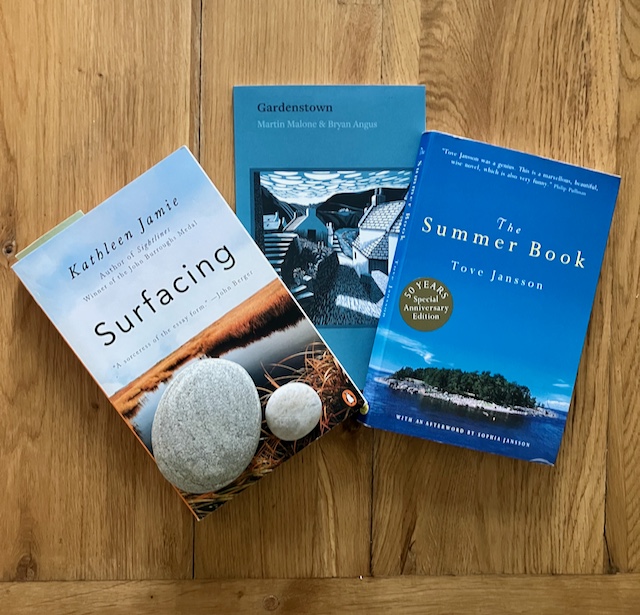
We looked at three pieces of writing that relate to the shoreline by writers who incorporate carefully and closely observed detail into their work, both with constraint and in celebration of a richly descriptive poetic form: Kathleen Jamie’s essay ‘Links of Notland’ in Surfacing, Martin Malone’s opening to his long poem sequence Gardenstown, and ‘The morning Swim’ in Tove Jannson’s The Summer Book.
If you haven’t read all these works yet, I can recommend them, both for how writers can use observation and place as a ‘way in’ to broader and more universal themes – whether that’s the idea of deep time in Kathleen Jamie’s narrative essay, Martin Malone’s exploration of climate change and ecological collapse in the quotidian details of his life in Gamrie, or the cycles of life and death in Jansson’s classic island tale told through the lens of a grandmother’s relationship with her granddaughter – and just as fantastic reads that should be read for simple pleasure alone. All of them ‘form’ favourites of mine, if you’ll excuse the pun…
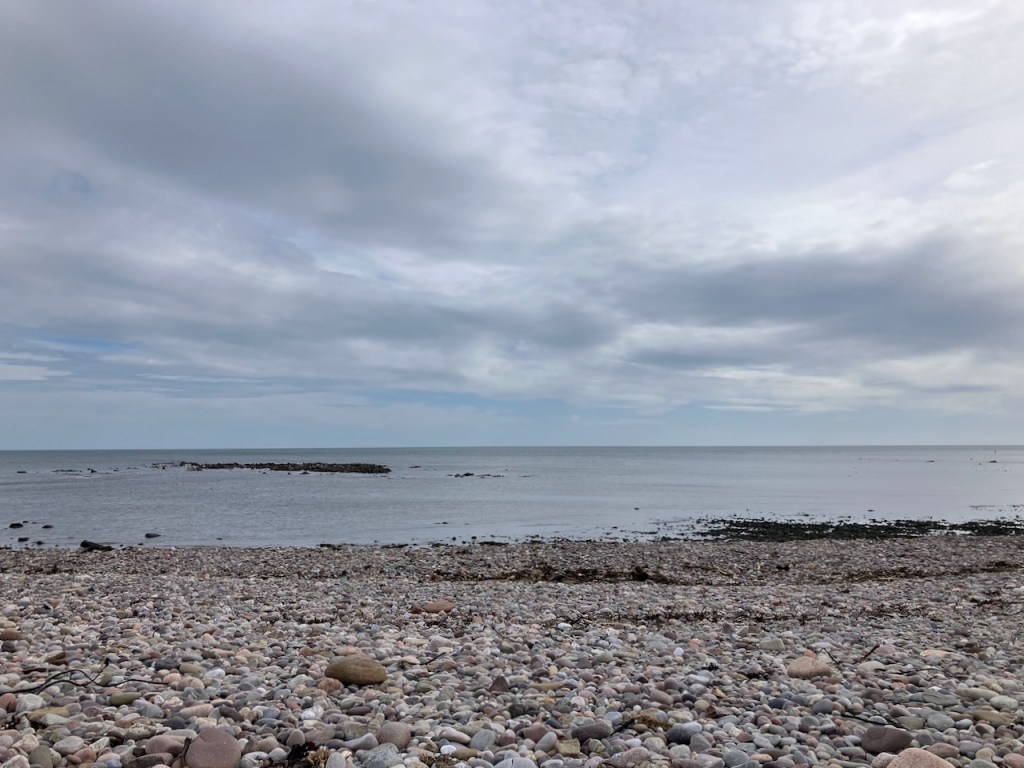
We took these pieces of writing as our starting point and then explored the shoreline. The tide was out and the rocks were exposed a little way offshore, the memory of waves retained in the undulations of the pebble beach, and the record of the winter storms still scattered in neat bands parallel to the shore. People found inspiration in the stones, in the time they held, in the hushing of the low waves and in the calmness and stillness and presence of the sea. They also found inspiration in the life of a busy beachfront on a mild Sunday afternoon: part of the long story of life here – endless, as one person remarked.
The time spent outside – observing, writing, noticing details – reflecting on what the shoreline might say to us – creating space to imagine that conversation – was very productive; and later, after we’d spent time writing and then had some soup, the range of responses were wonderful. They reflected the lives of each individual writer, and all of life, in those moments we had carved out for ourselves.
Writing is often seen as an activity confined to a desk and a chair carried out by a lone thinker in a room, but coming together as writers, taking time to notice the world around us in all its contradiction and rich detail, is sometimes the most fertile ground. Shorelines in particular are rich metaphors for a range of themes more human than we might at first imagine. Spending time there will always reward a writer with the patience to look closely, and in those smallest of details, we might find ourselves tackling surprisingly big questions.
For a fantastic read on noticing and writing that draws on the outdoors, see Linda Cracknell’s In The Moment: Writing Landscape(Saraband, 2023).
‘I bend down and trace the outline of each foot in the cool, hardened silt. I can feel the definite impression of the man’s big toe and a ridge of sand that had been pulled up under the ball of the foot as the toes gripped the surface and he pushed his weight forward with each stride. I can feel the outline of the woman’s heel: the rounded edge and then forward into the arch.
“So how old are these prints, again?” I ask.
“About six-thousand years old,” Burns tells me. “Just in that transition between the Mesolithic and the Neolithic.”‘
From ‘Traces’ Archipelago 2.3 edited by Andrew McNeillie and James Macdonald Lockhart, published by The Clutag Press (2024), pp. 107-115.
To say I’m pleased to have writing in these pages is an understatement. I’ve been following Archipelago for years and to be in it is, well, something. All issues of the journal get archived in the Bodleian Library in Oxford so I could be sitting hidden on a library shelf for many more years, yet…
’Traces’ explores the Mesolithic landscapes of the Sefton coast with archaeologist Dr Alison Burns. We search for prehistoric footprints found in fossilised beds of ancient mud along Formby beach, reconstruct the landscapes and lives of the Mesolithic past, and consider the implications of modern day sea level rise.
Also in these pages:
Nicholas Allen, Alex Boyd, Julie Brook, John Bryant, Moyà Cannon, George Chamier, Claire Connolly, Tony Crowley, Gerald Dawe, Tim Ecott, Nick Groom, Kirsty Gunn, Andrew Hadfield, Howell Harris, Ben Keatinge, Angela Leighton, James Macdonald-Lockhart, Edna Longley, Michael Longley, Jamie McKendrick, Garry MacKenzie, Angus Macmillan, Robert Minhinnick, Heather O’Donoghue, Judy O’Kane, John Purser, Alan Riach, Fiona Stafford, Michael Viney, David Wheatley and Lyn Youngson.
As the western calendar year comes to a close, it’s a natural time to look back and reflect on the previous twelve months. It’s been a significant year for me on a personal level. I turned fifty early in the second quarter of 2023 – a significant event for anybody – and I successfully defended my PhD thesis early in November, which marked the culmination of a long process of research, writing and reflection that helped answer questions that have occupied my thoughts for many years: questions of place, of identity, of how the landscape shapes our lives.
I have been able to explore these questions both creatively and academically, and the submission and accession of my thesis – comprised of a book-length work of creative nonfiction alongside a critical commentary – closes a significant period in my life whilst opening up another. The time spent working toward the PhD signifies a period of deep change and transition: from a former life as a helicopter pilot largely servicing the offshore oil and gas industry toward a new life that places my feet firmly on the ground, encompassing and embracing community and working in a way that is less certain but offers more freedom and is more in line with my values and the aspirations I have now.
This year has been one where I’ve seen hard work begin to pay off and a future direction begin to take shape, replacing the uncertainty that came with the end of a career and dominated my life as I embarked on doctoral study in the midst of a pandemic. It is a year that leaves me feeling hopeful and positive as I go forward, despite all the world-changing events that this same period has also been witness to.
As a writer, I have seen some of my writing find a home with Stravaig, Hinterlandnonfictionmagazine and, this coming spring, one of the chapters from my PhD will be published in Archipelago, a literary journal I have long admired. I’m pleased that my approach to questions of place will also feature in an anthology of academic writing through the University of Eichstätt-Ingolstadt’s Practicing PlaceCentre, due for publication in 2024. I was also very happy to have had writing published in the PaperboatsZine, for which I took part in a launchevent at the University of Stirling.
Beyond my own writing, in September I ran an outdoorcreativewriting workshop, helping people engage with their surroundings and fostering a sense of togetherness. Earlier in the year I became involved with the charity OpenBook, running a pilot creative writing group over the spring and summer that has become an established, monthly group as part of Open Book’s Scotland-wide Community Project. Seeing people develop in confidence and find their own voice in a supportive group setting is something that is hugely rewarding and I look forward now to taking the group – just one of many Open Book groups across the country – into 2024.
As I head into the New Year I will also embark on a significant community engagement project, working in collaboration and consultation on commission to explore how people feel about where they live and documenting community story and memory. It’s a role I hope will expand and flourish through 2024 and beyond.
What can we do but go forward? Uncertainty and change will always run side by side with our lives. 2023 has shown me that, on a personal level at least, positive change is possible, and that, if change is needed, it is worth living with the uncertainty that comes with not knowing what the outcomes might be. Despite the fears, taking those first steps toward an uncertain future is important. The change that you walk toward, the change that you need, will find you.
‘I try to imagine being stuffed into the cages shoulder-to-shoulder with a crowd of men in a duplicate cage above, the rock face racing by inches beyond the open frame as we descend into the mine, leaving the world of light and fresh air behind for a seven-hour shift over half a kilometre underground.’
‘From the Ground, Light’, Hinterland Issue 14, pp. 90-109, p.96.
As COP 28 comes to a close I’m proud to be among the contributors of Hinterland 14 – a climate writing special with wonderful cover art by Nature and Wildlife photographer Tashi R. Ghale, guest edited by Iona Macduff and featuring an interview with author of Marginlands Arita Kumar-Rao.
From the editors:
“Climate change has become a constant presence in our lives, and increasingly inflects our writing. Yet, actively writing about climate change is not easy. The contributors of this Climate Writing special issue have risen to the challenge, whether it’s writing about forest fires in New Mexico, frogs in Australia, rivers in Manchester, or the effects of human activity and the Anthropocene.”
My own contribution ‘From the Ground, Light’ explores the mining heritage of my hometown through the re-landscaped mining grounds of Sutton Manor Colliery and the experiences of a former miner. It reflects on our complex relationships with the landscape and the heritage of our industrial past, but also on the impacts of climate change, our ongoing reliance on fossil fuels, and our failure to transition to green energy.
Also featuring work from Alison Baxter, Joe Fenn, Tamsin Grainger, David Howe, Rita Issa, Clara Kubler, Wendy Johnson, Iona Macduff, Meg Mooney, Millie Prosser and Joe Shute, with photography by Tashie R. Ghale




 Groundings