Nature’s Voice

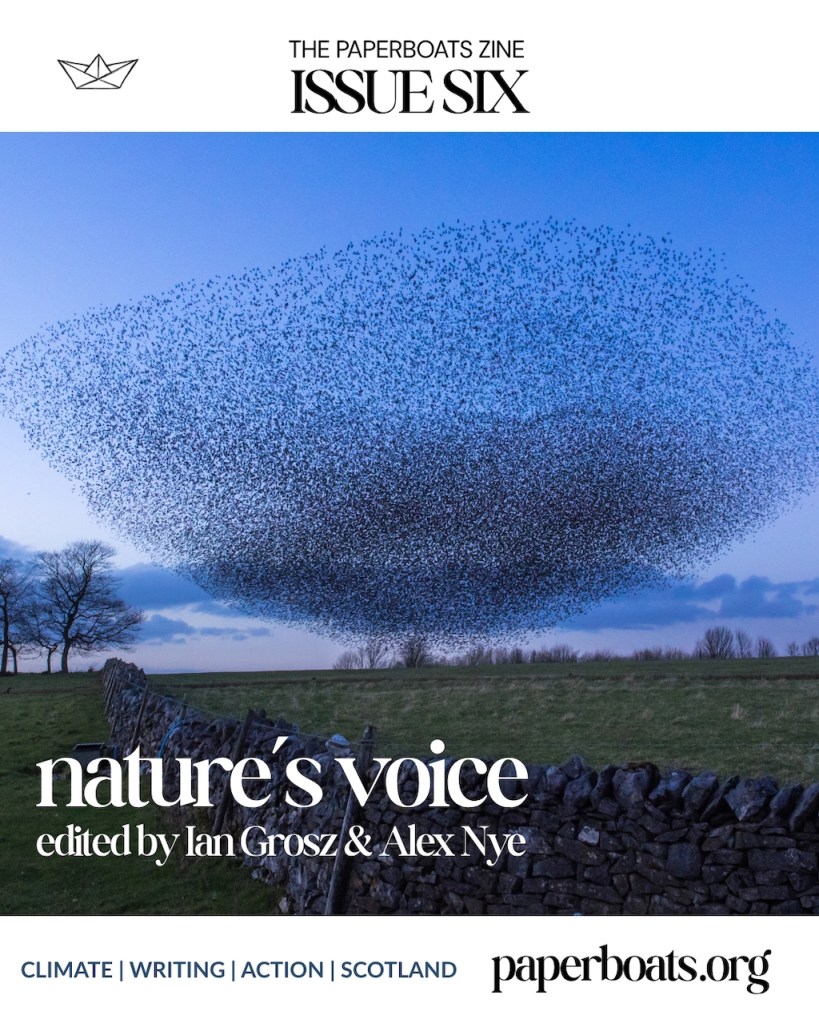
I’m very proud to have co-edited Issue 6 of the Paperboats Writers E-Zine alongside Alex Nye.

The issue incudes such a great range of thought-provoking writing by a diverse group of wonderful writers, all responding to the issue theme of ‘Nature’s Voice’ in inspiring and imaginative ways. 

In poetry and prose, our contributors bear witness to the vulnerability of birds and other animals; the human impacts on climate and environment; hear the imagined song of trees; give voice to glaciers and storms, mosses and lichen. We learn of grass-roots efforts to respond to the threat of extinction, and we recognise the need to pause and to listen, to take note and act before it is too late.

We are particularly delighted to feature specially commissioned work by poet, artist and curator, Madhu Raghavendra, who was awarded the Charles Wallace Writing Fellowship at Stirling University in 2024.His opening poem ‘Orbit’ sets the scene and encapsulates the themes of this issue perfectly.

Please do grab a cuppa and enjoy a great read by going to the link below.
Nature’s Voice

Nature’s Voice

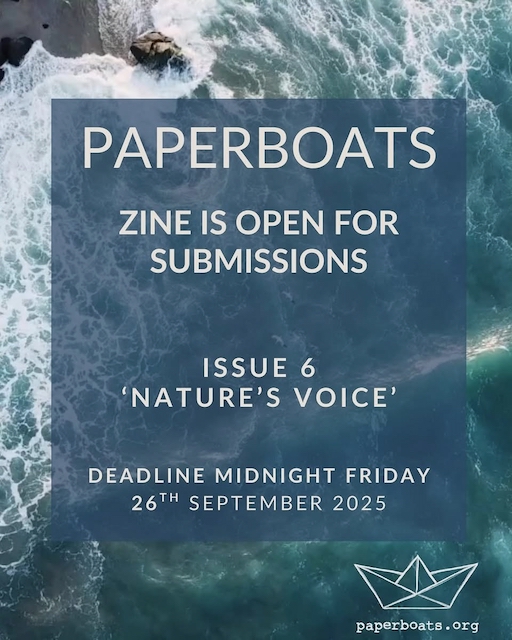
I’m proud to be co-editing the next issue of the Paperboats Writers e-zine with author Alex Nye, on the theme of Nature’s Voice.

The zine has featured some fantastic writers over each of the five issues that precede this one – both long-established, well known writers and emerging talent, and we hope to be able to continue to bring this diverse range of voices with our call to speak from the perspective of the more-than-human world at this time of climate and ecological breakdown.

Keep a look out for Issue 6, due out in late autumn 2025. In the meantime, you can catch up on each of the other five, fantastic issues, with the link below.

Paperboats Zine.

New Essay Published on THE CLEARING

‘I was left breathless by the wind – and the view – and Lewis took on a suddenly different feel: an awe-inspiring island of sense and frightening clarity; a lost world of elements; a dreamed-of place caught between sea and sky.’

A new essay on The Clearing – Little Toller Books’ online journal of Nature, Landscape and Place. 

‘Between Sea and Sky’ comes out of a research trip to Lewis back in 2022 and explores the changing land use on the islands. I met with a modern day crofter who, like many new generation crofters, is moving away from traditional crofting practices and using her land to plant native woodland instead of keeping livestock. She talked movingly about her experience relocating to and living on the islands, and of the deep connection she has found with the land. 

I had a great stay on Lewis and wrote a lot about my time there – it was a homecoming of sorts – a return – having lived in Stornoway for a while back in the mid-noughties. It’s not an easy place to live, especially as an incomer, but it’s a place I keep going back to. 

Thanks as ever to editor Jon Woolcott and to crofter Susanne Erbida for taking time to meet with me during my visit.

You can read the essay through the link below. I’d love to hear what you think of it.

Between Sea and Sky

elm is me and I am elm

“Where do the trees end and I begin? Where is the boundary between tree, roots, soil, air, my breathing and thinking and being? It is not just a hippy idea of ‘oneness’, this, a flaky new age folksy feeling that yes, we are all connected, but an intellectual, phenomenological and objective reality. Everything really is whole within the multitudinous, messy complexity of everything.”

An extract from my essay ‘elm is me and I am elm’ in the Paperboats Zine, Issue 5, released for Earth Day 2025.

The essay explores our deep entanglements with Nature through the presence, folklore and mythology of the wych elm, and reconsiders the false boundaries between the human and non-human worlds. It goes on to ask how we might incorporate the interrelationships we have with Nature in our thinking and planning, bringing in ideas found in ecology and more radical urban design.

I first wrote about the wych elm here on Elsewhere: A Journal of Place.

Issue 5 of the Paperboats Zine as a whole is on the theme of ‘Our Power – Our Planet’ and is edited by Polly Pullar and Linda Cracknell.

‘Power is addressed in the repercussions of our energy choices, but also in humans working together for common good and in sometimes relinquishing control so other species and habitats can flourish.’

The editors, Paperboats Zine Issue 5.

There is a fantastic range of writing in this issue, by some wonderful writers, with words from:

Margaret Elphinstone, Jonathan Clark, Hayli McClain, Charlie Gracie, Rebecca Stonehill, Anthony McCluskey, Lesley Harrison, Aidan Semmens, Victoria NicIomhair, Donald S Murray, Iona Macduff, Jeff Skinner, Craig Dobson, Angela Gilchrist, Joshua Adam Walker, Owen Gallagher, Kat Hill, Chris Cottom & Sarah Wallis.

Head to Paperboats.org/zine to read this and previous issues.

The Lithic Gathering

Shifting Temporalities and Mythologies of Ritual Stone Structures

Anyone vaguely familiar with my writing and work will have correctly guessed that I have more than a passing interest in stone circles, and more widely, our ancient sacred connections to the landscape. So, it might come as no surprise to learn that I’m more than a little excited to be presenting at the upcoming Lithic Gathering Symposium at Manchester Metropolitan University next month.

The symposium is organised by The Stones Project, part of MMU’s Visual Culture research group. The research collective examines how ‘we represent and experience ancient and modern British and Irish standing stones and ritual stone structures in their contemporary contexts, through a sensory and embodied research approach.’

The symposium gathers scholars and artists responding to standing stones in various ways, with presentations that explore how ‘these structures – and/or the materiality of the stone/the lithic itself – merges, redefines or shifts historical and mythological narratives in relation to their manifestations within global visual cultures and artistic practices.’

(The Stones Project, 2025)

My own presentation is based around a paper stemming from my PhD by practice research and an extended visit to Lewis in 2022.

‘This is Our Place: Narrative and Interpretation at the Callanish Standing Stones’ explores the various competing narratives and interpretations that surround the stones, touching on archaeology, folklore, literature and mythology. It argues that the stones represent a model of cosmological belief as well as a symbol of local identity, highlighting the relationships between the monument, the lunar standstill, the surrounding landscape and the use and significance of quartz in the monument’s design.

Tickets for the event, and a full programme of speakers and presentations can be found at the eventbrite link below:

The Lithic Gathering