“Staying still, I close my eyes and listen. I am filled by the moor’s presence: the sound of the burn at the side of the road; the faint calls of birds, unseen in the heather; the icy cold breath of the wind on my neck. A deep sense of peace comes to me. I feel held within the moor’s ever-changing, ever-present elements, its blossoming and its constant renewal: just one of countless life-processes.”
Ian Grosz, from ‘The Moor, the Sea, the Sky’, Sravaig 13, pp.30-33, p.33.
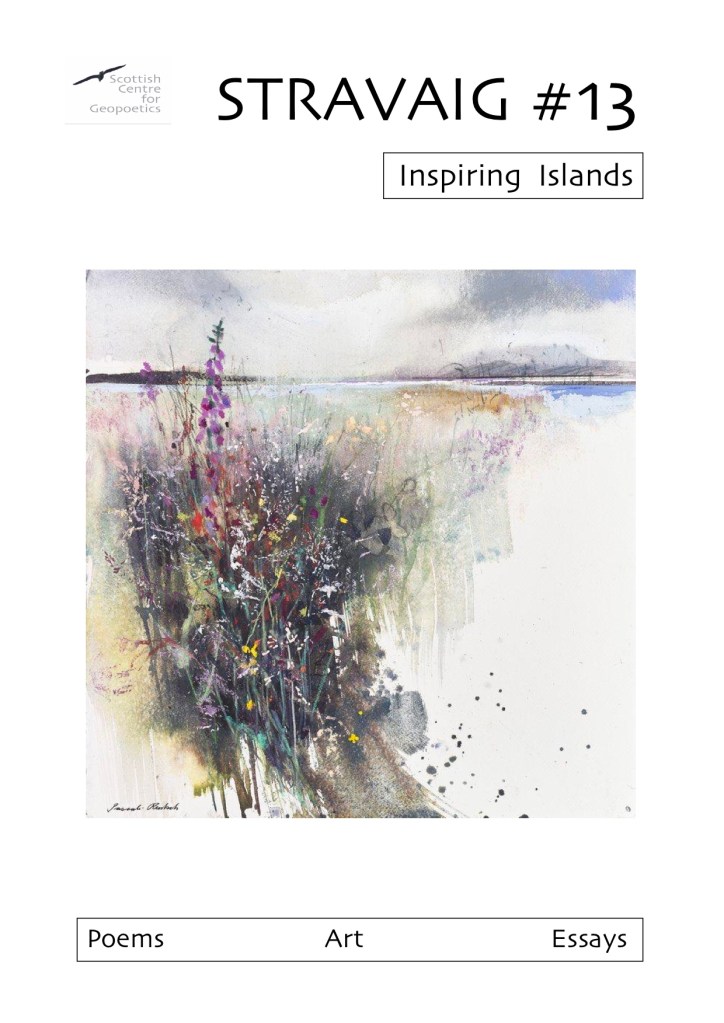
I’m looking forward to reading from my short essay ‘The Moor, the Sea, the Sky’ this evening, published in Stravaig 13 in the summer. Stravaig is the journal of the Scottish Centre for Geopoetics which draws on the writings and philosophy of Kenneth White to bring together a diverse range of writers, artists, academics, ecologists and earth scientists to explore how Geopoetics can be applied to our lives and our approach to the Earth as home.
My essay explores Lewis’s moorland landscape and my place within it on a return visit to the Western Isles in 2022 after an absence of fifteen years. It is a much-abridged extract of a chapter from a book-length work of narrative non-fiction exploring how landscapes shape a sense of place and identity, for which I am now seeking a publisher. I’ll be reading a short extract from the essay alongside the other contributors of this special Islands issue of the journal.
Click here for a link to join the event and on the image above to read Stravaig 13.
“We came in the afternoon to Slanes Castle, built upon the margin of the sea, so that the walls of one of the towers seem only a continuation of a perpendicular rock, the foot of which is beaten by the waves. To walk round the house seemed impracticable. From the windows the eye wanders over the sea that separates Scotland from Norway, and when the winds beat with violence must enjoy all the terrifick grandeur of the tempestuous ocean.I would not for my amusement wish for a storm; but as storms, whether wished or not, will sometimes happen, I may say, without violation of humanity, that I should willingly look out upon them from Slanes Castle.’
So mused Samuel Johnson who passed this way with his friend and travel companion, James Boswell, in the late summer of 1773 on their journey through Scotland to the Western Isles. Johnson’s account of the trip became the famous A Journey to the Western Islands of Scotland, later followed by Boswell’s The Journal of a Tour to the Hebrides, which brings the irascible Johnson joyfully to life. This being two-hundred-and-fifty-years since their passage through Aberdeenshire on their circuitous route westward, I felt compelled to visit the castle today.
Johnson doesn’t mention staying there, the castle then under the care of the Count of Errol, but he and Boswell spent the night at Slains after an excursion along the coast. It must have been opulently appointed in its day, but it’s a bleak and desolate ruin overlooking the cliffs now, the wind rushing through its empty corridors and doorless openings straight off the sea.
‘I had a most elegant room,’ Boswell writes: ‘but there was a fire in it which blazed: and the sea, to which my windows looked, roared: and the pillows were made with the feathers of some sea-fowl, which had to me a disagreeable smell: so that, by all these causes, I was kept awake a good while.’
In his half-waking, fitful sleep, he imagines the ghost of Lord Kilmarnock who had married into the Erroll title and was beheaded on Tower Hill in 1746 for his part in the Jacobite uprising. Wandering around the castle’s old halls and passageways, I couldn’t help but think of what other ghosts it might be host to.
The original thirteenth-century castle, a fortress built by the Comyn family five miles further along the coast to the south, was forfeited after the Battle of Barra in 1308 to the Hay family after the defeat of the Earl of Buchan, John Comyn, whose troops scattered and fled from the battlefield when Bruce himself appeared waving his standard. The new castle was built in the sixteenth century by Francis Hay, the ninth Earl of Errol, and grew from its original tower house into a Baronial style mansion. At the time of Johnson and Boswell’s visit it was still in the title of the Erroll line, but was sold in 1916 by the twentieth earl, whose finances, following previous generations of lavish spending and an agricultural recession, couldn’t maintain the upkeep.
The castle is most famous today for hosting Bram Stoker in the early part of the twentieth century, who would holiday regularly in nearby Cruden Bay and was thought to have been inspired by its setting. It’s certainly dramatic, and with the tail end of Storm Agnes still bringing the spray up over the rocks and flinging the crows from the castle turrets, I spent some time watching the waves crashing into the cliffs from a window at the northern end of the ruins. I could almost feel Johnson’s breath on me. ‘Well, sir!’ he seemed to be saying. ‘What did I tell you?!’
Later, walking along the cliffs, I watched a solitary cormorant surfing the air between the waves, its dark aquiline shape momentarily vanishing behind crests in the swell. I wondered if it relished a storm, and whether Johnson’s ghost was watching too, looking out from one of the windows in the castle’s now empty rooms.
Based on the thinking and writings of Kenneth White, the centre describes Geopoetics as being ‘deeply critical of Western thinking and practice over the last 2500 years and its separation of human beings from the rest of the natural world, and proposes instead that the universe is a potentially integral whole, and that the various domains into which knowledge has been separated can be unified by a poetics which places the planet Earth at the centre of experience.
It seeks a new or renewed sense of world, a sense of space, light and energy [and] also seeks to express that sensitive and intelligent contact with the world by means of a poetics i.e. a language drawn from a way of being which attempts to express reality in different ways e.g. oral expression, writing, visual arts, music, and in combinations of different art forms, sciences and thinking.’
Geopoetics is by nature, interdisciplinary, and engages with a broad range of practitioners in the arts and sciences, bringing ways of expressing the world together through both the journal and regular symposiums, seminars, workshops and retreats.
My essay ‘The Moor, the Sea, the Sky’ is a development of earlier work first featuring on Elsewhere: A Journal of Place in 2022, and comes out of my residency with Island Dark Room in the February of that year as part of my wider PhD research. It explores the moorland of Lewis both symbolically through the work of Lewis poet Iain Crichton Smith, and viscerally through my own experience in context with the thinking of anthropologist Tim Ingold.
You can read the essay by downloading Stravaig 13 here.
‘I can hear the distant sound of the ocean, smell the ozone in the air and feel the fine mist of salt-spray against my skin.’
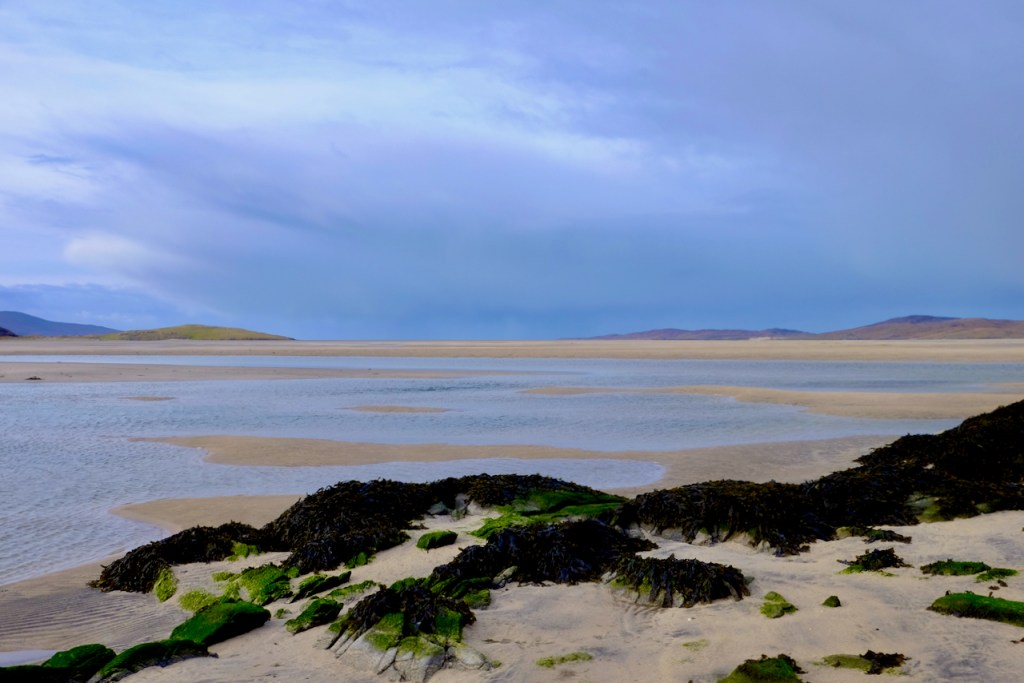
A new short essay on The Clearing: A Journal of Nature, Landscape and Placepublished by Little Toller Books. The essay takes the reader to Luskentyre in southwest Harris in the Outer Hebrides, exploring its origins and the forces still at play there, set against the ever burgeoning problems of climate change. I visited Luskentyre during my winter residency with Island Darkroom back in February. The essay is a much abridged extract from a chapter in my longer work-in-progress that forms part of my PhD. Thanks go to Jon Woolcott for his expert editorial input, and to Little Toller for hosting such a great online journal. I hope you enjoy the essay’s evocation of Luskentyre’s sense of place and time, which you can read here.
From July 22nd 2022, there will be an exhibition of work created by the Winter Artists in Residence hosted by Island Darkroom over early 2022.
Photographs taken during my research time on the island as part of my own residency will feature in the exhibition along with my thoughts and reflections following my stay. The research was for my PhD and the book that will hopefully come out of it, charting a journey back through the places that have featured in my life to better understand how the landscape can shape a sense of who we are. I was honoured that Island Darkroom drew on some of my writing for the title of the exhibition, and the work featured as a whole seems to chime with this theme.
If you’re in the Western Isles between 22nd July and 20th September, be sure to call in and check it out, with four international artists sharing exhibition space besides my own contribution.
You can find out more about the exhibition and the other events taking place at Island Darkroom by visiting their website and signing up to their newsletter, here.