A Time of Balance

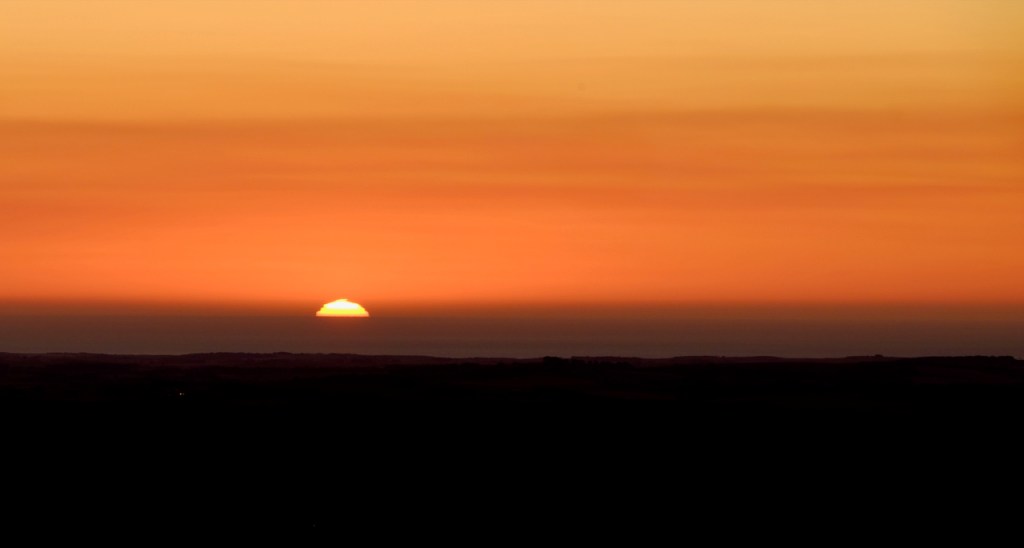
‘I set off an hour before sunrise. It is still dark: very dark, and I can see very little beyond the dim circle of light from my head torch. The thick scent of pine fills the air as I start up the trail. The presence of trees, melting into the darkness either side of me, are felt rather than seen; the still, almost-full harvest moon having disappeared into the cover of pine branches. A nervous glance behind reveals the comfort of a slowly brightening sky, suffused with faint orange and aquamarine banding toward the rim of an unseen eastern horizon. Amidst gaps in the canopy above, bright and brittle stars vanish and reappear. The tree cover opens a little and the moon’s glow pulls me upward.’

As the Autumn equinox approaches, here in the Northern Hemisphere, I am drawn back to our local hill and this moment from a couple of years ago when I climbed to one of its summits to witness the equinox sunrise. The short essay I wrote about it was published on The Clearing: Little Toller’s online journal of Nature, Landscape and Place. You can read the full piece here, or by clicking on the image above.

Traditionally marking the second harvest, a time to gather in the bounty of late summer signalled by the full moon, the Autumn equinox can also be a time of balance, of reset: a chance to take stock before the long slide into winter. Wishing you all a moment of balance as we begin our journey toward the darkness of the winter months.
The Moor, the Sea, the Sky

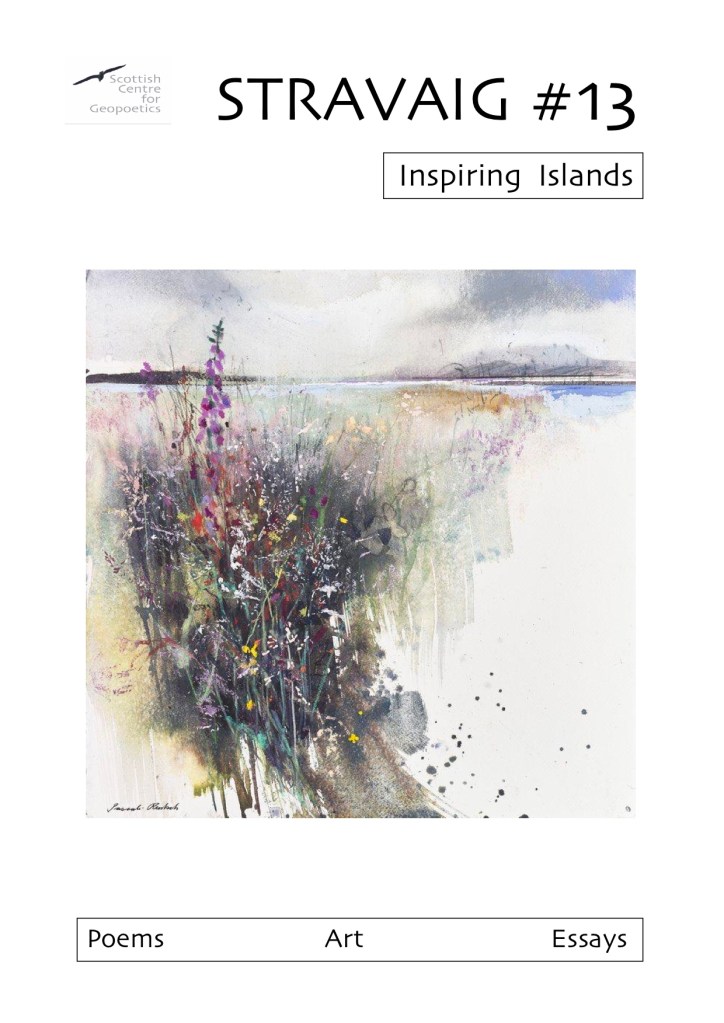
I’m delighted to have an essay included in the latest issue of Stravaig: an online journal for the Scottish Centre for Geopoetics.

Based on the thinking and writings of Kenneth White, the centre describes Geopoetics as being ‘deeply critical of Western thinking and practice over the last 2500 years and its separation of human beings from the rest of the natural world, and proposes instead that the universe is a potentially integral whole, and that the various domains into which knowledge has been separated can be unified by a poetics which places the planet Earth at the centre of experience.

It seeks a new or renewed sense of world, a sense of space, light and energy [and] also seeks to express that sensitive and intelligent contact with the world by means of a poetics i.e. a language drawn from a way of being which attempts to express reality in different ways e.g. oral expression, writing, visual arts, music, and in combinations of different art forms, sciences and thinking.’

Geopoetics is by nature, interdisciplinary, and engages with a broad range of practitioners in the arts and sciences, bringing ways of expressing the world together through both the journal and regular symposiums, seminars, workshops and retreats.

My essay ‘The Moor, the Sea, the Sky’ is a development of earlier work first featuring on Elsewhere: A Journal of Place in 2022, and comes out of my residency with Island Dark Room in the February of that year as part of my wider PhD research. It explores the moorland of Lewis both symbolically through the work of Lewis poet Iain Crichton Smith, and viscerally through my own experience in context with the thinking of anthropologist Tim Ingold.

You can read the essay by downloading Stravaig 13 here.

Sacred Mountain


‘I become only breath; movement; the sound of my feet crunching along the trail, vaguely aware of the dawn chasing behind me.’

Along with Elsewhere: A Journal of Place, a publication that I have followed and admired for a long time is The Clearing edited by Jon Woolcott of Little Toller Books, an online journal of nature, landscape and place and a natural home for my interests, so I’m really pleased to have a piece feature.

‘Sacred Mountain’ takes the reader on a walk to the summit of an iconic hill that defines my local landscape to watch the Autumn Equinox sunrise, exploring notions of the sacred and what it might mean to us. You can read ‘Sacred Mountain’ HERE.