Taking Notice

In our busy lives, bombarded as we are with news and media and the demands of life and work and family, we very rarely have space to notice the world around us, to pause and to take stock of the passage of time, the changing of the seasons and just where we’re at with ourselves. But writing can help us to do that. It helps us to take notice because it focuses our attention. Linda Cracknell writes: ‘The small weight of a notebook and pen in my pocket is my passport to feeling alive […] The act of writing causes us to refresh our tired ways of noticing.’*

Taking these thoughts as inspiration, I ran a workshop at a local visitor centre at the weekend, first exploring outdoors, encouraging close attention through the conscious use of all the senses and recording our experiences, before coming together in a collaborative space to share what we had seen and felt, writing a group poem with everyone’s input.

The workshop was as much about allowing ourselves that time and space to be, and to notice the world around us, as it was about creative writing; and that experience shared, brought a wonderful sense of connection: with the landscape, with both the past and the present, and with each other.

Paying attention – focussing on the world around us, how we experience it, in that mindful, conscious way – always has the power to connect us with others and a world outside of ourselves. It’s this sense of connection people attending felt the most, I think. It’s certainly what I took away from it, and it was great to see folk who were previously strangers coming together this way in just two short hours.
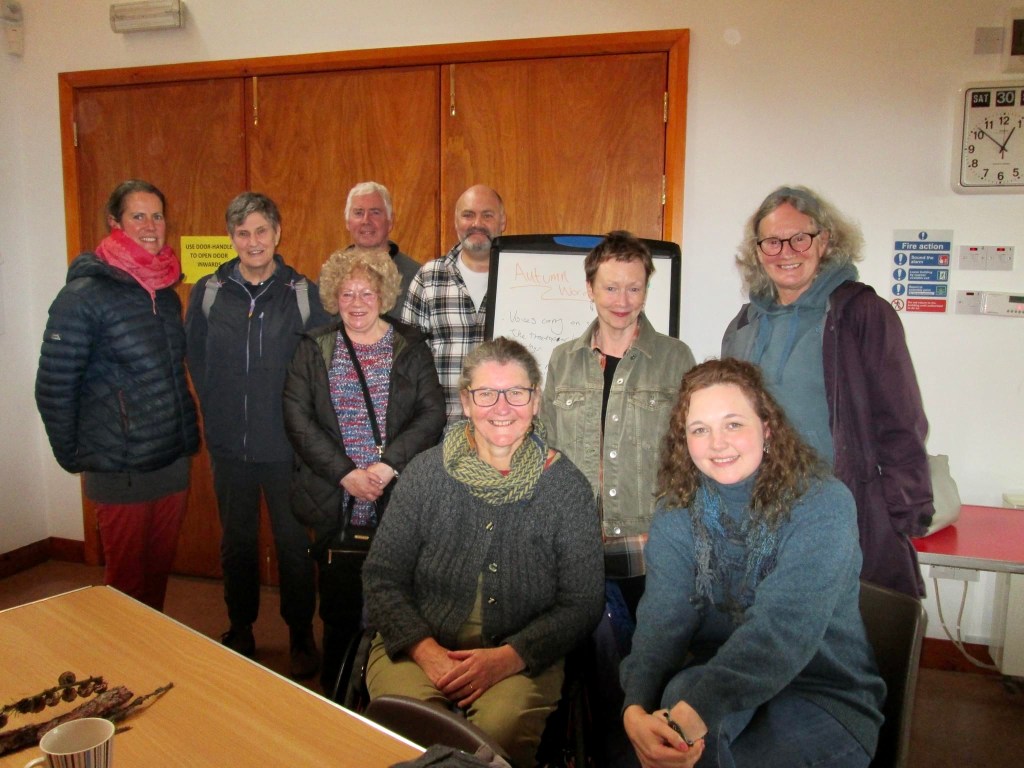
Attendees at the Autumn Words Creative Writing Workshop.

* Linda Cracknell, ‘Script and Scrape’, in Writing Landscape: Taking Note, Making Notes – In The Moment (Glasgow: Saraband, 2023), pp. 1-10, p.3.
A Time of Balance

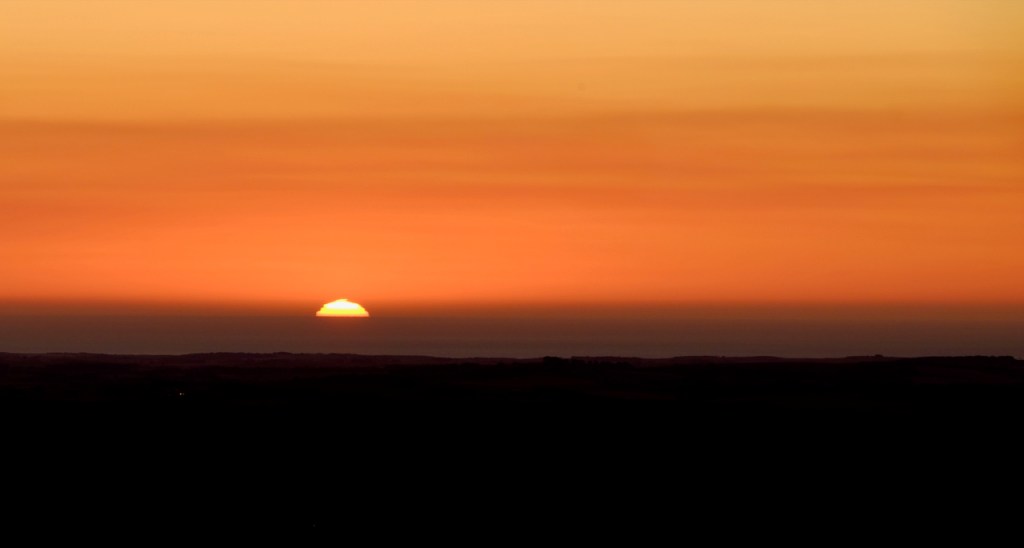
‘I set off an hour before sunrise. It is still dark: very dark, and I can see very little beyond the dim circle of light from my head torch. The thick scent of pine fills the air as I start up the trail. The presence of trees, melting into the darkness either side of me, are felt rather than seen; the still, almost-full harvest moon having disappeared into the cover of pine branches. A nervous glance behind reveals the comfort of a slowly brightening sky, suffused with faint orange and aquamarine banding toward the rim of an unseen eastern horizon. Amidst gaps in the canopy above, bright and brittle stars vanish and reappear. The tree cover opens a little and the moon’s glow pulls me upward.’

As the Autumn equinox approaches, here in the Northern Hemisphere, I am drawn back to our local hill and this moment from a couple of years ago when I climbed to one of its summits to witness the equinox sunrise. The short essay I wrote about it was published on The Clearing: Little Toller’s online journal of Nature, Landscape and Place. You can read the full piece here, or by clicking on the image above.

Traditionally marking the second harvest, a time to gather in the bounty of late summer signalled by the full moon, the Autumn equinox can also be a time of balance, of reset: a chance to take stock before the long slide into winter. Wishing you all a moment of balance as we begin our journey toward the darkness of the winter months.

Open Book – An Update

After the successful completion of the growth pilot earlier this year, and following a successful funding bid through Creative Scotland, Open Book Reading have announced that they can support all the groups that took part in the pilot, and so I’m delighted to be able to continue the work of the charity through leading a group in partnership with Live Life Aberdeenshire.

The wider community project runs from October this year to September next, and will consist of eight supported sessions exploring stories and poems and nurturing a supportive environment to try creative writing. We’ll also be visiting a literary festival together and fostering a sense of community through the shared enjoyment of literature and poetry.

You can learn more at Open Book’s website.

An Interview with Shane Strachan

The latest episode of From the Old Brewery brings you an interview with creative writing lecturer, current Scots Scriever and performance artist Dr Shane Strachan. Shane talks about his northeast roots, his use of Doric and Scots as a creative platform and his role as Scots Scriever. He also talks about his many projects and collaborations as a poet, writer and artist, and reads his poem Doric Dwams.

We had a really engaging talk with Shane and we’re sure you’ll feel inspired learning more about his journey and his work. This is my final episode as co-host on From the Old Brewery, but after many fascinating discussions with many fascinating researchers, writers and academics, I’m very happy to end on a high note with such a prominent and talented northeast Scots writer. Enjoy.

You can listen below or find us on your preferred platform.

Moving Forward

There’s a famous quote by Mark Twain. You know the one: 

“Twenty years from now, you will be more disappointed by the things you did not do than the things you did. So throw off the bowlines. Sail away from the safe harbor. Catch the trade winds in your sails. Explore. Dream. Discover.” 

This kept surfacing and resurfacing in my thoughts when, in 2017, I left my job to study anthropology and then creative writing. Six years on I have submitted my PhD thesis – a work of narrative nonfiction with commentary exploring how landscapes shape us, and what it might mean to belong. 

It’s not the PhD that counts, of course, but the journey to get there, for ‘it is better to travel hopefully than to arrive,’ as that other famous writer Robert Louis Stevenson told us. And it has been a journey – fraught with uncertainty and waymarked by personal crisis and self discovery. 

I’ve learned that we are many things, and that the narratives we write for ourselves can change unexpectedly – by both accident and design, and that who we thought we were is not set in stone, but a continual process of renewal and re-creation: a perpetual becoming framed by an evolving understanding. 

Places frame our lives – map out our histories and identities through the landscapes in which we live. The journey I’ve taken and the people I have spoken to have shown me that. We come to know self through place, through all the entanglements and histories that reach out into the wider world. 

I still face uncertainty and there will continue to be change: both driven and unexpected. I guess learning to embrace those things in life is part of what Mark Twain was getting at.