Practicing Place

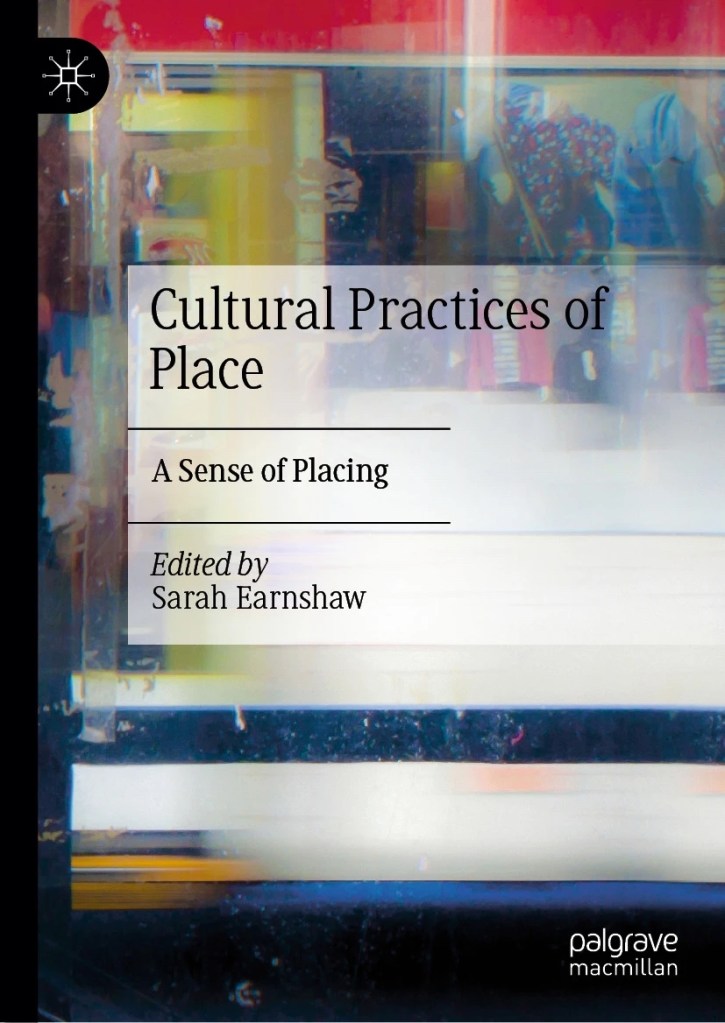
Some of the output of the critical component of my PhD project is a chapter in this book of collected essays, edited by Sarah Earnshaw and published just this month by Palgrave Macmillan:

Cultural Practices of Place.

Things take a long time in academia and it’s great to see this out in the world three years on from its origins at the ‘Here, There, and Somewhere In-between: Practicing, Placing, Configuring’ conference at the Practicing Place Centre, University of Eichstätt-Ingolstadt, in November 2022.

The collection pulls together contributions from literature and the humanities, the social and political sciences, and cultural studies, to offer a truly multidisciplinary examination of the different ways place features, and is expressed, in our lives.

Cultural Geographer Tim Creswell, writes in the Afterword:

‘Collectively, these essays make it clear that thinking about place, and specifically its links to practice, is an intellectually ongoing business that brings a conceptual and political liveliness to the ways we contemplate and act in the world.’

Place for me is at the heart of things, and my contribution explores the methodology of relating place to self through a creative practice and others’ lived experience.

From the Introduction by Sarah Earnshaw:

‘Ian Grosz […] embarks upon an interdisciplinary reflection on his autoethnographic creative writing practice in Chapter 9 to explore the role of landscape in individual and collective senses of place, and thus, in the formation of identity […] Weaving perspectives from social scientific literature with [British] nature writing alongside his personal narrative with the stories of interview partners, Grosz’s contribution exemplifies the dynamic and relational practices of place through an inquiry on the bread and butter of knowledge production—narrative writing, the stories we tell and share.’

I feel very privileged to feature in this collection of essays and to have met the people in and behind its publication.
Talking About Old Stones

I had the very real privilege of presenting a paper at The Lithic Gathering organised by the wonderful Scholars of the Stones research group on Friday May 16.

There was a truly inspiring range of multidisciplinary responses, covering ritualistic practices, sensory investigation through sound, film and haptic interpretation, the reframing of narratives surrounding sacred stone structures, and artistic and aesthetic reframing through storytelling and architecture.

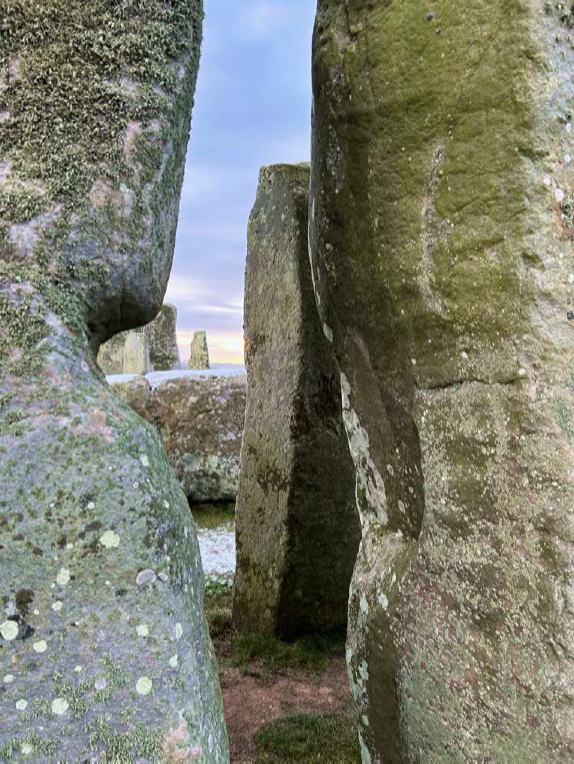
Drawing on work in post-processual and cognitive archaeology, my own paper – ’This is Our Place: Narrative and Interpretation at the Callanish Standing Stones’ explored the different narratives and interpretations surrounding the complex at Calanais on Lewis in the Outer Hebrides, suggesting that the monuments are a product of cosmological modelling as well as local identity.

A symposium is always a temporary community bringing different scholars and practitioners together through shared themes, but this felt like something broader and deeper – a day as much about time and connection and empathy as it was about stone. It was great to feel among friends and to play a small part in such a thought provoking day.

The Lithic Gathering is part of The Stones Project at Manchester Metropolitan Univeristy’s School of Gothic Studies and is led by Dr Fiona Barber with Drs Beccy Kennedy-Shtyk, Hannah Singleton and Martha Lineham.

The Lithic Gathering

Shifting Temporalities and Mythologies of Ritual Stone Structures

Anyone vaguely familiar with my writing and work will have correctly guessed that I have more than a passing interest in stone circles, and more widely, our ancient sacred connections to the landscape. So, it might come as no surprise to learn that I’m more than a little excited to be presenting at the upcoming Lithic Gathering Symposium at Manchester Metropolitan University next month.

The symposium is organised by The Stones Project, part of MMU’s Visual Culture research group. The research collective examines how ‘we represent and experience ancient and modern British and Irish standing stones and ritual stone structures in their contemporary contexts, through a sensory and embodied research approach.’

The symposium gathers scholars and artists responding to standing stones in various ways, with presentations that explore how ‘these structures – and/or the materiality of the stone/the lithic itself – merges, redefines or shifts historical and mythological narratives in relation to their manifestations within global visual cultures and artistic practices.’

(The Stones Project, 2025)

My own presentation is based around a paper stemming from my PhD by practice research and an extended visit to Lewis in 2022.

‘This is Our Place: Narrative and Interpretation at the Callanish Standing Stones’ explores the various competing narratives and interpretations that surround the stones, touching on archaeology, folklore, literature and mythology. It argues that the stones represent a model of cosmological belief as well as a symbol of local identity, highlighting the relationships between the monument, the lunar standstill, the surrounding landscape and the use and significance of quartz in the monument’s design.

Tickets for the event, and a full programme of speakers and presentations can be found at the eventbrite link below:

The Lithic Gathering

A Day for Nature

I was delighted to be a part of the Paperboats e-zine 2 launch which featured in the University of Stirling’s symposium ‘A Day for Nature’, organised by poet and Teaching Fellow Dr Chris Powici to celebrate, and advocate for, the natural world.

The event featured a panel of speakers including conservationists and Nature Writers Polly Puller and Tom Bowser of the Argaty Red Kites project, broadcaster and author Rebecca Smith, historian Dr Catherine Mills, and vice president of the university student Earth and Environment Society Ivet Stancheva. Each of the panelists gave fascinating talks about changes in the landscape over time from their different perspectives with a Q+A.

The Paperboats E-Zine is edited by Chris Powici and Kathleen Jamie and features work by writers from across Scotland and beyond concerned about our mounting ecological crises. The paperboats name and its inclusive, non-disruptive activism, has been inspired by Jamie’s poem written as Scottish Makar in response to the commitments of COP26, where, in the final verse, the poet speaks as the river Clyde.

“I heard the beautiful promises…
and, sure, I’m a river,
but I can take a side.
From this day, I’d rather keep afloat,
like wee folded paper boats,
the hopes of the young folk
chanting at my bank,
fear in their spring-bright eyes
so hear this:
          fail them, and I will rise.”

You can read the full poem here.

Despite the promises made, our politicians are failing us, and Paperboats aims to send a message on Thursday 23rd November 2023 by gathering outside the Scottish Parliament to deliver 1000 Paperboats, 1000 Climate Hopes, to demand that MSPs of all parties come together to deliver on their promises and a just transition to green energy.

The event will feature poetry from Kathleen Jamie and music from Karine Polwart.

To read the Paperboats E-Zine, go to Paperboats Writings.

2022 Round Up

Looking back over a busy year that started on the Isle of Lewis. My trip was delayed because of the storms in January, but the beginning of the year saw me spending ten days with Island Darkroom: a great opportunity that really helped my project find its feet. 

In February the world changed of course, with Russia’s invasion of Ukraine, which continues to mar the world with violence, loss and sadness, and it’s difficult to believe that this terrible war has dragged on now for almost a year. All we can do is hope for a resolution in 2023 that will end the needless suffering as the people of Ukraine continue to be an inspiration.

Earlier in February my writing was included in Echtrai Ed. 1 with some wonderful company, and that led to an engaging chat with the lovely and never still Helen Needham for the BBC Scotland Outdoors podcast. I also had writing published with Little Toller’s The Clearing, Paul Scraton’s online journal Elsewhere, Southlight Magazine and Poetry Scotland.

In May I read work at a symposium with The Sir Herbert Grierson Centre, and in September I gave a workshop on writing Landscape and Place as part of the 2022 Wayword Lit. Arts festival. In November I gave a paper at the University of Eichstätt-Ingolstadt for the Practicing Place conference.

Finally, my work featured in the long awaited book Four Rivers:Deep Maps with a chapter on the River Don, tracing its sacred associations from source to sea and exploring how they have shaped the area’s geography and identity over time. The book was published by UWAP in late September. 

I’m nearing the end of my major work-in-progress now and hope to get it out there next year which looks set to be as busy as the last, with some teaching work lined up, and hopefully an academic publication on my research and a further conference in the summer. Beyond that I hope to do some more workshops and get my thesis in on time! 

Wishing you all the very best for the year ahead and hoping the world finds itself a little kinder in 2023.