Four Rivers, Deep Maps UK Launch

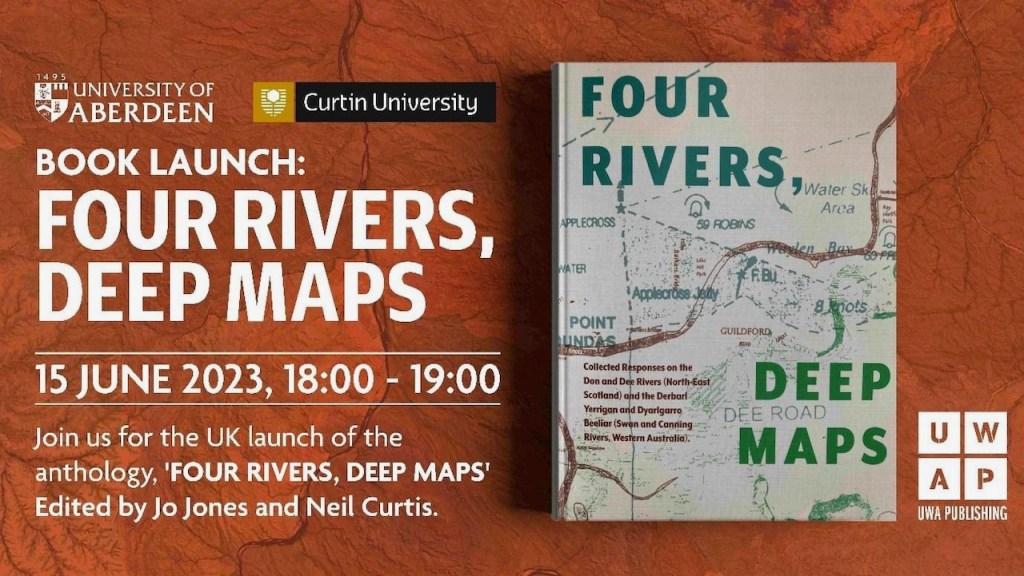
After being published through UWAP in September 2022 and launched initially in Perth, WA, Four Rivers, Deep Maps comes to the UK with a launch event at the University of Aberdeen on Thursday 15th June in the Sir Duncan Rice Library. Click on the image above for details.

The cities – Perth, Australia, and Aberdeen, Scotland – have received relatively little attention as specific geographical–cultural locales. Often perceived as industrial, isolated and lacking romantic association, they nevertheless have rich historical, narrative and creative traditions that characterise interactions between humans and place, particularly along the length of the four rivers.

My own contribution charts the River Don from source to sea, uncovering its ancient sacred associations and exploring how they have shaped the geography and identity of the region through time.

All the contributions of this book are woven together through strands of deep mapping and ideas of place, history and inhabitation. Countercultures seem to return to specific place knowledge that predates industrialisation, whether in the traditional shapes of the Nyoongar knowledge of the Derbarl Yarrigan (Swan River) and Beeliar (Canning River) or the traditions and ancient patterns of Aberdeenshire: we come back to these profound knowledge systems that, in fact, never went away.

Copies of Four Rivers, Deep Maps are in stock at Blackwells and will be available to purchase on the night.
Fields of Meaning

The latest podcast from the postgraduate community at Aberdeen University’s School of Language, Literature, Music and Visual Culture where I interview author Eden Unger Bowditch with fellow creative writer Jane Hughes.

Eden talks about her novel in progress Two-Hundred-and-Fifty Years at Home and her thesis Fields of Meaning which examines the role of ambiguity in the literary text. You can listen to it through clicking on the image above or find it on your preferred podcast platform.

An Open Book


Really excited to be setting up a new Open Book writing group in Aberdeenshire in the coming weeks.

Open Book are a fantastic organisation, set up in 2013 to help build communities through shared reading. Their groups now encompass creative writing and have been set up across Scotland. They are expanding their current provision with a Growth Pilot of 5 further groups in areas not currently served and which I’m very happy to be a part of.

Details will follow!

What I’m Reading

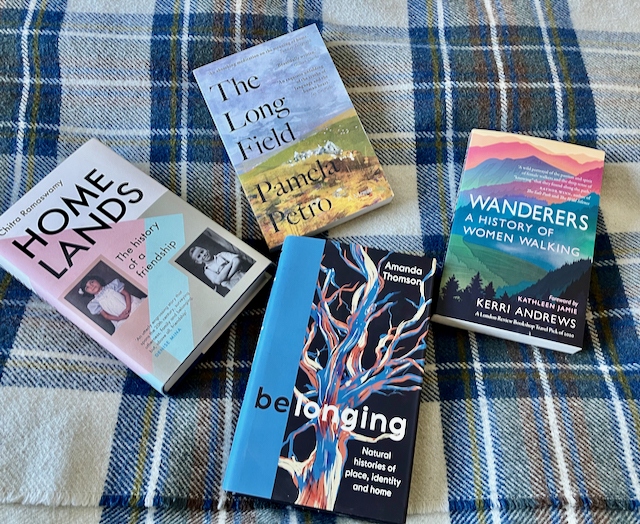
I’m a day late for International Women’s Day, but this collection of great books by wonderful women authors all offer thoughtful and enlightening perspectives on landscapes, belonging, and the nature of home and homelands. I was lucky enough to hear Chitra Ramaswamy, Kerri Andrews and Amanda Thomson read and discuss their work at Pitlochry Theatre’s Winter Words Festival last month, and I’ve been following the trajectory of Pamela Petro’s The Long Field since being published, with a new paperback edition just out.

Kerri’s entertaining, funny and at times, moving book, re-writes the canon on mountain literature, and the place of women writers within it, while Pamela Petro’s Long Field is a deep exploration of longing, language and identity. Amanda Thomson’s book weaves personal narratives of place and self through the forests of Abernethy, and Chitra Ramaswamy’s book is an exploration of borders and identities through a poignant and very moving account of her long standing friendship with two Holocaust survivors.

Each of these books explore place and identity in different ways, and speak to us at a time when both of these things are at the fore in the national and global narratives that are reshaping our world.

Great books by great women writers.

Our Lady of the Storms

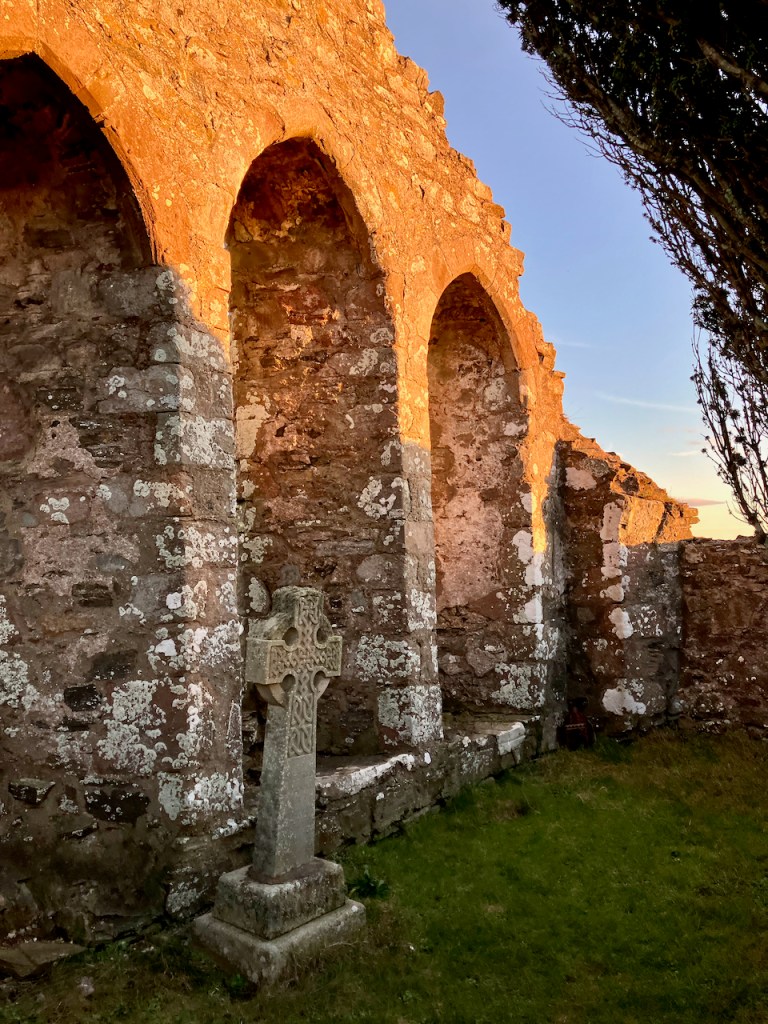
With the long, cold month of January drawing to a close, we took a walk along the Aberdeenshire coast from the historic fishing town of Stonehaven just ten miles south of Aberdeen. It was still cold, but dry with little wind, the sea flat calm and the low sun of a northern winter’s afternoon casting its glow across the clifftops. The path climbs steadily upwards from Stonehaven’s harbour above the rocks and old fisherman’s cottages at Cowie, where tall poles once used to spread and dry the fishing nets still poke up awkwardly out of the communal green space like some ancient wooden henge.

We were making our way to an old Catholic chapel perched precariously high on the sandstone cliffs and once dedicated to the Pictish Saint Nathalan who is attributed to several of the early churches of Aberdeenshire. His treasure is said to have been buried wrapped in a bull’s hide somewhere between the old chapel and its outer wall. The extant building dates to the thirteenth-century – some six-hundred years after Saint Nathalan’s time – and is also known as the Chapel of Our Lady of the Storms, re-dedicated to Saint Mary in 1276. The ruins of Cowie Castle, built by the Scottish king Malcolm Canmore in the eleventh-century, are just a short distance to the south, passed as you approach the chapel from the direction of Stonehaven along the narrow clifftop path. 

We spent half an hour or so wandering around the chapel’s burial ground as the sun sank steadily toward the fields. An old yew tree and holly tree take up much of the chapel’s roofless interior, and its stone arches catching the low winter sun in the stillness of the late afternoon created that eerie sense of time’s suspension. We found no treasure, but there are the gravestones of local fisherman lost at sea and a memorial commemorating a crew of lifeboatmen who drowned in the February of 1874. The sun finally dipped out of view and we made our way back along the cliffs, the old fisherman’s cottages at Cowie shrouded in deepening shadow and the waves just audible amongst the rocks below.